This blog is the fourth in our ongoing series on the “Black Antifascist Tradition.”
Protest is the best teacher. Hardly kindly, but its lessons stick. And they cover a range of useful subjects, ranging from the hidden workings of power and subjugation to the arts of invention and faith needed to outmaneuver power and to escape subjugation. Each and every act of protest ends up being instructive in one way or another, but there are certain historical outbursts of it that outshine the rest, such is the fierceness of their revelatory light. Among these, no doubt, are the Hands Off Ethiopia protests of 1935, world-spanning acts of dissent and uprising that were crucial in shaping the thought of an exceptional generation of Black intellectuals, an uncanny number of whom were themselves part of the Hands Off Ethiopia movement.[1]
The movement came together out of a shared sense of outrage at fascist Italy’s imperialist campaign to colonize Ethiopia. The Italian dictator Benito Mussolini had had his eye on Ethiopia for some time. He got serious about making his move at the end of 1934. The time seemed propitious to him. In Italy, fascism had consolidated its rule, and the dictator could now turn to exploring the unmapped possibilities of “totalitarian rule” both at home and, where he thought he could, abroad. The previous year, the Nazis had established the Third Reich, and concentration camps, in Germany. Fascist movements were underway, and growing, in a terrifying number of countries throughout the world, including Britain, Chile, China, Argentina, the United States of America, South Africa, Syria, France, Mexico, and Egypt. In Kenya, fascist settlers were organizing with the slogan, “Make Kenya a White Man’s Country.” All in all, somewhat suddenly, fascism had made itself into an omnipresence of the world’s affairs, capable of posing a plausible claim of incipient world domination. Liberal capitalism, meanwhile, at 1934’s end largely lay in ruins, undone by a half-decade of global depression of its own making. In short, it quite seemed that the world was turning with inexorable force to fascism.
And so Mussolini saw fit to strike Ethiopia. That he targeted Ethiopia was both predictable and telling. If such an act of international militarism appeared to many, in the moment, as an outrageously fascist act, it also poked at fascism’s fundamental paradox. Yes, fascism was stomping about in the early 1930s as the monstrous enemy of Enlightenment Modernity, but at the same time there was nothing entirely new in it. Looked at not from the perspective of its specific historical moment but rather from that of the longer historical run of things, what was the idea of colonizing Ethiopia in 1934 if not a stab at finishing off Enlightened Europe’s decades-running imperialist project in Africa? What was it if not the next logical step in the no-longer-very-new “new imperialism?” Which among the liberal powers—the leading colonial powers—could legitimately denounce Mussolini’s imperialist aims? Considered among fascism’s main acts, racialized colonial conquest was among the most normative. That it was both squarely fascist and deeply normative at the same time was the central insight developed by the Black intellectuals of the Hands Off Ethiopia movement.
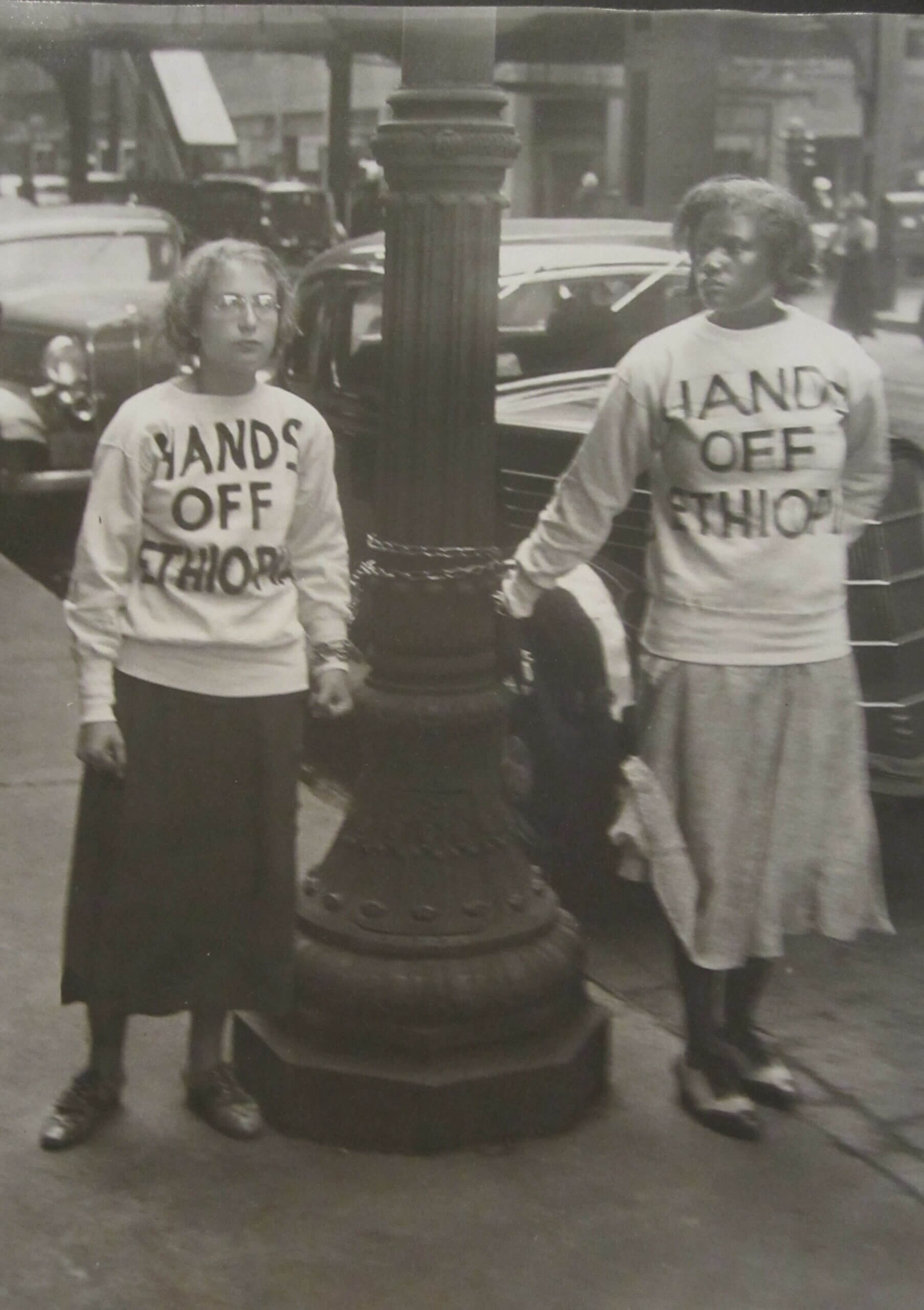
Using a borderland incident as his pretext, Mussolini started mobilizing for war. Right away, in response, around the world, little local movements of opposition kicked into being. Almost everywhere, Black people were the movements’ most dedicated organizers. They came to the effort from a number of ideological positions, and they belonged to various different political parties. They were nurses, students, sailors, Pullman porters, labor organizers, preachers, professional revolutionaries, journalists, dockworkers, waiters, and more. Though the hierarchy of the Communist International occasionally claimed credit for the outburst of protests, what the organizers and participants made, protest by protest, was a true people’s movement.
The way that Cedric Robinson put it, in a classic 1985 article contextualizing the protests, was to suggest, “The global character of the Black response to the invasion of Ethiopia provides a support for the interpretation that it was largely spontaneous.”[2] (Understand spontaneity here definitely not in its more typical usage, “arising from a momentary impulse,” but rather according to the much less typical, but much more truth-telling definition, “directed internally: self-acting.”) Throughout 1935, locals directed internally and self-acted their way to producing mass protests in Johannesburg, Durban, Lüderitz Bay, Chicago, Detroit, Harlem, Panama City, Havana, Port au Prince, Kingston, Rio de Janeiro, and so on. At one point, the most indefatigable organizer of mass protests in Paris, Tiémoko Garan Kouyaté, announced to a crowd there that demonstrations had taken place in Japan, Egypt, Tunisia, India, Trinidad, British Guiana, England, the United States, Martinique, the British Gold Coast, and Kenya.
Some of the most brilliant organizing was done in London. There, C. L. R. James, Amy Ashwood Garvey, Jomo Kenyatta, and George Padmore organized protests in Hyde Park and Trafalgar Square. They wrote fierce polemics against Mussolini’s war mongering in particular and against fascist barbarism in general. Robinson, in Black Marxism, depicted this cadre’s protest-organizing as an intense intellectual crucible. In a powerful passage, he detailed James’s intellectual trajectory amid the demonstrations. At one point, early on, James inquired of the Ethiopian Embassy how to enlist in the nation’s army. The Embassy told him to stay in London and keep agitating there. Which could be read as a rejection, but the protests, in London and around the world, were doing real work, holding up the plight of the Ethiopian people for all the world to see and reckon on and to give a thought to.
Robinson, though, stressed what the insistent protest did for James’s own thought. He argued that James’s “tutorship under European radical thought had come to an end,” and from the time of Hands Off Ethiopia onward, “his work would leap beyond.”[3] He wasn’t alone in this. Labors in the Hands Off Ethiopia protests helped to define “the radical Black intelligentsia,” in the minds of its members themselves, and then this now-self-conscious intelligentsia went on to fashion new liberatory lines of thought. James, having taken part in a transnational protest movement, promptly wrote the great transnational history of revolution and liberation The Black Jacobins. It was a work informed by James’s own antifascism, and more generally by the Black antifascism being made in the time of its writing. Padmore was able to put out How Britain Rules Africa even more promptly than James put out Black Jacobins. It too was a work of Black antifascism, its analysis shaped by insights gained from the drama surrounding the fascist invasion of Ethiopia.