
This essay is the first in a forum on the “Black Antifascist Tradition.” Anna Duensing, one of the forum intiators, writes that this was “a robust and longstanding tradition of Pan-African, anticolonial, anti-imperial, and anti-racist antifascisms that, in the words of Black Studies scholar and political scientist Cedric Robinson, ‘spontaneously extended throughout the Black world.'” Luther Adams-Free Man of Color’s essay is based on a book project, which historicizes the origins and impact of police brutality on African American communities. The piece addresses the history of Black formulations and condemnations of U.S fascism—often termed “Native Fascism”—that focused on the police and other iterations of law enforcement and carceral state violence.
Every time I sat down to write this essay on Blacks struggle against police brutality, and with fascism in the WWII era, a song from another space and time played in mind. Le Femme Fetal, if you don’t know it, the essay will wait while you listen.
Recorded just over 30 years ago by Diggable Planets, it advocates for abortion, a woman’s right to control her own body, asking us to imagine the consequences if Roe V. Wade were overturned. In just over 4 minutes, the song covers a lot of ground: the “youth and economic state” and sadness surrounding the choice to terminate a pregnancy; violent opposition of hateful “pro-lifers” unconcerned with life after birth; the patriarchal desire of men to control women; the burden health risks that fall on the poor; and the Supreme Court – as they say: “the fascists are some heavy dudes.” In the end, Butterfly’s job is “to lay it on the masses, to get them off their asses, to fight against these fascists.”
Which brings me to the point: In the 1940s, the Black Press used police brutality against Race Soldiers to do similar work as Diggable Planets. In newspapers like the Afro-American Blacks learned about fascism through the “horrifying story of police brutality surpassing anything dreamed up by Hilter’s dreaded Gestapo.”[1] Police brutality was an economic, political, racial, and bodily concern key to the operation of fascism. Drawing on what Black people already understood about America, the Black Press shared and affirmed Black knowledge to mobilize mass action against fascism. Black anti-fascist traditions are long, deep and lurking in the undertones of Black culture thought and history.
Black men and women in uniform defied violence and disrespect as whites fought to reestablish the racial order disrupted by war. In his contribution to What the Negro Wants, A. Phillip Randolph warned Blacks “be not deceived,” the war was not about freedom or democracy – it was “a war to continue ‘white supremacy,’ the theory of Herrenvolk, and the subjugation, domination, and exploitation of the peoples of color” – imperialists were on both sides (135). Even the Double V Campaign, a ploy to gain Black support, acknowledged fascism abroad and at home. Race Soldiers clashed with Army, MPs, city and state police and white citizens combating segregation on and off base, lifting the hopes of Blacks across the nation & placing their lives in jeopardy.
The Pittsburgh Courier, reported the “Race” was angered by the mistreatment of Black soldiers, “One of the worse problems for Negroes in Columbus is the brutality of white city police in cooperation with white MPs from nearby Fort Benning. Negroes have been mercilessly beaten for no reason except that they fail to conform to the rule of subservience set up for Negroes.”[2] The Afro-American broke a “stubborn veil of secrecy” reporting Second Lieutenant Nora Green, an Army nurse stationed with the Tuskegee Airmen, was snatched off an all-white bus and savagely beaten, breaking her nose and blacking her eyes, in a patrol car by four Montgomery police. The Afro American reported from Berlin, Germany “the ugly head of Military police brutality” left Pvt. Henry Moody dead from a bullet sent through his stomach by three white MPs.
In 1944, Chicago Defender’s blistering essay “Dixie Ways Rule Memphis” damned “native fascism in Memphis,” housing shortages, rampant job discrimination against Black war workers, and the “lily white” MPs and Shore Patrol who made street cars and busses sites of inhumane treatment and police brutality, while the local metropolitan press “killed or down played such incidents.” No case drew more attention to the brutal treatment of Black soldiers by police than the blinding of Isaac Woodard. As Walter White of the NAACP put it in the Afro-American, “for sheer bestiality and fascist terror the terrible story told by young Woodward is without parallel.”
Horace Cayton and St. Clair Drake, signal in Black Metropolis: “Negro newspapers were quick to sense the meaning of fascism and impart it to their reader-audience” (89). Through police brutality Black newspapers warned of the danger of fascism. With wide readership extending across the country and globe, the Black press actively struggled against police brutality. With more than 210 newspapers in circulation, Black press circulation reached 1.6 million, and increased 40% during WWII.[3] The Black press broadcasted injustice, helped people understand the depths and complexity of fascism, and protected Black life advocating to end brutal policing.
The idea of fascism became familiar to readers of the Black Press. During the 1930s, Halie Selassie, Benito Mussolini and Ethiopia were two of the most written about people in the Chicago Defender. It is almost cliché to say: “This Ain’t Ethiopia But It’ll Do.” The words of the Black soldier ring true, and it obscures a lot too. Ethiopia held attention and interest of the Black world long before the Spanish Civil War. Whether it was Princes coming out of Egypt, or Ras Tafari – Ethiopia held weight in Black religious and political life. The Berlin Conference and Italy’s defeat at Adwa in 1896 linked the nation to Black liberation and anti-colonial struggles.[iv] Ethiopia was big news.
The Black Press covered it all. In the Chicago Defender, journalist and Howard professor Metz Lochard wrote “the Ethiopia situation” put “Nordic civilization” on trial, & blasted fascism as “a form of barbarism in which the law of the strong is enforced on the weak.”[v] The Defender reported police brutality was used to break up a Pro-Ethiopia Demonstration in New York city. Witnesses swore police men “recklessly” clubbed men and women; forced those arrested to “run a gauntlet” of 50-60 police; and refused medical care for injured. The point was clear violence was a tool of fascism.[vi]
Warning, “See Danger Ahead,” the Afro-American reported on the National Negro Congress 1936 meeting in Chicago: it alerted its readers that Blacks would “face more suffering in the future.” It emphasized “war on Ethiopia” demanded consideration by “minority people all over the world.” It made plain “jobs at decent wages;” “complete equality” for women; the “fight against lynching, mob violence and police brutality;” intertwined with the effort “to oppose war and fascism, the attempted subjugation of people in Ethiopia, the oppression of colonial nations throughout the world, for the independence of Ethiopia.”[vii]
The Black press primed readers to understand the Spanish Civil War’s meaning for Black freedom struggles near and far. In “Langston Hughes and the Futures of Diaspora,” Brent Edward Hayes reminds us Langston Hughes’ covered the Spanish Civil War on the Afro-American’s dime. On his way to Spain, he stopped at the Second International Writers Conference in Paris. Speaking as a representative of Black and poor Americans he said: “We are the people who have long known in actual practice the meaning of the word fascism. For the American attitude toward us has always been one of economic and social discrimination.” (704)
The Black press defined fascism as colonialism – Amié Césaire signals in Discourse on Colonialism Hilter and Hilterism “applied to Europe colonialists procedures which until then had been reserved exclusively for the Arabs of Algeria, the “coolies” of India, and the “niggers” of Africa.” (36) Fascism was white supremacy, fascism was colonialism – the violent exploitation of the people and their labor, of the land and its wealth. Albert Memmi’s Colonizer and the Colonized suggests: “There is no doubt…colonialism is one variety of fascism” (63) When Blacks read, and heard about fascism abroad, it reminded them of their connection to people of color the world over. “Native fascism” was the historical experience of Black America writ large.
Adam Clayton Powell, a minister, politician and a national spokesman for Black people, the People’s Voice was his medium. However, it is in Marching Blacks, that Powell makes clear Black anti-fascism always existed in this nation. He tells the story of the New Negro, a movement that began with the resistance of the first Africans enslaved in the Americas, and continued in the on-going effort to win “Civil War II” (WWII) saying:
It was not the problem of slavery that caused the Civil War I. It was the same problem that we are faced with today State’s rights versus Federal control, reaction as opposed to progress, pseudo-democracy striving to stifle pure democracy, hatred struggling against brotherhood, the majority exploiting the minority – Fascism versus anti-Fascism! (20)
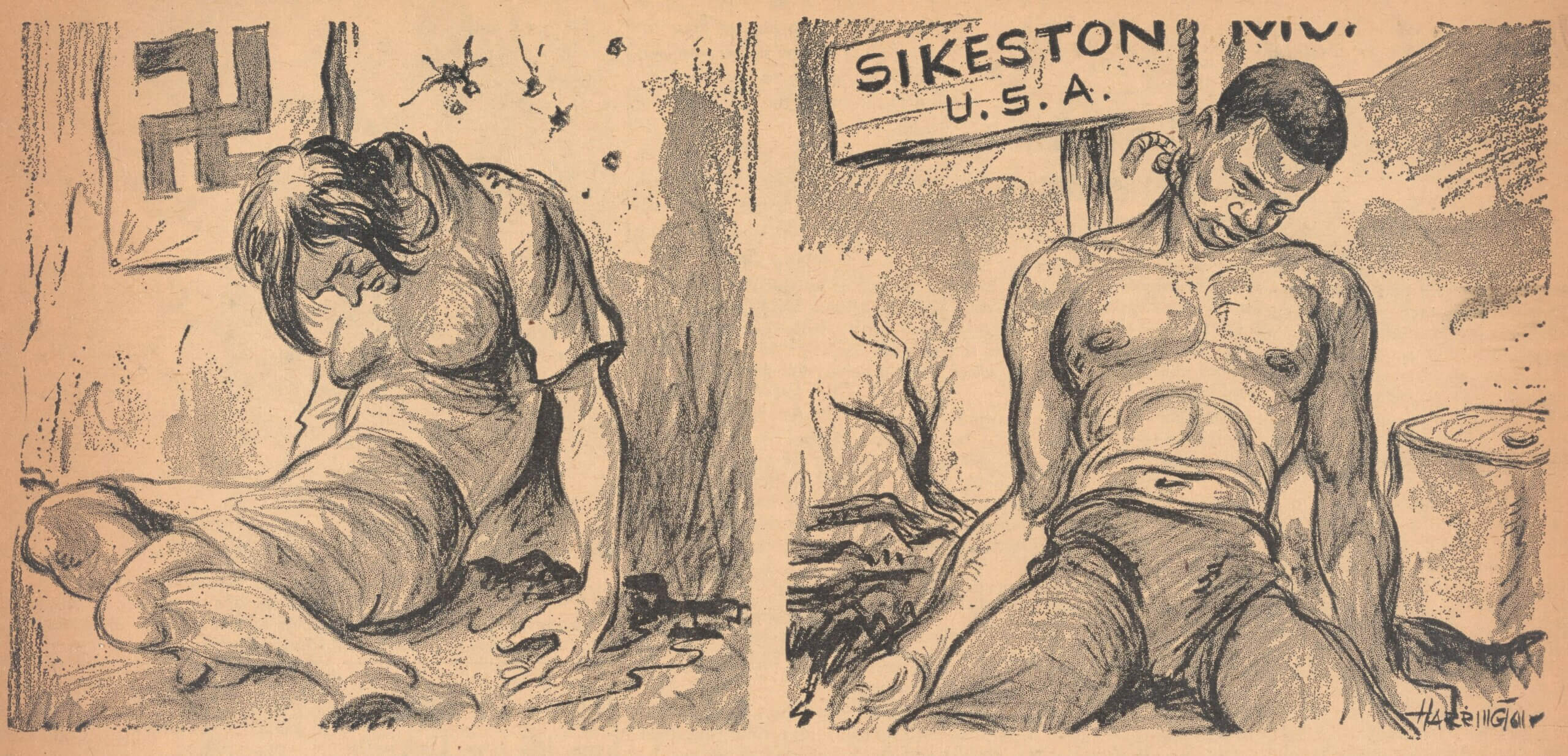
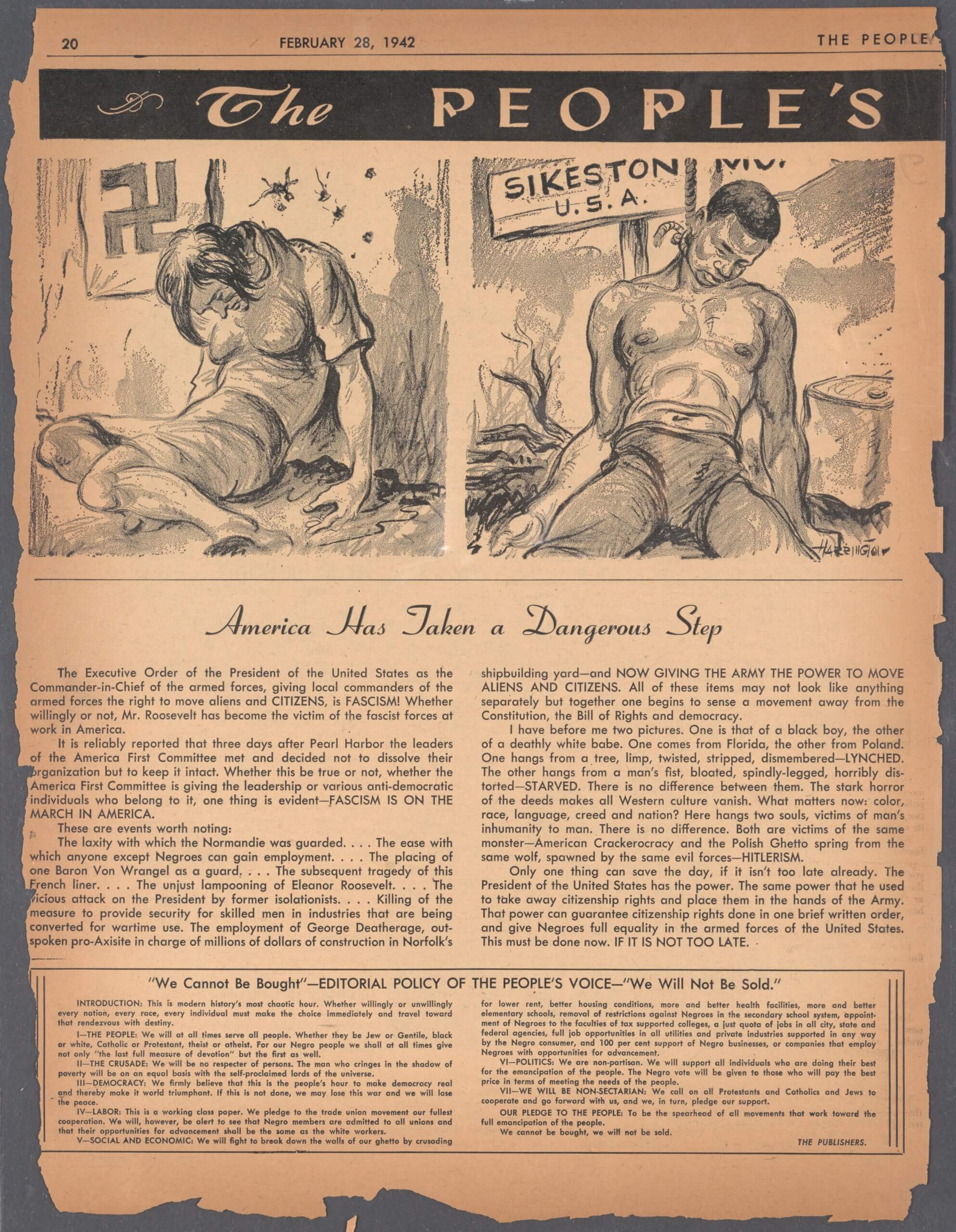
The Black struggle for justice and liberation is itself anti-fascist. Or as James Boggs put it in Pages From a Black Radical’s Notebook:
The United States has a history of racism longer than that of any other nation on earth. Fascism, or the naked oppression of a minority race not only by the state but the ordinary citizens of the master race, is the normal, natural way of life in this country(173).
When Adam Clayton Powell vacated his seat on the NYC City Council, Benjamin Davis filled it. Davis was “proud to be American, Negro and communist,” and editor of Negro Liberator and The Daily Worker. The office of NYC councilman Benjamin Davis published “Police Brutality: Lynching Northern Style,” best known today for arguing police brutality in the North served the same function as lynching in the South. His “special message” “End Police Brutality!” was concerned about the present and future. Police brutality was the “number one public menace” and “an invasion of civil liberties and a warning of the danger of fascism.” As the “most oppressed population” police brutality fell on Blacks with a “special ferocity,” “bolstered by the Fascist ideology of ‘white supremacy.’” A counterpart to lynching, police brutality stemmed from a “system of national oppression” designed to keep Blacks in their place; “to force down the economic and social status of the Negro workers; to divide Negro and white; and to make the Negro and other minorities the scapegoat of repeated ‘crime wave’ slanders.” He concluded: “This is the scapegoat technique of fascists, the world over.”
In the effort to end police brutality, and challenge “native fascism” the Black Press shared Black meanings and perspectives that made clear to its readers the place of Black people in America and the world. Race Soldiers, here not only enlisted men and women, but those determined that women must control their own bodies, that order cannot rest on violence, that “fight against these fascists” join a long Black struggle. There are and always have been “foreign fascists” & “American Nazis,” – in the face of widespread “anti-Negroism,” as Powell contends in Marching Blacks, “the Negro had always been an anti-fascist” (117).
[1] “Vet Blinded By Cops: Eyes Are Gouged Out by Savage Policeman Holder of Battle Star Suffers All Night,” Afro-American, July 20, 1946.
[2] “Race Soldier Beaten For Using Telephone,” The Pittsburgh Courier, July 18, 1942; John H. Young III, “Police Acts in Columbus Anger Race” The Pittsburgh Courier, Jan 27, 1945; “Army Nurse Beaten by Cops in Ala.,” Afro-American, Sept. 26, 1942; “Unarmed GI Slain by MP’s in Germany,” Afro American, Nov. 16, 1946; “Dixie Ways Rule Memphis; Skilled Jobs for White Only,” The Chicago Defender, Jan 22, 1944; & Walter White quote in “Vet Blinded by Cops.”
[3] Henry Lewis Suggs, ed. Black Press in Middle West, 1865-1985, (Greenwood Publishing Group, 1996); Marjorie McKenzie Lawson, “The Adult Education Aspects of Negro Press,” in The Journal of Negro Education, (Summer, 1945); Sitkoff, “Racial Militancy and Interracial Violence in the Second World War,” p. 662; and P.L. Prattis, “The Role of the Negro Press in Race Relations,” Phylon, Vol. 7, No. 3, Third Quarter 1946, pp. 273-83
[4] Mohammed Elnaiem, “The Defense of Ethiopia from Fascism,” JSTOR Daily, April 22, 2020, accessed April 1, 2025. Elnaiem concludes the essay with an excellent selection of readings on Ethiopia and its role in Pan-African thought and praxis.
[5] Metz Lochard, “Panorama of World News,” Chicago Defender (National Edition), September 7, 1935.
[6] “Urge Mayor to Prove Alleged Police Brutality,” Chicago Defender (National Edition), October 12, 1935.
[7] “Fred Douglass’s Spirit Dominate National Conference,” Afro-American, January 4, 1936.
“