Black Anti-Fascist Forum LaborOnline LAWCHA

A Fighting Anti-Fascist Army

Like many Black soldiers conscripted in the segregated armed forces during World War II, Burt Jackson did not need did need battlefield instruction to understand the fascist enemy. He had studied it at home; basic training in the Jim Crow South might as well have been the belly of the beast.  An artist from New Jersey who had joined the Communist Party in 1935, he was disgusted by the color lines snaking through barracks, shipyards, factory floors—and, of course, across the mud and blood combat itself. These were, after all, the legal and social mechanisms of a violent racial state reproduced under the banner of national unity amidst a global war against another racial state. If military segregation mirrored the many harms and humiliations of civilian life, the wartime rhetoric of defending democracy against fascism sharpened the contradiction. The United States claimed to wage a global crusade for freedom even as it disciplined Black Americans and other racial minorities at home in ways that—at least for many under the boot-heel—resembled fascism. 

With the U.S. entrance into the war in late 1941, Jackson counted himself among a rising ride of Black Americans who espoused the common-sense conviction that fascism had never been confined to the geographic and chronological boundaries of interwar and wartime Europe. As such, the worldwide struggle against fascism necessarily spanned Munich all the way down to Mississippi. GIs like Jackson served as vanguards in a broader campaign across the Black public sphere to recast the war a multifront-front struggle, rejecting official war aims that quarantined fascism as an enemy menace “over there” from racial domination at home. Mobilized in this struggle, however, Jackson nonetheless occupied distinctive political ground. A Black radical forged in the interwar years, he had already taken up arms against fascism with the Abraham Lincoln Brigade in Spain, bringing to World War II a relatively rare Black antifascist perspective rooted in global antifascist currents, Black internationalism, labor militancy, an uncompromising opposition to white supremacy—all subsequently informed by his experience during the Spanish Civil war.

After the outbreak of the Spanish Civil War in 1936, nearly 40,000 volunteers from more than fifty nations converged on the country to serve in antifascist forces known as the International Brigades. Roughly 2,800 departed from the United States. At least eighty-three were Black volunteers, among them Burt Jackson. As Cedric Robinson, Robin D.G. Kelley, Bill Mullen, Jeanelle K. Hope, and others have noted, most Black volunteers were responding to the global moment, though their actions must be situated within a longer, global genealogy of Black internationalism that that bound European fascism to colonial rule. The Italian invasion of Ethiopia in 1935 radicalized many African Americans, fusing diasporic solidarity with an emergent analysis of fascism as racial-colonial domination. Spain, in this reading, was not an isolated theater but a front in a global war against white supremacy.

This small cadre of Black antifascists who served in both Spain and World War II further unsettles tidy chronologies that cast Black participation in World War II as the moment of popular antifascist awakening. They were a cohort already seasoned in antifascist struggle, carrying into the “good war” for democracy a hard-won skepticism about racial liberalism’s limits and a militant vision forged across literal combat alongside anti-lynching campaigns, labor radicalism, and transnational anticolonial revolt.


But how should we understand these exceptional few—Black antifascists like Jackson—who encountered fascism first between Scottsboro and Addis Ababa, then in the blood-soaked fields of the Ebro, and soon after in the Jim Crow barracks of the U.S. South? Scholars such as Thomas A. Guglielmo and Matthew F. Delmont have rightly argued for the centrality of Black soldiers and veterans to the Black freedom struggle before, during, and after World War II—including challenges to more patriotic iterations of antifascism in Black public discourse that privileged the urgency of the war effort over that of destroying Jim Crow. Yet this small cadre of Black antifascists who served in both Spain and World War II further unsettles tidy chronologies that cast Black participation in World War II as the moment of popular antifascist awakening. They were a cohort already seasoned in antifascist struggle, carrying into the “good war” for democracy a hard-won skepticism about racial liberalism’s limits and a militant vision forged across literal combat alongside anti-lynching campaigns, labor radicalism, and transnational anticolonial revolt. 

To be sure, it remains very worthy of our attention and study that the war years opened a striking, if short-lived and highly contingent political space in which “win-the-war” antifascism entered the American mainstream, sanctified by state rhetoric and popular culture. Yet the politics of these two-war antifascists strained against that consensus. Their internationalism, antiracism, and militancy exceeded the narrow terms of national unity, pressing much harder questions: What kind of democracy was being defended? For whom? And what would become of fascism’s structures—at home and abroad—once victory was declared? Compared to many of their new brothers-in-arms in the U.S. armed forces, these two-war veterans were uniquely equipped to grasp World War II not as an unprecedented rupture but as the latest campaign in a protracted fight to uproot fascism in all its racial, imperial, and capitalist forms. They understood fascism less as a foreign aberration than as a mutable system with domestic analogues and durable afterlives.
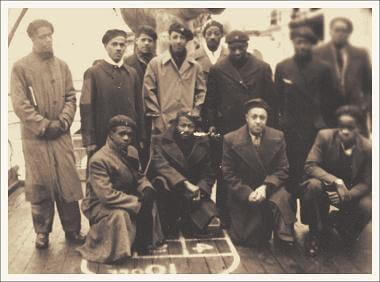
African American service members who served with the Abraham Lincoln Brigade during the Spanish Civil War. Photo credit: the Zinn Education Project.

Burt Jackson sailed for Spain in May 1937 and returned in December 1938. In February 1942, he enlisted in the U.S. Army Air Corps. The uniform had changed; the enemy had not. Despite the vastly different flag he now served under, he still saw himself as a member of a fighting anti-fascist Army.” By this, of course, Jackson meant his aims remained the same: he was engaged in armed struggle against fascism, rather than in the service of Allied war aims. The line between “over there” and “at home” was perilously thin. Talk of “defending democracy” meant very little. Democracy was not self-executing, never guaranteed to rise phoenix-like from the ashes of Nazi defeat—to say nothing of the likelihood of its enactment in full by the U.S. federal government on its own soil. Democracy itself had to be remade as an antifascist project, stripped of its racial exclusions and imperial alibis, or it would remain vulnerable to the very forces the war purported to destroy.

Walter Garland, another Abraham Lincoln Brigade veteran and a friend of Jackson’s who enlisted in the Army in 1942, took a similar position to his comrade twice-in-arms. Early in the line of duty, Garland found the U.S. Army was falling short in developing its men into “the mighty anti-fascist force needed” to defeat fascism. Of course, he observed, the Army’s pervasive white supremacy and attendant low Black troop morale were the main reasons for this grave shortcoming. James Bernard “Bunny” Rucker, another veteran-turned-soldier, pointed to the military’s color lines, but also to those running deep across the home front’s rich and bloodied soil: evidence, from where he stood, of Jim Crow’s family resemblance to fascism. For Rucker, the Jim Crow status quo would keep the U.S.’s overt and latent fascist sympathies meant it would never land on the right side of antifascist struggle.

Still, these men found pride in returning to combat and once again facing off against a fascist foe. Jackson’s fighting spirit suffered gravely while stationed in Alabama, but he remained eager for combat: “a chance at the Major perpetuators of racial superiority…And think how ‘der feuhrer’ will feel when he sees his prized air force knocked out of the sky by people he has taught his ‘aryans’ to despise.” Although this cohort advanced far sharper critiques of Black military service and the glaring hypocrisies of wartime rhetoric, they did not retreat into abstention. They grasped the stakes. The defeat of the Axis mattered, and the visible presence of Black soldiers in that defeat carried political weight. Their position was neither simple patriotism nor cynical detachment, but a tense, strategic engagement with the state. In this sense, they offer us a critical perspective between the conditional patriotism of the “Double V” campaign—victory against fascism abroad and racism at home—and the more systemic critiques articulated by figures such as Claudia Jones and C. L. R. James, who read the war as a racial-imperial crisis spanning the world over. These two-war antifascists shared that dialectical view: support the defeat of fascism, but refuse the illusion that Allied triumph alone would secure justice, let alone liberation. For them, military participation was tactical—a wager that Black presence in the machinery of war could be leveraged in the larger, unfinished struggle against white supremacy and empire. It is likely that many were also simply eager to get back to the business of killing fascists.

While these soldiers’ perspectives enrich our understanding of Black antifascist politics during the war itself, they also proved strikingly prescient about the problems of peace. Their wartime correspondence was marked by an exceptional concern about what their country would do after it had, on its terms, defeated the Axis and about the willingness of the United States to keep fighting for democracy after it had purportedly secured it abroad.

This was especially so for Bunny Rucker, who dwelled on the bleak horizon he foresaw in the war’s final months. Writing from the front lines in Italy in January 1945, he was already bracing for the next campaign. Jim Crow, he insisted, was democracy’s negation. “Jim Crow is fascism and fascism is death,” he wrote. In April, with the end of fighting in sight, Rucker was severely wounded in combat. News of the war’s end reached him in a hospital bed on Staten Island. It did not bring much relief. By October 1945, his letters registered a simmering disillusionment: “I’m very disgusted with the whole Goddamned mess—the hospital, the Army, the Government, the country and the people in it.” The war against the Axis powers had been won; the struggle against fascism, he feared, had barely begun.
Tracing the postwar lives and activism of Rucker, Garland, Jackson, and their comrades reveals neither defeat nor retreat, but persistence. Cold War politics may have narrowed the political language available, repressing and criminalizing any overt invocations of antifascism, but their commitments did not expire in 1945—just as they had not originated in 1941.


The frustrations of his long, halting recovery paled beside his disaffection with the nation he had nearly died defending. Rucker’s doubts crystallized around the U.S. role in denazifying and democratizing Germany. How, he wondered, could a country so compromised presume to remake another? “There is such a small part of American life that has any more integrity than there was in Germany,” he wrote, leveling a devastating indictment of U.S. racial order and imperial posture. The antifascist struggle, in his view, was nowhere near complete. “The purpose of the war sacrifices was to make living tolerable,” he insisted—for the racialized and colonized, for the subjugated and oppressed, for workers and toilers across the globe. Anything less betrayed the dead.

Many Black servicemembers emerged from the war with comparable disappointment and trauma. In light of Rucker’s longer arc of militant antifascism, however, his despair carries particular weight. Yet tracing the postwar lives and activism of Rucker, Garland, Jackson, and their comrades reveals neither defeat, nor retreat but persistence. Cold War politics may have narrowed the political language available, repressing and criminalizing any overt invocations of antifascism, but their commitments did not expire in 1945—just as they had not originated in 1941. Their trajectories press us to unmoor U.S. antifascism from the triumphalist frame of World War II and to situate it instead within the long durée of the Black Antifascist Tradition, boasting far deeper roots and a robust and evolving history that cuts across 1945 and up into our current moment. 

Author

  • Anna Duensing is an historian whose research and teaching focus on African American history, Black internationalism, Black radicalism, and transnational social movements. She is a Postdoctoral Fellow at the University of Virginia’s Carter G. Woodson Institute for African-American and African Studies and the incoming Albert R. Lepage Endowed Professor in History at Villanova University (Fall 2024). She is currently working on her first monograph, tentatively titled Fascism Is Already Here: Civil Rights and the Making of a Black Antifascist Tradition. Her writing has also appeared in History & Theory and the Washington Post’s Made By History. In addition to her academic research, writing, and teaching, Duensing is an active public scholar with over a decade of experience in museums, documentary, oral history, 9-12 curriculum development, community radio, and podcasting.

Anna Duensing is an historian whose research and teaching focus on African American history, Black internationalism, Black radicalism, and transnational social movements. She is a Postdoctoral Fellow at the University of Virginia’s Carter G. Woodson Institute for African-American and African Studies and the incoming Albert R. Lepage Endowed Professor in History at Villanova University (Fall 2024). She is currently working on her first monograph, tentatively titled Fascism Is Already Here: Civil Rights and the Making of a Black Antifascist Tradition. Her writing has also appeared in History & Theory and the Washington Post’s Made By History. In addition to her academic research, writing, and teaching, Duensing is an active public scholar with over a decade of experience in museums, documentary, oral history, 9-12 curriculum development, community radio, and podcasting.