For the current issue of Labor: Studies in Working Class History, Duke University is making free a transcribed conversation provoked by the ongoing crises in higher education from a labor history perspective. “What Universities Can Be: Strategizing amid the Crisis in Higher Education” is available until June 3, 2026. A week before Trump’s inauguration, Jessie Wilkerson, Senior Associate Editor of Labor led a conversation with Davarian Baldwin, Karma R. Chávez, Eric Fure-Slocum, Claire Goldstene, Anne Langendorfer, Jennifer Mittelstadt, Donna Murch and Annelise Orleck. They sought to ponder the strategies necessary to resist and reframe the university’s prospect as a part of democratic life. Then they continued that conversation over the next year. The goal was to chart “where we’ve been, where things stand, and how to move toward proactive strategies to remake higher ed into a democratic institution.” Jessie Wilkerson asked Paul Ortiz, Vice-President of the Labor and Working Class History Association, to reflect on the dialog, and the following essay resulted, which adds beautifully to the conversation.
A year after she had been wounded by deputized gun thugs in Youngstown during the Little Steel Strike, the feminist labor journalist Mary Heaton Vorse published a stirring account of Committee for Industrial Organizing (CIO) union organizing in steel, auto, mining, textiles, agriculture and other occupations. Vorse’s Labor’s New Millions, released in 1938, also highlighted union activism by those who were then known as “white collar employees.” In contrast to those workers from the professional classes who had facilitated the rise of Mussolini and Hitler in Italy and Germany, Vorse believed that teachers, insurance agents, shopkeepers, government employees, and clericals in the United States might learn through labor organizing that the government of the many was preferable to the despotism of the few. In Vorse’s telling, the fate of the embattled labor movement was at stake. Police and hired gunmen had already killed and wounded hundreds of workers attempting to join CIO unions. Vorse held that factory operatives needed their office-bound counterparts to join the larger battle for industrial democracy. So much was at stake. “In estimating the power of this movement,” Vorse warned, “we must remember that the middle class has been the recruiting ground of the fascist movement.” Mary Vorse believed that the Great Depression had spurred professionals to recognize that mass, democratic protests might save the republic from corporate tyranny. She wrote:
“Until the depression, the white-collar workers sailed along unconscious of their place in the world; their clean hands and clean collars gave them the illusion of superiority. Actually the changing economic scene with its closed frontier, huge aggregations of capital and steadily shrinking opportunities for small ownership had completely altered the status of these workers…The depression shattered the world in which they lived and revealed to them that they were as insecure as any man who has nothing to sell but the work of his two hands.”
Like Mary Heaton Vorse, the scholar activists in “What Universities Can Be” in Labor’s newest issueportray an inspiring array of struggles against authoritarianism waged by workers who, until recently, many believed to operate largely outside of the purview of unions, mutual aid, and solidarity. This roundtable is an invaluable primer on the essentials of labor organizing in higher education as well as a sophisticated analysis of how the crisis in higher education is at the same time a crisis in capitalism. Each of the participants has offered brilliant insights into the experiences of higher-ed workers today as well as the legal, political, and economic contests facing students, faculty, staff and working-class people employed in and around universities and colleges across the country. Using the organizer’s language of relationship building, these writers emphasize the need for academics to practice solidarity with our colleagues each day, to be there for graduate student unionists, and to build alliances with chronically underpaid campus workers as well as the neighborhoods that sustain our campuses.
It is no coincidence that the participants of this important dialogue engage in community-based scholarship. As public-facing intellectuals, we have experienced academic learning at its best as well as at its most exploitative. We join picket lines and give testimony at public hearings on affordable housing, living wages, and voter suppression only to see our own institutions betray the public interest time and time again. The roundtable highlights the need to defend the hard-won spaces of dissent, mutual aid and bridge building that our academic ancestors sacrificed so much to institutionalize. These spaces include programs and departments of Black Studies, Chicano Studies, Gender Studies, and LGBTQ+ Studies, and now the Trump administration seeks to abolish them in its quest to re-gentrify higher education.
A key takeaway from “What Universities Can Be” is that higher education is as central to capitalism today as steel and basic manufacturing were in the early 20th century. This helps explain why universities and colleges are under siege today. Another point emphasized in this roundtable is that the fate of workers in higher education—including adjunct lecturers, graduate students, tenured faculty, groundskeepers, custodians, office managers, etc., etc.—are central to the future of the labor movement in the United States.
The United States is an imperial nation, and this shapes labor relations as well as prospects for democracy on the nation’s college campuses, and everywhere else for that matter. In his farewell address in 1961, President Dwight D. Eisenhower, former Supreme Commander of the Allied Expeditionary Force in Europe during World War II, lamented the severe impact of the “military industrial complex” on intellectual freedom, technological innovation, and the advancement of knowledge:
“Today, the solitary inventor, tinkering in his shop, has been over shadowed by task forces of scientists in laboratories and testing fields. In the same fashion, the free university, historically the fountainhead of free ideas, and scientific discovery, has experienced a revolution in the conduct of research. Partly because of the huge costs involved, a government contract becomes virtually a substitute for intellectual curiosity.”
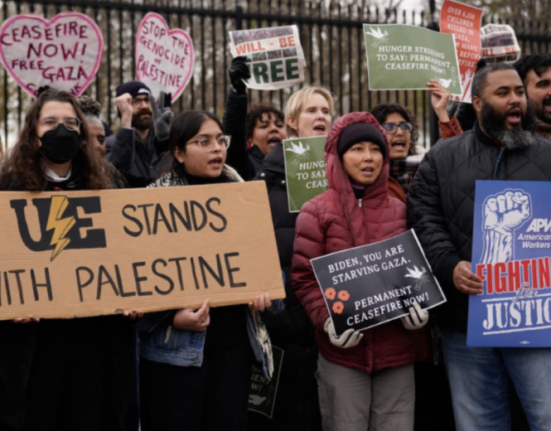
Eisenhower’s paramount warning was, “We must never let the weight of this combination [the military-industrial complex] endanger our liberties or democratic processes.” This is exactly what is happening today. The US ruling class is attempting to exert control over universities and to silence dissent because of the strategic role higher education plays in the empire. This explains why many university boards of trustees and administrations signed off on violent police attacks against non-violent, pro-Palestinian teach-ins and encampments in 2024-2025. Like the early waves of industrial sit-down strikes that gave birth to the CIO in the mid-1930s, the student encampments had the potential to spread internationalist values of solidarity across borders and ideas such as “an injury to one is an injury to all.” Note also that many of the students, staff, and faculty assaulted by police during the protests were members of the United Auto Workers, the United Steel Workers, and the United Electrical Workers, unions whose rank-and-file were attacked, tear-gassed and incarcerated for challenging corporate supremacy during the Great Depression.
The democratic aspirations expressed by students, instructors and staff who have organized against war, genocide, and repression by universities are antithetical to empire’s insistence on nationalism, inequality, and historical whitewashing. Witness the Trump movement’s edicts to abolish Critical Race Theory, Gender Studies, and African American history. These fields of study give us tools to explain how we got into this mess of misogyny, mass incarceration, and militarism as well as how we might find ways to build a more just and peaceful planet. To reiterate a point made by this roundtable: these fields were brought into being by generations of protest and they will only survive the current repression by more protest.
In closing, I’d like to raise some questions for further discussion. How can we leverage our power as academic laborers to support our students in this chaotic time when universities are relentlessly serving the military-industrial complex while underfunding basic science and shuttering multicultural student programs? Should we engage in electoral politics? Should campus labor coalitions mobilize to elect pro-union candidates to state legislatures to restore funding to public, K-20 education? How can we better link campus movements to broader working-class struggles? Here, I am thinking specifically of the El Gran Paro Estadounidense or the 2006 International Workers’ Day strikes that connected Latinx and immigrant uprisings with campus protests. When I taught at UC-Santa Cruz, for example, we shut the campus completely down on May Day, 2006 at the request of local unions with large memberships of immigrant workers. Can we weave together what we used to call “social movement unionism” with efforts to strengthen our collective bargaining contracts to defend academic freedom? In a related sense, how do we explain the ideals of academic freedom in our teaching, research, and service dimensions so that our students and our surrounding communities don’t suspect us of the kind of snobbish elitism that has undermined previous organizing efforts? Finally, how might we democratize the debate over the future of tenure into a movement demanding all workers deserve security of employment guarantees on the job? I don’t have the answers to these questions, but I am certain that this roundtable will help us continue discussing how we might build a movement more powerful than empire. As IWW organizer Ralph Chaplin reminded us in another era of labor insurgency, “In our hands is placed a power greater than their hoarded gold, Greater than the might of armies, multiplied a thousand-fold.” Solidarity forever!
Paul Ortiz is a professor of labor history and Director of Graduate Studies for the Latina/o Studies Program at Cornell University. He is the former President of the United Faculty of Florida, UF (FEA/AFT/AFL-CIO) and PEN award-winning author of An African American and Latinx History of the United States. He began working in the labor movement in 1989 as an organizer with the United Farm Workers of Washington State during their successful campaign to unionize Chateau Ste. Michelle wine vineyards. Paul is the incoming Vice President of the Labor and Working-Class History Association (LAWCHA).
Paul Ortiz is a professor of labor history and Director of Graduate Studies for the Latina/o Studies Program at Cornell University. He is the former President of the United Faculty of Florida, UF (FEA/AFT/AFL-CIO) and PEN award-winning author of An African American and Latinx History of the United States. He began working in the labor movement in 1989 as an organizer with the United Farm Workers of Washington State during their successful campaign to unionize Chateau Ste. Michelle wine vineyards. Paul is the incoming Vice President of the Labor and Working-Class History Association (LAWCHA).