
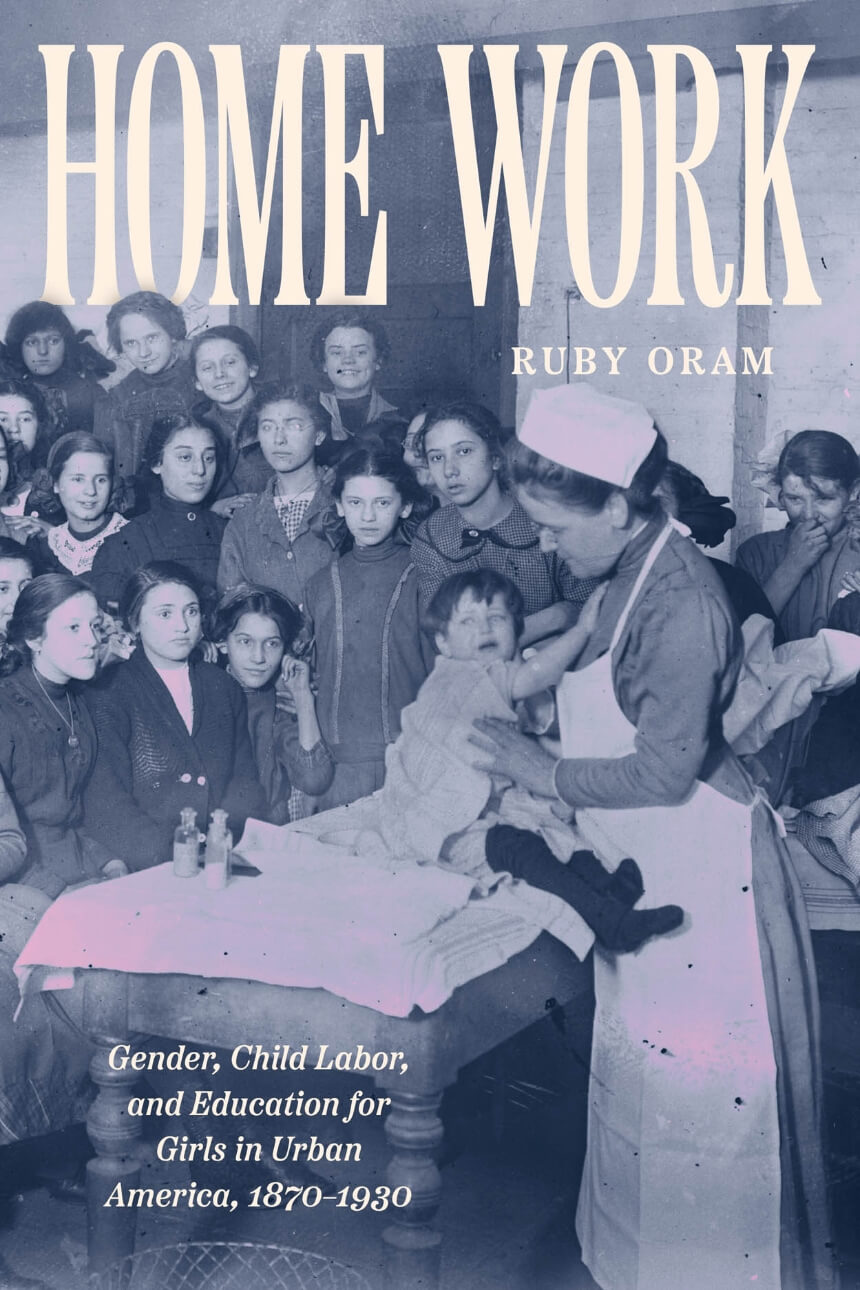
Ruby Oram’s Home Work: Gender, Child Labor, and Education for Girls in Urban America, 1870-1930 (University of Chicago Press, 2025) examines how working people and reformers in Chicago debated secondary education curricula for girls in the late nineteenth and early twentieth centuries. Debates over the curriculum for junior high and high school “manual training” and later “vocational” education for girls turned into deep discussions on the privileges and obligations of the working classes. On one hand, as Oram shows, club women often aspired for working girls to learn the arts of domesticity, including food preservation, food preparation, hygiene and childcare. Many pushed for courses on these subjects in continuation schools starting in the late nineteenth century, anticipating that many girls from immigrant and African American families would enter paid domestic service and later serve their own families. On the other hand, trade union women in Chicago, as well as many working-class parents of girls, consistently rejected defining vocational education for girls around domestic labor. They knew, after all, that most family caregiving would not earn a wage. Some were attracted to secondary programs in the skilled trades (like needlework) and an even greater number were interested in preparing for secretarial work in fancy office buildings, alongside middle class men. Oram’s rich community study shows how debates about the curricula of girls’ education were a lens into a broader conversation about how to define “good citizenship” for the working classes, and particularly for working-class women.
I sat down with Ruby for a conversation about her book.
Your book begins by showing that state reformatories in the late nineteenth century were among the first public institutions to develop secondary education for poor and working class girls. You emphasize that these schools not only “gendered” children but also built curricula around racialized cultural scripts. What was the stated and implied curriculum within those reformatories?
The first state-funded reformatories in Illinois (what I refer to as “carceral schools” in the book) trained girls under eighteen years old for waged work as domestic servants. Groups of wealthy white club women founded these institutions in the late nineteenth century to remove urban children from poverty, family neglect, and general troublemaking in industrial cities. They framed state reformatories as maternal investments in the health, morality, and education of the city’s most vulnerable children. In the book, I argue that this juvenile reform movement was rooted in a class-based labor anxiety known as “the servant problem.” The Ladies’ Industrial Schools Association trained young, white, American-born girls to work as live-in servants while incarcerated in the Illinois Industrial School for Girls during a servant shortage. They “indentured” girls to work for Chicago families as live-in servants and used their wages to help fund the institution. The vocational goals of these institutions fractured along racial lines during the early decades of the Great Migration. By the 1910s, child welfare reformers in Chicago argued that lessons in cooking and housekeeping prepared white girls for their future social responsibilities as mothers in benevolent state schools for “dependent” children. Vocational training for waged domestic service continued for the increasing number of Black girls deemed “delinquent” and sentenced to the remote State Training School for Girls in Geneva, Illinois.
The rise of compulsory education laws in the early twentieth century gave Chicago’s superintendent of schools, Ella Flagg Young, a real opportunity to set education policy for teenage girls from working-class families. Tell us about the several groups of people in Chicago who had designs on defining the curricula for girls’ education and how this debate developed.
Many of the same reformers who ran carceral schools for girls became involved in public school governance by the turn of the twentieth century. They argued that public schools had a responsibility to educate girls for respectable labor and protect them from the physical (and moral) dangers of industrial wage-earning. These women lobbied for tighter child labor and compulsory attendance laws for girls in Chicago. Many embraced eugenic arguments that child labor harmed the “delicate” reproductive health of white, American-born girls and threatened future generations of citizens. Activism from women like Jane Addams led to the Child Labor and Compulsory Attendance Laws of 1903, both of which regulated girlhood labor in distinct ways that I explore in chapters two and three of the book. A closer look at these laws reveals that Progressive Era reformers were not simply interested in regulating child labor, but white girl labor specifically.
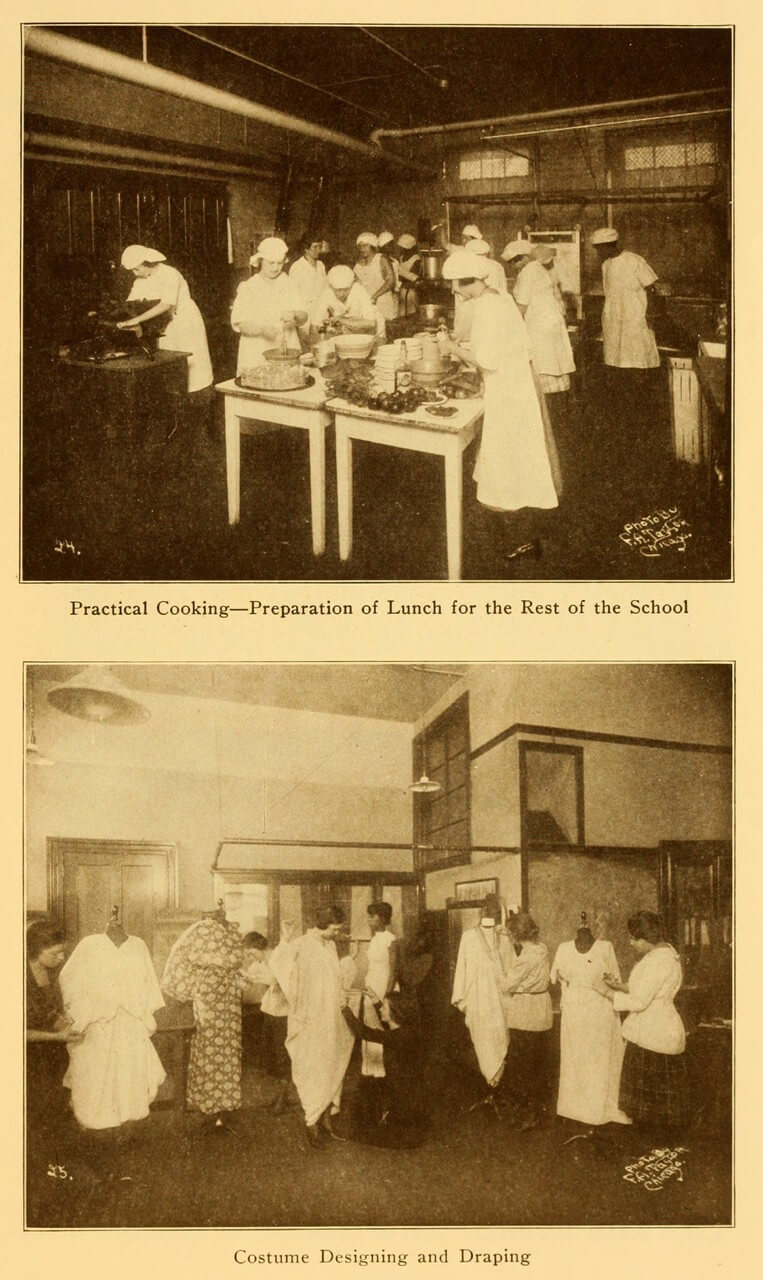
The 1903 laws also extended girls’ school lives to the age of sixteen and inspired debates over the purpose of the girls’ high school curriculum. Labor activists like Agnes Nestor wanted public high schools to offer trade courses for girls like dressmaking and millinery. Club women wanted girls to prepare for unpaid domestic work through courses like housekeeping, cooking, and “little motherhood.” Labor women, club women, and settlement house workers ultimately compromised on hybrid programs for girls that forwarded their dueling reform agendas. All of these school reformers positioned the white, American-born daughters of immigrants as the most vulnerable children in the industrial city who needed educational support to prepare for work in and outside their homes. As I show throughout the book, their school reforms largely rendered Black children invisible or unworthy of public school investment.
One important insight you develop in the book is that home economics curricula served as a secure jobs program for middle class women. Draw us into these club women’s worldview. I would imagine that middle class women’s groups like the Vocational Supervision League knew that the girls from poor and working-class families were leaving school to join the skilled trades and secretarial work. I also imagine they knew that paid domestic labor was becoming less desirable, not only because of the low pay but because of the long hours and often demeaning nature of the service. Why do you think these club women insisted that public schools teach the domestic arts? What problems did they think it remedied? Did they actually envision a world where poor women did not have to work for wages?
Club women and settlement house workers initially wanted girls to learn domestic skills to solve very real public health issues in tenement housing. Socialist labor reformer Florence Kelley argued that public schools should teach girls the science of cooking and cleaning to protect immigrant homes from contagion and malnutrition. Many of these reformers accepted that working-class girls would earn wages outside the home (at least until they married). In their view, that was precisely why public schools had a responsibility to prepare girls for homemaking before they left school to earn wages.
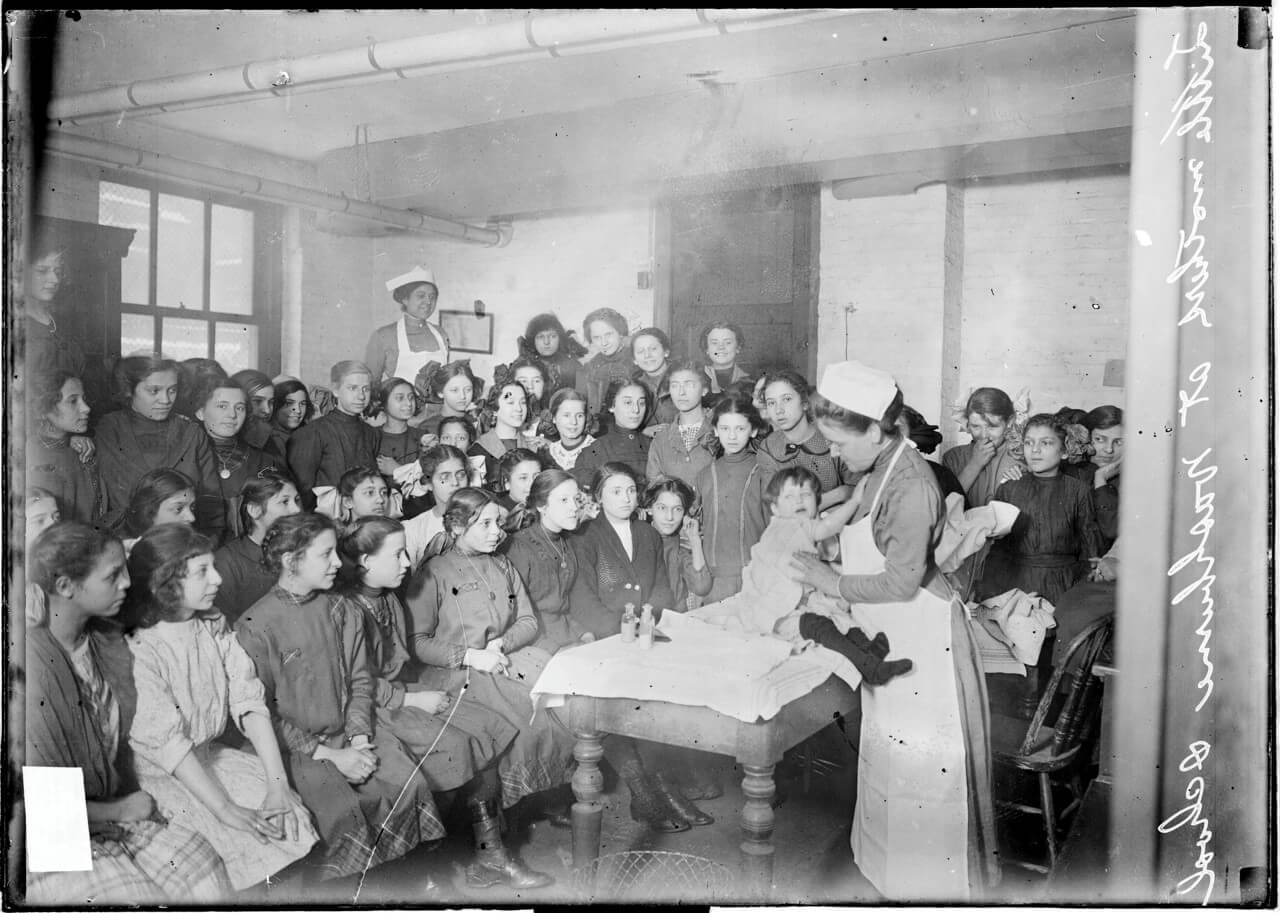
But to your point, this movement was marred by contradictions. For example, settlement house workers argued that immigrant parents violated child labor laws when they kept girls home from school to cook, clean, and care for younger siblings. Yet reformers wanted girls to cook, clean, and care for neighborhood infants as part of their home economics and “little mothers” courses at school. They suggested that domestic work performed under the guidance of middle-class teachers was educational. Domestic work performed at home to support working-class families was illegal child labor. Middle-class white women gained new professional opportunities in colleges and government agencies by the 1920s through their advocacy for domestic education. Many remained single and childless for their whole lives while promoting the unrealistic labor expectation that working-class girls devote their adulthoods to unpaid homemaking.
What did students make of these education reforms for girls?
Girls of legal working age (those above the age of fourteen) are important historical actors in this story. School reformers from the women’s club movement, settlement house movement, and labor movement ignored what working-class girls actually wanted from a public school education. The daughters of European immigrants wanted training for white-collar work. To them, an “American” job was an office job, not a union job as a garment worker. Black high school students (and their families) prioritized respectability at all-girl public schools like Chicago’s Lucy Flower Technical School for Girls. They focused on a traditional liberal arts education for teaching and college careers. In the book, I show how working-class girls ignored, resisted, or exploited new school programs to their own gain. Their generational conflict with Progressive Era social reformers shows the limitations of schools as sites of social control.
Now draw us into the worlds of some of the working women you studied. When Congress earmarked federal funds for vocational education (in the Smith-Hughes Act), Agnes Nestor, a Chicago trade union leader, made the case for using some of this to train women in the skilled trades. Lenora O’Reilly literally pointed out that if home education was so important, why were boys not trained in it too? Club women, as you mention earlier, pushed back. Do you think there was anything more that trade union families (including male union leaders in Chicago) could have done to move public schools to invest in what you call the “wage earning potential of urban girls”? How did this struggle fit into the other priorities of Chicago’s labor movement?
Labor women like Nestor and O’Reilly tried to use the Smith-Hughes Act of 1917 to reflect the priorities of the women’s labor movement. Smith-Hughes was the first federal education policy that shaped the public school curriculum, and Nestor was the only working-class member on the bill’s drafting committee. Nestor argued that home economics did not prepare working-class girls to earn a wage and should therefore not be included in federal funding for “vocational” education. She wanted trade courses that taught labor skills and labor values through courses on collective bargaining and the history of labor legislation. Politically powerful club women went above her head to include funding for “vocational home economics” in the bill, which became the standard curriculum for high school girls in the 1920s. These women relied on growing anti-immigrant sentiment to win this argument against Nestor’s labor demands. At the beginning of World War I, members of the General Federation of Women’s Clubs argued that Congress should invest in home economics to Americanize immigrant daughters for the social expectations of women’s citizenship (motherhood and wifedom).
This conflict over Smith-Hughes reflected both the priorities and blind spots of labor activists like Nestor. Nestor and her colleagues in the Women’s Trade Union League focused on school programs for women’s needle trades like dressmaking and millinery to prepare working-class girls for skilled work in the female garment economy. Many working-class girls in Chicago wanted to learn office skills for white-collar work or teaching. The next generation of working women viewed public education as a path out of the working class. Labor feminists could have included office work in their educational agenda to address the “wage earning potential of urban girls.” But as I explain in the book, reformers were slow to support white-collar training because of sexual panic about girls working under and alongside married men in mixed-sex offices.
Perhaps my favorite part of your book is your deep analysis in the last few chapters about how and why domestic labor became the centerpiece of “good citizenship” education for working class girls in the early twentieth century. The League of Women Voters, for example, made the case for the “equalization” of funding between trades’ education for boys and home economics for girls. As you show, this expansion of home economics departments suggested that working women’s best opportunities for social mobility would come through marriage and “homemaking,” not through their own education and skills.
Home economics education addressed many of the social reform agendas of middle- and upper-class white women in the Progressive Era. They wanted the state to invest in the health of children, mothers, and families. Home economists represented women’s professional advancement: they ran female-dominated departments in universities and directed government agencies by the 1920s. For these reasons and more, organizations like the League of Women Voters viewed home economics as a feminist education movement. But home economics did not signal “equalization,” to use their term, in girls’ education. Rather, home economics segregated school resources by gender and promoted women’s financial dependency by teaching the breadwinner-homemaker model.
Home economics also segregated public education by race and class. As I argue in the book, the daughters and granddaughters of European immigrants benefited from home economics education to assert their “Americanness” (and “whiteness”) after World War I. Home economics education for Black girls continued to function as training for waged domestic service in the interwar decades, even as Black high school girls excelled to teaching, nursing, and college careers.
How did the working-class labor feminists of the 1920s and 1930s respond to this? How does your research help us better understand the history of labor feminism?
The Progressive Era movement to reform girls’ education shows how labor feminists tried to use the public school system to empower working-class women. Members of the Women’s Trade Union League like Nestor and O’Reilly viewed the public school curriculum as a tool for the women’s labor movement. Some labor feminists successfully shaped public education by the 1920s. They lobbied for Smith-Hughes funds to develop “continuation” classes for girls led by experienced tradeswomen at publicly funded schools like the Manhattan Trade School and the Boston Trade School for Girls. But all these public programs were paired with (if not overshadowed by) home economics. Labor feminists in Chicago responded by creating their own schools that prioritized the values of the labor movement. Agnes Nestor co-founded the Training School for Active Women Workers, which was the first full-time labor school in the United States.
This history shows the importance of thinking generationally about the demands and priorities of working women. Labor feminists who became school reformers in the Progressive Era ignored the priorities of the next generation of working women because of their cultural definition of “skilled” labor for women and their faith in the respectability of female-run shops. They promoted dressmaking and millinery courses for girls, two fields that employed less than 2 percent of Chicago women by World War I and excluded women of color outside of Black-owned shops.
Public school reform for girls ultimately served the demands of “domestic feminists,” the middle- and upper-class white women who believed political enfranchisement stemmed from uplifting women’s unpaid labor as wives, mothers, and caretakers in the home. I think it’s important to highlight, however, that these school programs did not completely reframe girls’ choices and job prospects. Girls had agency. They complained about home economics courses and pursued jobs in stores, offices, classrooms, and hospitals. School was just one part of their lives, and only one place they learned.