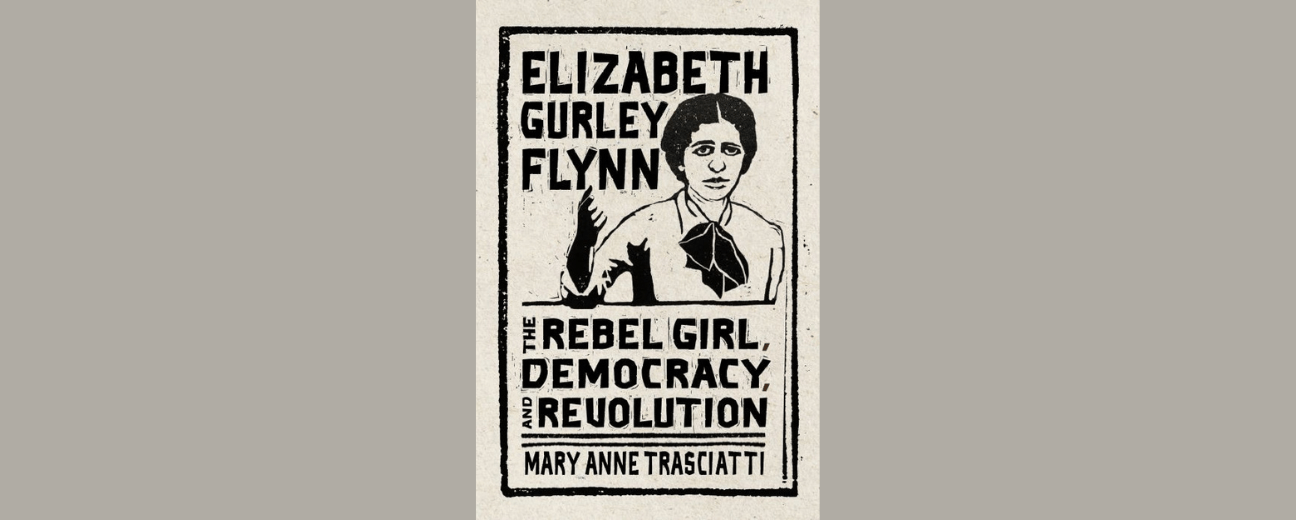
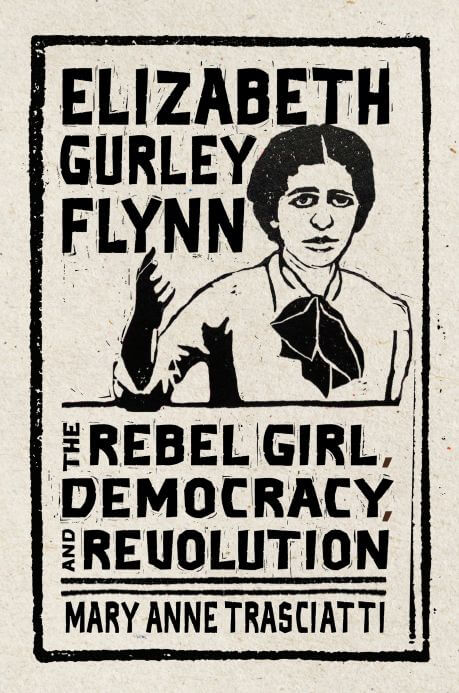
In Elizabeth Gurley Flynn: The Rebel Girl, Democracy, and Revolution (2025), historian Mary Anne Trasciatti traces Elizabeth Gurley Flynn’s path to becoming one of the most important labor radicals in US history, taking part in almost every major left campaign of the first half of the twentieth century. Often seen in biography and popular memory as a relic of the IWW, the Flynn of Trasciatti’s new book instead takes form as a dynamic and profoundly talented organizer who consistently devoted her life to building an American left tradition committed to free speech, democracy, and working-class power. A strong advocate for racial and gender equality, her skill and commitment to these principles made her a critical figure on the left across many decades of campaigns and organizational commitments. Rosemary Feurer interviewed Trasciatti about her new biography.
First, could you speak by telling us what we should know about Elizabeth Gurley Flynn, why she’s an important figure in labor history.
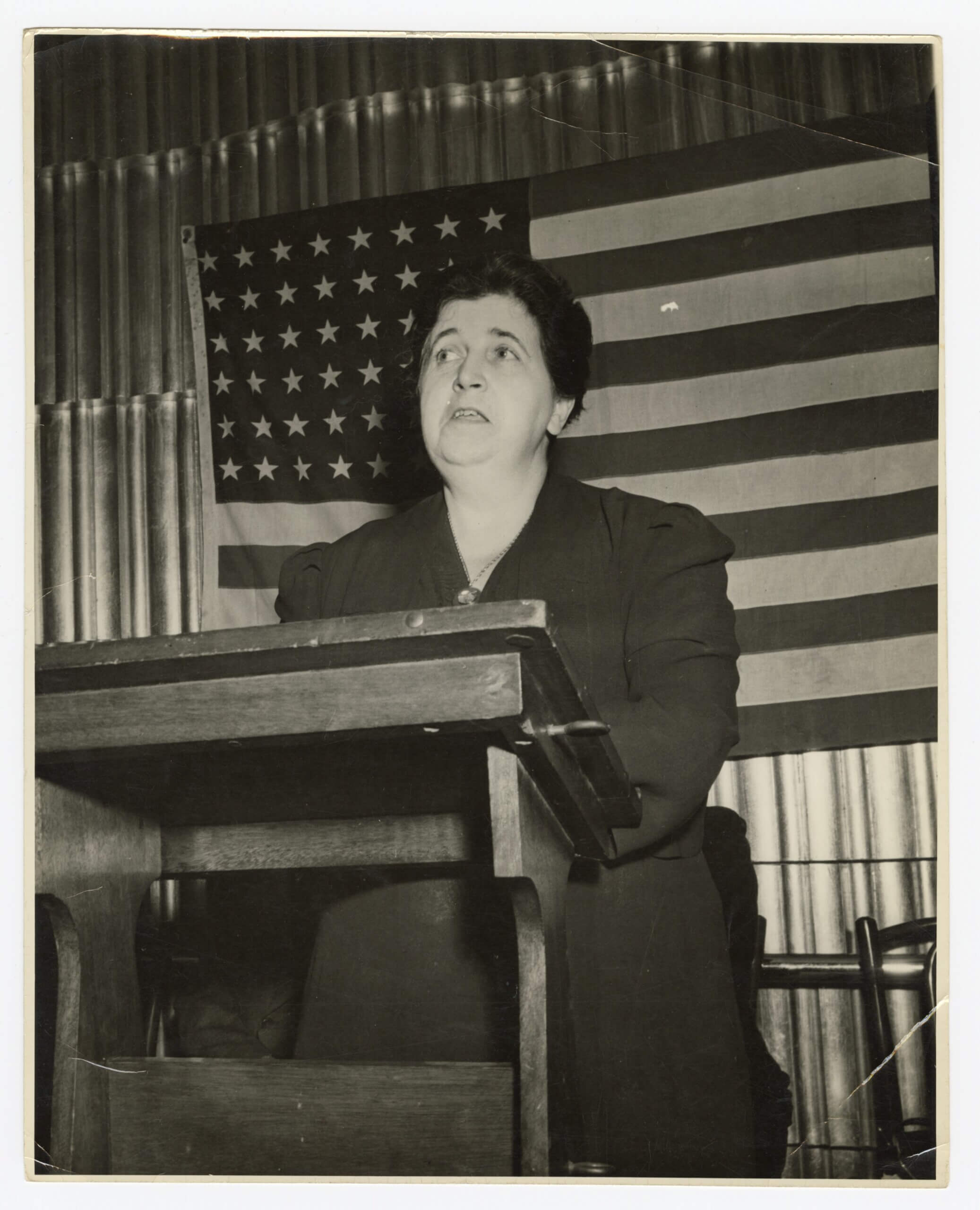
Elizabeth Gurley Flynn spent half a century as an activist for working people in the United States. and yet she’s barely known now unless you’re into radical or labor history. Even then, people know mostly her early years as the Rebel Girl of the Industrial Workers of the World. In her lifetime she was a household name among working-class people, practically a celebrity, and she knew everybody.
She was born in New Hampshire in 1890 and grew up in New York hearing about the Irish independence struggle and seeing working-class people struggle all around her. She was precocious, a socialist as a teenager, and then a Wobbly, a member of the Industrial Workers of the World, which was a radical union dedicated to organizing all workers in all industries. The Wobblies had no truck with electoral politics. They believed that change would come on the shop floor: workers would take over the means of production and ensure that workplace democracy was extended into society generally. And she was very popular as an organizer and an agitator—a “jawsmith,” as the IWW called it—because she was super smart and super well-spoken. So, she traveled around organizing workers into unions, standing up for workers who were on strike, and defending free speech.
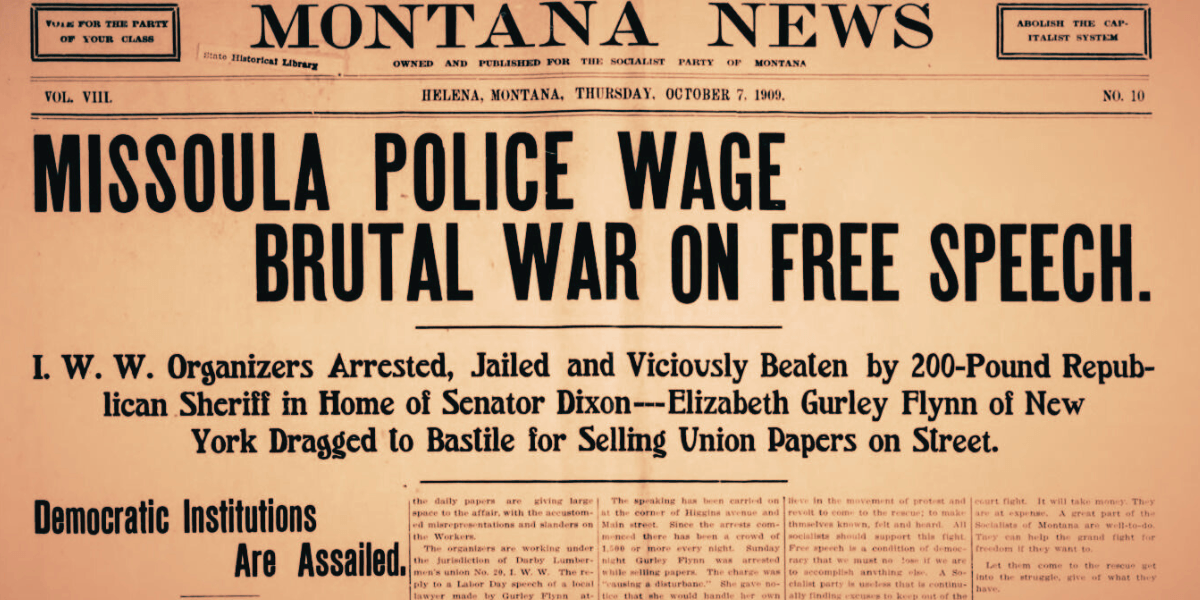
The first couple of chapters of the book are about the free speech fights in Missoula and Spokane to show how important Flynn was to them and how important they were for organizing workers. In the early twentieth century, cities like Missoula and Spokane passed laws against street speaking to keep the IWW from organizing “undesirables,” and Flynn devised many of the tactics the union used to defy these laws. The rationale was, “If we can’t speak on the street corners to organize workers, we’ll violate the law and speak anyway, get arrested, and fill the jails until the laws are changed.” When she led the free speech fights, Flynn was young, beautiful, and pregnant, and the call for Wobblies to “defend” her helped launch the tradition of recruiting hobos into those fights.
Flynn was involved in just about every cause the left took up between 1906, when she first became an activist, until her death in 1964: free speech; labor defense; union organizing; strikes; antifascism; campaigns against deportations, lynching, the poll tax, and housing discrimination; you name it.
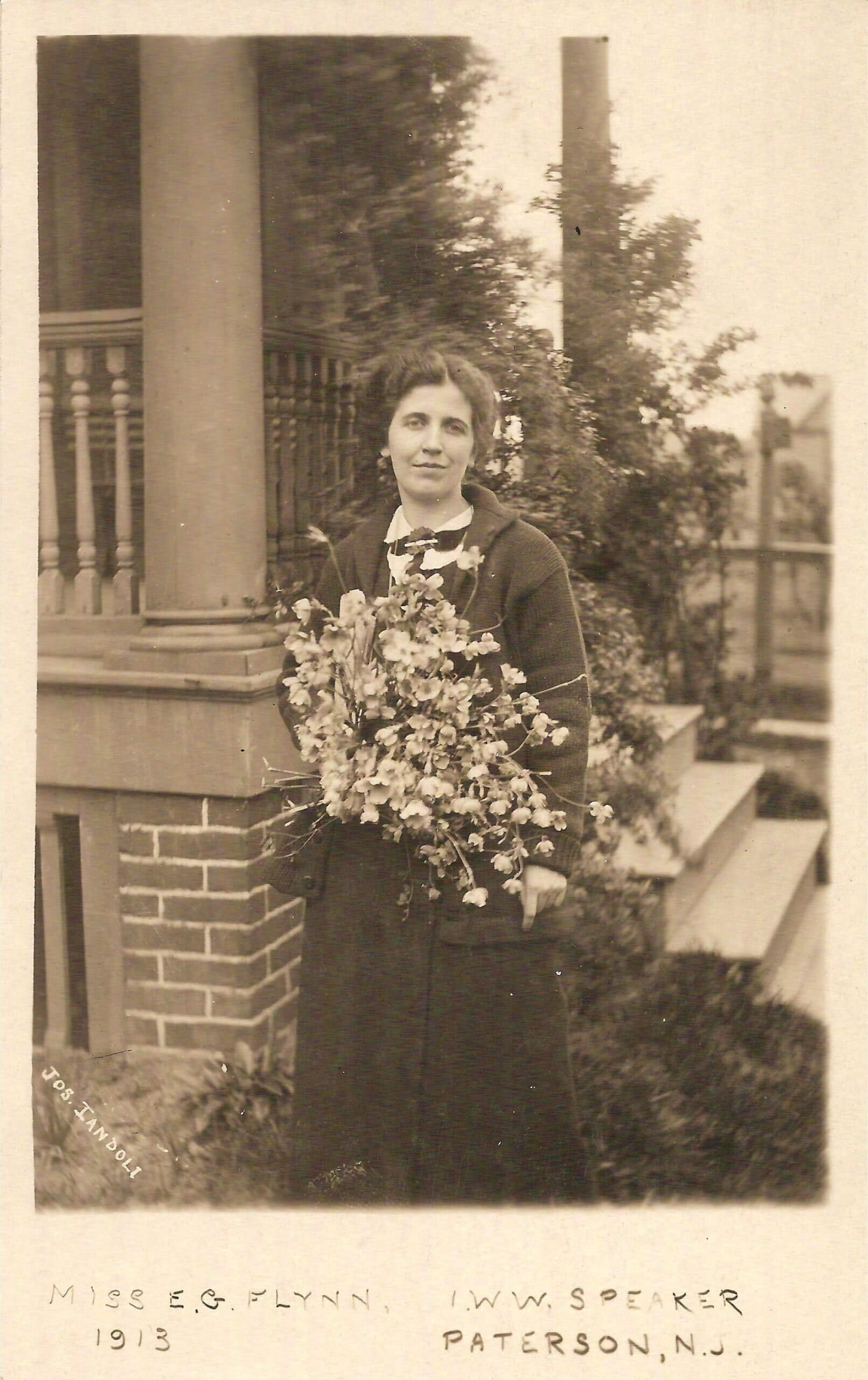
In no time, Flynn earned a reputation as an important and popular organizer. Wherever she went, she attracted crowds and media attention. Young women were enamored of her. She inspired them to organize and to be on the front lines, for instance, during strikes in the textile mills in Lawrence, Massachusetts in 1912 and the silk mills in Paterson, New Jersey in 1913-1914.
During World War I, Flynn was arrested in the federal raids on the IWW. She escaped trial by pleading with President Woodrow Wilson in a letter, essentially saying, “I’m a mom, how can I be a radical?” (It’s a little cringy.) It was at this time that she broke from the Wobblies. But she didn’t abandon the movement. In 1918, she founded the Workers Defense Union to defend anyone – trade unionist, socialist, anarchist, Wobbly, and later, communist – prosecuted under the Espionage Act, which made it a crime to hinder the war effort in any way. The left is really good at fighting amongst itself, but Flynn bucked that trend and brought people together around a shared goal: to defend free speech for labor activists.
In the early 1920s, she became an antifascist. We tend to think of anti-fascism in the United States as beginning with the rise of the Nazis and opposition to the Nazis. But really, it was Italian radicals in the 1920s who saw their friends, relatives, and comrades brutally repressed by Mussolini’s regime and organized in opposition. Flynn was in a romantic relationship with Italian anarchist Carlo Tresca at that time, and what she learned convinced her that fascism was an anti-democratic ideology that threatened not just Italy, but all people around the globe. She saw the Ku Klux Klan and the American Legion as particularly American forms of fascism, rooted in racism but also attempting to squash working-class organizing.
After a personal crisis in 1926, Flynn left public life and spent the better part of ten years living with anarchist Marie Equi in Washington State. The Popular Front brought her back to New York and to politics. That was the moment when the Communist Party turned from advocating the overthrow of capitalism by revolution to supporting Franklin Roosevelt’s New Deal and building alliances with liberals in the struggle against fascism. The Popular Front was very appealing to Flynn. She joined the Communist Party of the United States in 1937 and remained a Communist for the rest of her life.
So, you could say that Flynn was a lifelong American radical: first, a socialist, then, a syndicalist, and finally, a Communist.
She spoke at Northern Illinois University around 1961. There’s a transcript of it at NIU’s library. And all of those students were just interested in her Wobbly past. Some other biographers have followed that. Your book insists that there is a throughline with the earlier periods of her life, not a significant contrast. So can you talk about that a little bit? What was your choice there in thinking about how to make sense of her life?
Elizabeth Gurley Flynn was so cool and such a fierce champion for the working class, and it bums me out that she is not better known, especially among young people. I wanted to do something to help change that. Flynn was involved in just about every cause the left took up between 1906, when she first became an activist, until her death in 1964: free speech; labor defense; union organizing; strikes; antifascism; campaigns against deportations, lynching, the poll tax, and housing discrimination; you name it, I could keep going. I asked myself, “How can I tell the story of this incredible organizer and activist in a way that hangs together and doesn’t repeat what had already been said about her a million times?”
I realized there was something I could trace from the beginning of her career to the end, and that was her defense of the First Amendment and her commitment to free speech and civil liberties. At the time she was doing this work, not everyone thought it was necessary. Accounts of the Wobbly free speech fights note that there was controversy over them: there were people who thought they were taking away from the important work of organizing.
Flynn was part of an earlier radical tradition that saw the anti-capitalist left as part of the revolutionary tradition the nation was founded upon.
And I’ve heard historians say the same within the last ten years. What is your view?
Flynn—and I agree with her—rejected that assessment, because without the right to free speech and assembly in public space, you can’t organize. During the Paterson silk strike in 1913, for example, local government and law enforcement tried to shut down access to halls, streets, and parks. What do you do if you have thousands of workers on strike and no place to hold a meeting? How do you keep up morale? Build solidarity? Discuss strategy? You could use private homes, which they did. For example, the Botto House in Haledon, New Jersey, the town next to Paterson, where they had a socialist mayor. But a labor union can’t rely on access to people’s homes during a strike.
Flynn understood free speech not as an abstract right. She knew that speech is a concrete action. It’s the way you reach people, the way you organize, the way you bring the message to the workers, because you can’t rely on the workers coming to you. They’re tired. They don’t have access – they don’t know you’re there if you’re in some far-off place. For her, freedom of speech, freedom of assembly, freedom of the press were essential tools, the necessary preconditions, for organizing workers. You can’t organize people if you can’t reach them.
Flynn never wavered in her commitment to civil liberties. She fought for workers’ right to the streets, to organize a strike even during wartime, to a fair trial even if you’re an immigrant with radical ideas; or to be a member of whatever political organization or party you choose, even if that party is the Communist Party.
And we should mention that the Communist Party was legal when these prosecutions mostly were taking place.
Exactly. And for me, that’s how the book hangs together. It doesn’t matter whether Flynn is a socialist or a Wobbly or a Communist. She’s an organizer of working-class people, a radical organizer with a profound commitment to civil liberties. That’s a little ironic for some people, but she was utterly devoted to defending the First Amendment.
When I started writing this book, we were in a moment—I think we’re moving away from it—where to be an activist on the left was to really focus on the flaws of the United States. But Flynn was part of an earlier radical tradition that saw the anti-capitalist left as part of the revolutionary tradition the nation was founded upon.
To give one example, the Declaration of Independence was an important tool for the Wobbly free speech fights. Wobbly orators would stand on a streetcorner soapbox, read from the declaration, because a lot of these people were not eloquent speakers, and wait to be arrested so they could demand their First Amendment rights. It blows a lot of people’s minds to think about a left that says “This revolutionary tradition is ours, and the people who are grinding us under their heels are the ones violating its promise. We need to wrench the American revolutionary tradition away from an imperialist, capitalist, racist society and hold it to its true roots, which are freedom from tyranny, freedom from oppression, freedom for all.”
For her, freedom of speech, freedom of assembly, freedom of the press were essential tools, the necessary preconditions, for organizing workers. You can’t organize people if you can’t reach them.
During the Wobbly free speech fights there was a conversation about free speech and civil liberties that reverberated around the country and as far away as Australia. This kind of conversation is called popular constitutionalism, and it goes something like this: “You don’t need people trained at law schools to tell you what the First Amendment says. You can decide for yourself. You read the Constitution, you read the First Amendment, and there it is.” People really responded to that idea, even if they didn’t know what it was called. They were empowered by it. They debated in multiple languages, in their own newspapers, in public forums. This conversation was important, and Flynn helped set it in motion. And I think that’s key. It exemplifies Jim Barrett’s “Americanization from the bottom up” thesis: in their debates about the Wobbly free speech fights, working-class people figured out what this country means for themselves.
I think that’s a remarkable achievement, and it deserves to be more widely known and celebrated, because it provides inspiration in this present moment of “America 250.” Who do we include in the story? Why does this American revolutionary tradition matter? Well, Flynn would say it matters because working-class people can exploit that tradition, in the best sense of the word, and make it their own and say: freedom and liberty and the good things in life—we deserve all that.
Your book suggests that the Irish networks she travelled in contributed to this perspective.
Her identity as an Irish American was very important to Flynn. She felt that if you were true to your Irish roots, you had to be a socialist; you had to be an advocate for the underdog; you had to do labor defense. She saw Irishness as a responsibility: if you are Irish, you are part of a history of exploitation, particularly of working people—of rigged juries and stolen wages and oppression of all kinds—and you have an obligation to stand up for the oppressed and the exploited wherever you find them. She was really frustrated by Irish American police. She called them “fat-jowled Hibernians” and a few other things.
Flynn was deeply committed to Irish socialist James Connolly’s idea of a workers’ republic. She helped found the Irish Socialist Federation with Connolly when she was just a teenager. She was also friends with Jim Larkin. She learned from him as well. There’s a moment after the Paterson silk strike when Flynn is forbidden from speaking in that city. A group of affluent women in New York decked her out in fancy clothes so that she could sneak into a meeting hall and address workers. That was 1915. I think she got the idea to disguise herself from Larkin, who during the 1913 Dublin Lockout wore a disguise so he could make his way past police in the crowd before taking it off to address workers from a balcony. Unlike Larkin, Flynn didn’t fool anyone with her disguise, but it was a good idea.
Flynn was also an anti-imperialist and anti-colonialist, because she believed that to be Irish was to carry with you the history of colonialism and imperialism and all the exploitation they entailed. She supported the Mexican Revolution and the Indian independence movement. In the offices of the Workers Defense Union, she had Indian anti-colonial pamphlets printed. She encouraged Indians and Irish to march together in the St. Patrick’s Day parade in New York. She was committed not just to the creation of a workers’ republic in the United States, but also to supporting anti-colonial struggles around the globe, because she was Irish.
In 1952, when Flynn was called to testify before the Subversive Activities Control Board, which was established by the McCarran Act to identify and investigate subversive organizations, she was asked if she owed allegiance to any foreign power. And she said, “No foreign power at all. But I admit I have a soft spot for Ireland.” And she meant that.
What they wanted to suggest was that her only loyalty was to the Soviet Union.
Exactly. She was loyal to the United States, but she had a soft spot for Ireland. And when she was convicted under the Smith Act and sent to prison, the Irish responded. There were calls for her release. There were celebrations of her as a socialist and advocate of the workers’ republic. So, the warmth went both ways. She was appreciated in Ireland.
She saw Irishness as a responsibility: if you are Irish, you are part of a history of exploitation, particularly of working people—of rigged juries and stolen wages and oppression of all kinds—and you have an obligation to stand up for the oppressed and the exploited wherever you find them.
Another fascinating part of your book is the story of how Flynn was part of the rise of civil liberties, but then was expelled from the ACLU?
Flynn founded the Workers Defense Union in 1918, initially as part of the Liberty Defense Union, which was the precursor to the ACLU. She later described the WDU as “a godchild of the ACLU”. And there was a lot of complementary work going on there. Flynn helped organize the ACLU, but the other organizers really didn’t know how to reach working-class people, immigrants, people whose languages and cultures were unfamiliar to them. They turned to Flynn and said, “help us; be our liaison with working-class people and movements.” These people were good-hearted and well-heeled, part of an American elite. Flynn always preferred hanging out with working-class people, but she could talk to elites; she could code-switch, in contemporary language. At the same time, she was beloved by immigrants of various ethnic and national groups. Her speeches were published in Finnish newspapers, in Italian newspapers. These communities knew her. So, she could be the liaison between the American liberal elite and working-class communities, many of them immigrant communities. The Workers Defense Union worked on behalf of Emma Goldman, Eugene Debs, Sacco and Vanzetti, and many more individuals with little or no name recognition. The reputation that Flynn for this work got her elected to the executive committee of the ACLU in the 1930s. But after the 1939 Nazi-Soviet Pact there’s a growing rift in the ACLU between New Deal liberals and anti-communists.
One reason for the rift is that the ACLU was moving in a new direction on civil liberties. The organization was founded in 1920, largely, though not only, to assist labor activists who were imprisoned or otherwise targeted for their activism. But after the Nazi-Soviet Pact, it pivoted to embrace a value-neutral position on civil liberties, treating free speech as the sign of a democratic society. And for Flynn, that didn’t fly. She believed civil liberties are a starting point for democracy, a necessary precondition for balancing power between “haves” and “have nots.”
The rift continued to grow. In 1940, the ACLU passed a resolution, not unlike what was recently debated in Congress, that fascism and communism are equally bad because both are authoritarian ideologies, and anybody who was a member of a fascist organization or a communist organization had no place on the board of the ACLU. A lot of people called it a “Communazi” resolution. Flynn was the most obvious target for that resolution, and she saw it that way. It became personal, and it got ugly. And while, yes, there was disagreement over the ACLU’s move towards a value-neutral approach to free speech, the resolution was a reflection of a rising tide of anti-communism. Members of the board were afraid of being red-baited. They were worried about J. Edgar Hoover, worried about being called before the House Un-American Activities Committee and losing political and financial support. Because they couldn’t get Flynn to resign from the board, they put her on trial. She spoke in her own defense quite eloquently. She called out board members for their red-baiting and noted that if she had been targeted during the ACLU’s early years, the ACLU would have endorsed her cause. Her argument was, “You’re saying I violated my commitment to free speech by becoming a Communist. One, you knew I was a Communist when you elected me to the board the first time and when you renewed my term. And two, you are the ones who have violated your commitment to the First Amendment with this political litmus test.”
Alas, she lost. The vote was tied, and the tie was broken, I think, by John Haynes Holmes, who voted to have Flynn expelled from the board. The decision was very controversial when it was brought to a nationwide vote. Some members resigned from the organization in protest. Others worried that the ACLU was violating its own principles and setting a dangerous precedent. But several members around the U.S. cheered the move.
What else is noteworthy about these speeches is how she tied the experience of Irish Americans to that of African Americans.
Flynn’s experienced her expulsion from the ACLU as a personal betrayal, and I think she was right. But she also realized that when the going got tough, her former civil liberties allies would not stand up to red-baiting for anyone. And I think this is important. When the ACLU expelled Flynn, they basically gave the liberal left’s seal of approval to red-baiting and anti-communism. We know, for example, that organizations passed their own “Communazi” resolutions that were modeled on the ACLU one.
The liberals turned toward what they called “principled anti-communism,” and this important organization was authorizing that perspective. A lot of resolutions were passed in labor councils in the aftermath of this.
Yes, and what you couldn’t say to these labor councils or other organizations was, “oh my gosh, this is in violation of everything you stand for!” Because they would point to the ACLU and say, “if the organization dedicated to defending free speech can find a principled stand on anti-communism, so can we.” The ACLU was divided at this time, too, right before they tossed her out, about the sit-down strikes. They waffled in their position on the sit-down strikes at General Motors.
With this more neutral position: they make free speech and property rights both somewhat sacrosanct.
Yes, because the sit-downers were arguing, “We have a right to our jobs. We’re not claiming a right to the actual property of the factory, but we’re sitting down on our right to our jobs.” And the ACLU really waffled on that. And they also waffled in their response to Ford’s attack on UAW organizers at the River Rouge plant. The thinking was, “Well, employers don’t have a right to beat up organizers, but they do have a right to discourage unionization.” The ACLU was now defending union busting in the interest of a value-neutral approach to free speech! And Flynn was like, are you kidding me? Her position—and I think you see something very similar in the preamble to the National Labor Relations Act—was that working people need collective organizing because they are not on a level plane with employers. If we want to avoid disrupting society completely, we have to level the playing field, and collective organizing and collective bargaining are the way to do that. Unless you have free speech, you don’t have that level playing field. So, to say that Ford has the same rights as the UAW organizers and that union busting is okay—well, Ford has so much more power, and you’re not recognizing power. That frustrated her.
When the ACLU expelled Flynn, they basically gave the liberal left’s seal of approval to red-baiting and anti-communism.
And there’s the idea that there are such things as collective free speech rights. With that change of course toward individual free speech, we lose a lot of that, and the ideas behind it are still resonant. Like you said, we’re celebrating America 250, and our history department has a series starting in November on figures in American history. I tried to put Elizabeth Gurley Flynn into the mix there, and was turned down.
I’m shocked. No, I’m not.
When I read your book, it’s this amazing figure who sees her positions as consistent, at least on those issues of defense and the way labor should organize, and on the revolution’s legacy and all of that. But I guess it’s still a hard sell, even after the Cold War is over. But maybe, bringing it up the way you do, it’s not as hard to sell her as a heroic figure as it may have been during the Cold War?
When Flynn was imprisoned at Alderson after her Smith Act trial, she was asked to write an article for the Fourth of July issue of the prison newspaper, the Alderson Eagle. In her article she links the revolution to FDR’s Four Freedoms. It’s a really interesting move. They also asked her and Claudia Jones, a Trinidad-born member of the Communist Party and dear friend, to help desegregate the prison when the order came to desegregate, because they knew that as Communists, they were committed to racial justice and racial equality. Even in prison people grudgingly acknowledged this stuff.
Yes. There is this proud part of the tradition in the Communist Party, and it links to her earlier life too: the ideas of freedom of speech, freedom of assembly, and anti-fascism. Tell us a little more about that.
Gurley Flynn was always organizing across boundaries of race and gender. Although she wasn’t a feminist, she thought it essential to organize women. And she also thought it essential to organize Black workers in the United States: Caribbean Americans, African Americans, Black workers of all kinds.
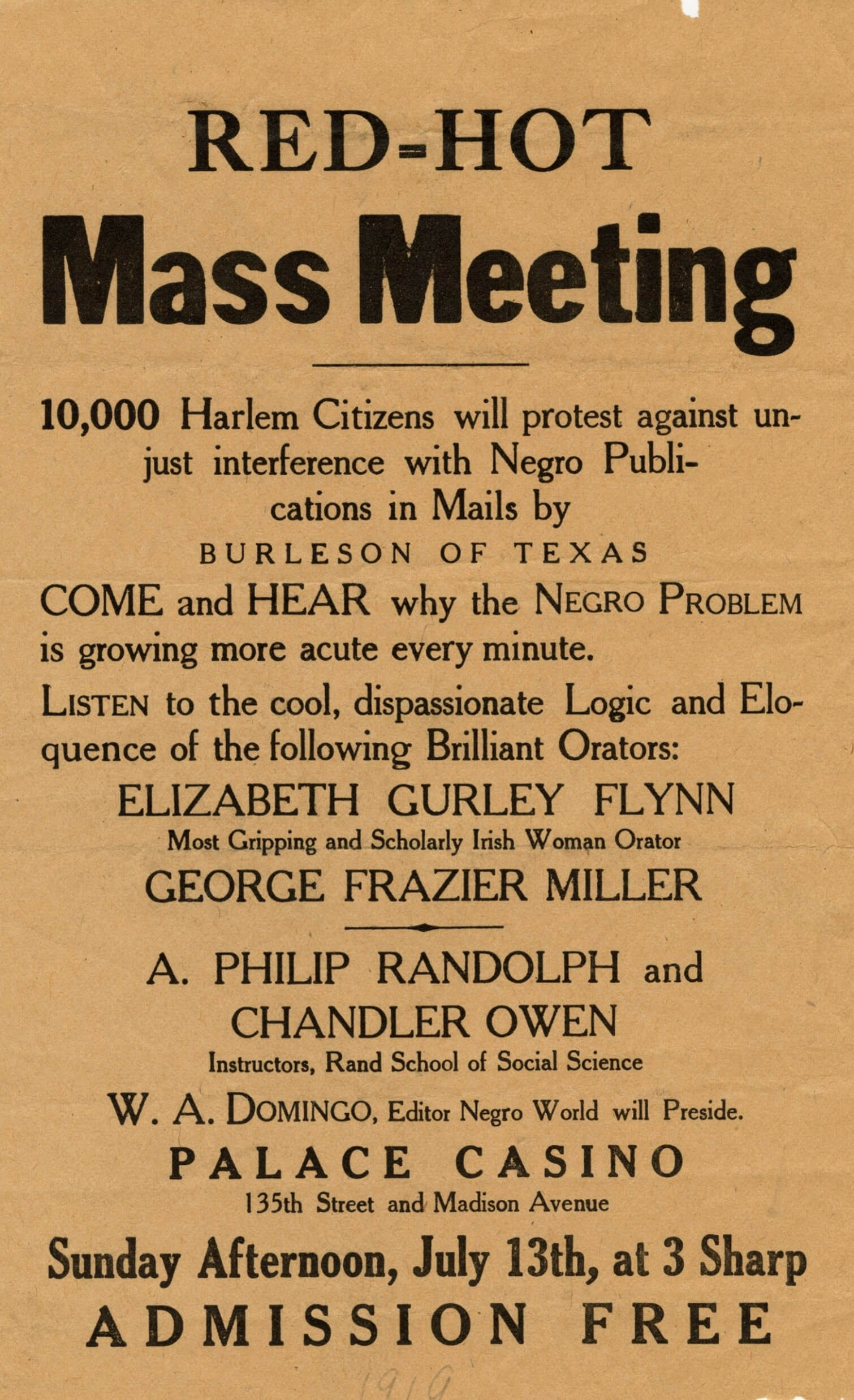
During the first Red Scare, when the Messenger, the newspaper published by socialists A. Philip Randolph and Chandler Owen, was suppressed because of its antiwar position—Black Americans were among the first to see the acute irony of the nation fighting to make the world safe for democracy while many of its citizens were denied democracy based on their skin color, and they were very straightforward about that—there was a meeting in Harlem, and Flynn was one of the speakers. She was billed as a “Most Gripping and Scholarly Irish Woman Orator” – I love that! And after the Elaine Massacre, when organizing among sharecroppers in Elaine, Arkansas, was brutally repressed, she spoke again in Harlem.
Those speeches were transcribed, because New York had passed an anti-radical law that meant state agents would be going to the meetings and transcribing them. She used to mock those agents mercilessly. And thank goodness for them, in a way; it’s a bittersweet thing, because now we have these transcripts. When you read them, you get a real sense of how brilliant she was as a fundraiser. She would speak last, because she was one of the main events, and then the hat would be passed and she’d be up at the microphone saying: “Oh, I hear a lot of jingling, but we need some paper. So, let’s hear it for the paper. And how about the Irish? You need to step up here, because I know a lot of you, and you don’t want me to see you on the street and know that you didn’t put anything in the basket.” She just harangued the heck out of people in the audience, and they ponied up money.
She played an important role as the public face of the CPUSA, connecting the Party to the history of labor organizing in the United States, and she was very popular among rank-and-file members of the Party.
But what else is noteworthy about these speeches is how she tied the experience of Irish Americans to that of African Americans. “My people came here because they were fleeing starvation and persecution; your people were forced to come here. But we both came here and were met with exploitation, and so ours is a common struggle and we must work together.” She would tell Black workers in the audience, “You can’t fight alone. You need to join the IWW. This is the organization that organizes across racial boundaries. You need to fight for your rights; fight with the IWW.” Later, in the 1920s, she advocated organizing among Black people, by Black people. But during the first Red Scare, she called for multiracial alliances. And she would say to the white workers, Irish American and otherwise. “You need to stop this nonsense. We are all exploited, oppressed people, and it is our responsibility as Irish people to extend a hand across the racial barrier. We will never succeed in the struggle if we don’t tear down the racial barrier. “ And people responded. In the transcription you see that she got cheers from the audience. Her message was simple. I think it fell on fertile soil. People really responded.
Flynn carried that message forward into the 1920s and into the 1930s in her work with the CPUSA. So it wasn’t that she became an anti-fascist and an anti-racist because of the CP. She brought work she had already been doing into the Party: against lynching, against housing discrimination, against job discrimination, articulating the triple jeopardy status of Black women. Her relationship with Claudia Jones and other Black communists is not to be underestimated. There was mutual respect and mutual fondness. Angela Davis says that Flynn was one of the few white women at the time who understood the plight of working-class Black women. I think that’s remarkable, and it’s a real model as we grapple with race and class. She offers inspiration for how to organize across those barriers.
Your book doesn’t flinch when discussing the difficulties she had in the Communist Party.
Her first act as a Communist, in 1937, was to speak at a fundraiser for the Abraham Lincoln Brigade, the volunteer brigade from the United States that joined the International Brigades to fight against Francisco Franco’s fascists in Spain. As a longtime anti-fascist, this was a perfect way to begin her association with the CPUSA. The Party’s commitment to building the CIO also appealed to the labor organizer in Flynn. She played an important role as the public face of the CPUSA, connecting the Party to the history of labor organizing in the United States, and she was very popular among rank-and-file members of the Party.
Sadly, Party leaders didn’t respect Flynn as they should have. She was a woman and they kept shunting her into “women’s work.” (The CP was much better at dealing with issues of race than it was at dealing with issues of gender.) Also, she wasn’t a theorist. She was a Marxist, I suppose, but she didn’t go around quoting Marx. What she did was talk to working-class people and she was very good at it. She got a lot more, intellectually and emotionally, out of talking to coal miners in northeastern Pennsylvania, than sitting around with Party leaders theorizing about this or that approach to revolution. So, she was considered kind of an intellectual lightweight, which I think is a real irony: a party that aims to organize the working class to overthrow capitalism finds that the member who probably has the best rapport with working-class people, and the most love for them as a class and as individuals, is an intellectual lightweight. But there you have it.
She was really important to the CP when the Nazi-Soviet Pact was announced. I’m sure she was devastated by the pact, because here’s an anti-fascist to the bone since the early 1920s who is now part of an organization attempting to make peace with the Nazi-Soviet Pact, the agreement between the Soviet Union and Germany that neither would attack the other. That was hard. And that was the moment when support for the Popular Front really began to crumble. Roger Baldwin was gobsmacked by it, and he wasn’t alone. So, we begin to see support peeling away on the liberal left, which begins to question the Party, its members, and its leaders in particular, for suddenly being able to defend the Nazi-Soviet Pact. Flynn remained an anti-fascist throughout this period, but she was a good Communist, so she didn’t criticize the pact. The party line was that the war going on in Europe was an imperialist war, a war of imperial powers, not an anti-fascist struggle anymore. Of course, that all changes when Germany invades the Soviet Union, and suddenly we’re back to the being a war against fascism, and Flynn falls in line again.
Before the Soviet Union and the United States were allied in the war, the head of the CPUSA, Earl Browder, was arrested, and Flynn led the campaign for his defense, continuing the work she had been doing since she was a Wobbly. She co-chaired the defense campaign with Tom Mooney, who was actually very sick and in intensive care, on oxygen. But he had an important symbolic function. Like Flynn, he was an Irish American radical, and a link between the Party and the history of labor activism and organizing in the US. He did not live to see Browder released.
The Smith Act, a.k.a., the Alien Registration Act, which was passed in 1940, made it a crime to advocate the overthrow of the U.S. government by force and violence. The first group prosecuted under the Smith Act were Trotskyists, and when that happened, the CP, including Flynn, did not come to their defense. Donna Haverty-Stacke’s book Trotskyists on Trial is great for anybody who’s interested in this story. The case of the Trotskyists should have served as a warning to the CP, but of course it didn’t. A few years later, in 1948, the party’s leadership was rounded up, arrested, and prosecuted under the Smith Act. These were the “first-string” Smith Act defendants in New York. Flynn was not among them, and she was kind of miffed that she wasn’t, because—
She thought she should be first string.
Yeah: “I’m a somebody, and I wasn’t rounded up.” She did for her comrades what she had done for Earl Browder and for the Wobblies and Sacco and Vanzetti, and many others: she formed a defense campaign and advocated for their release. It was kind of a hard sell by this time. In past defense campaigns she had organized the goal was to bring people together and say, “whatever your ideological differences, this is a threat to free speech and civil liberties generally in the United States, and it is a way to hobble organizing among working-class people, and we need to put a stop to it.” But it was a hard sell for the Smith Act defendants, and the campaign became a Communist endeavor.
In 1951, Flynn herself was arrested as part of the “second-string” Smith Act indictments. She chose to defend herself in court, and to lead a defense campaign for herself and the other Communists who were arrested with her. And like the first Smith Act defendants, she and other Second String defendants were found guilty and sent to prison. Flynn served about two and a half years at the federal women’s prison in Alderson, along with Claudia Jones.
While she was in prison, there was division in the Party over the revelations about Stalin that followed his death and the Soviet invasion of Hungary. Flynn tried not to take a stand; she felt that she needed to consult with comrades before she decided which side to support. When she was released from prison, she initially saw some value in the proposed reforms, which would have oriented the Party away from an internationalist outlook toward a more American outlook, one that put conditions in the United States at the forefront of organizing. But for reasons I don’t quite understand, in the end she decided she didn’t support those changes.
Flynn wrote the first half of her autobiography before she went to Alderson and it was published while she was in prison. She never got around to writing the second half, because she was constantly drawn into defense work, mostly defending the Party and its members from prosecution under the McCarran Act. She complained about not having time to write and it’s a shame because it would be interesting to read her thoughts about her life as Communist.
Under the terms of the McCarran Act, members of the Communist Party could not apply for or hold a passport. Flynn, who had traveled to Europe and the Soviet Union after World War II, had her passport confiscated, as did another Party member, Herbert Aptheker. They appealed the decision, and while their case was making its way to the Supreme Court, she wrote and spoke in defense of the right to travel as a civil liberties matter. Her argument was interesting. She criticized the use of a litmus test for citizens who wished to travel and pointed out that when federal authorities confiscated her passport, they were censoring her politics and denying those beyond the borders of the US the right to hear her point of view. She continued to speak against the McCarran Act and for civil liberties even after the court had her passport reinstated.
But her audiences were smaller and smaller, and older and older. She had joined the party in the 1930s, when, if you wanted to be at the forefront of working-class organizing and making change in the United States, you were likely either to flirt with joining the CP or to join outright. By the time of the passport denials, Flynn and other Party leaders were speaking on college campuses, but the energy just wasn’t there anymore. The torch had passed to a new generation of organizers.
When her passport was granted again and she was able to travel, she went to the Soviet Union. She had every intention of going to Ireland. But she never made it. She got sick and died in Moscow in 1964. There was a big state funeral for her there. Her ashes were then brought back to the United States, and were buried in Chicago, in the same cemetery as the Haymarket martyrs and Emma Goldman. There’s a lovely marker there with a great epitaph: The Rebel Girl. Fighter for Working Class Emancipation.