We asked Neil Johnson-Rogers to introduce readers to some of his findings, published in the new issue of Labor, about the vaunted autoworker retraining programs from the 1970s and 1980s. The essay takes us through programs that were touted as solutions to the misery brought by disinvestment and a lifeline for workers and communities displaced and gutted by capitalists’ decision. The programs were a strategy for labor peace and concessions as much as anything else. Johnson’s findings are worth a year’s subscription to Labor!
The Ford Motor Company’s sprawling, 160-acre assembly plant in Milpitas, California, first began churning out cars in 1955. A product of the postwar drive to decentralize and suburbanize manufacturing, it was designed to replace the automaker’s aging Western Assembly Plant in nearby Richmond. Equipped with transfer machines, press welders, and automatic spray guns, it was celebrated as a feat of modern engineering.
The modernity of the plant was frequently depicted in stark contrast with its surroundings. In 1952, the year before Ford purchased the site from the Western Pacific Railroad, Milpitas was a small farming community with a population of about 700. Pretty soon, some 2,500 autoworkers would be employed there, most of them transferred from Richmond. The subsequent proliferation of new, single-family housing tracts in the Milpitas area was of great interest to a generation of sociologists and anthropologists, who sought to better understand how the trappings of suburban life might give rise to new patterns of working-class formation. For social scientists such as Bennet Berger of UC Berkley, or Felix Keesing and others associated with Stanford’s “social anthropology in relation to industry” project, the Milpitas plant provided a case study in the effects of industrialization.
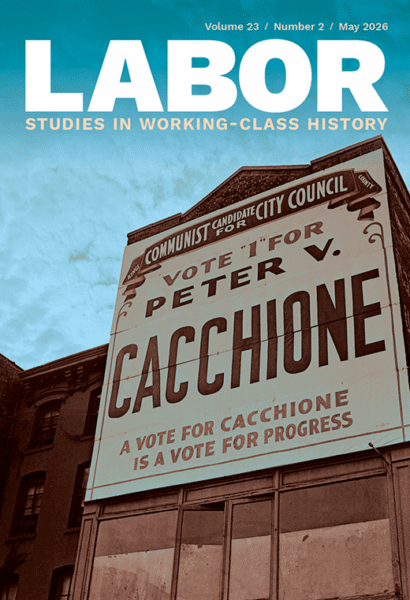
From another vantage point, though, the Milpitas plant might also be considered a case study in deindustrialization. My article, “The Learning Never Ends”: Jointness and the Limits of Retraining in the US Automobile Industry, which appears in the May 2026 issue of Labor, opens in the early 1980s. By then, the U.S. auto industry was straining under the weight of foreign competition. On the back of successive global oil crises, domestic purchases of fuel-efficient imports had assumed a larger and larger share of the market. And the restrictive monetary policies of Paul Volcker’s Federal Reserve had made a bad situation worse, precipitating a wave of plant closures that swept from Detroit to Milpitas. On May 20, 1983, the Milpitas plant produced its last Ford car, a bright red Escort GT.
What struck me about this particular plant closure was the way it was characterized as a success—held up by journalists, academics, and policymakers as a model of how to humanely and responsibly shutter a factory. This is because it was here that Ford’s National Development and Training Center (NDTC), jointly established with the United Auto Workers (UAW) in 1982, was first put to the test. The purpose of the NDTC was to finance and oversee a range of new education and training benefits for UAW members. In Milpitas, these benefits materialized on the shop floor long before the plant’s last day: during scheduled downtime, workers were encouraged to participate in job search workshops, individual consultations with career counsellors, or “targeted vocational retraining” courses in (for example), upholstery, welding, and computer repair.
When the Milpitas plant finally closed, NDTC officials celebrated a job well done, citing reports that about 30% of the workers there had participated in some form of education or training. A follow-up survey commissioned in 1985, however, painted a more complicated picture: just over 60% of respondents, representing a fraction of the total workforce, had found employment elsewhere, and at average hourly wages of $2.33 less than at Ford.
What, then, explains the fanfare with which Ford’s retraining programs were greeted? My argument is that the NDTC embodied the cooperative spirit of the so-called “new industrial relations.” Its joint structure took the principle of labor-management partnership that was so fundamental to the “quality circles” and “employee involvement” schemes of the 1970s and applied it to the otherwise decidedly antagonistic process of deindustrialization. If the deployment of the NDTC in Milpitas was indeed a success story, it was because it had depoliticized Ford’s decision to close the plant. As I put it in the paper:
Much like the “welfare capitalism” of an earlier era, these programs bound workers and their institutions ever closer to management, even as the specter of plant closures threatened to force them further apart. Insofar as retraining held out the promise of a second career, of an economic future beyond the factory, it was one that ultimately hinged on the continued cooperation of labor and management, and by extension, the preservation of labor peace. Retraining, one labor economist said approvingly, would turn “the plant closing process” into a “truly joint venture,” unmarked by the stain of industrial conflict.
There was a lesson in this for Ford’s competitors. When General Motors (GM) shuttered two of its West Coast assembly plants in the spring of 1982—one in Fremont and the other in Southgate, California—the company’s displaced workforce waited several months for retraining assistance to become available. Over the next several years, however, GM learned to emulate the Ford model—setting up, in the plant (or sometimes in the community), retraining assistance centers with joint labor-management representation, several months in advance of a scheduled shutdown. The 1989 closure of GM’s stamping plant in Willow Springs, Illinois, was thus reported on not because of the anticipated social fallout, but because of the extent to which retraining had neutralized tensions between labor and management.
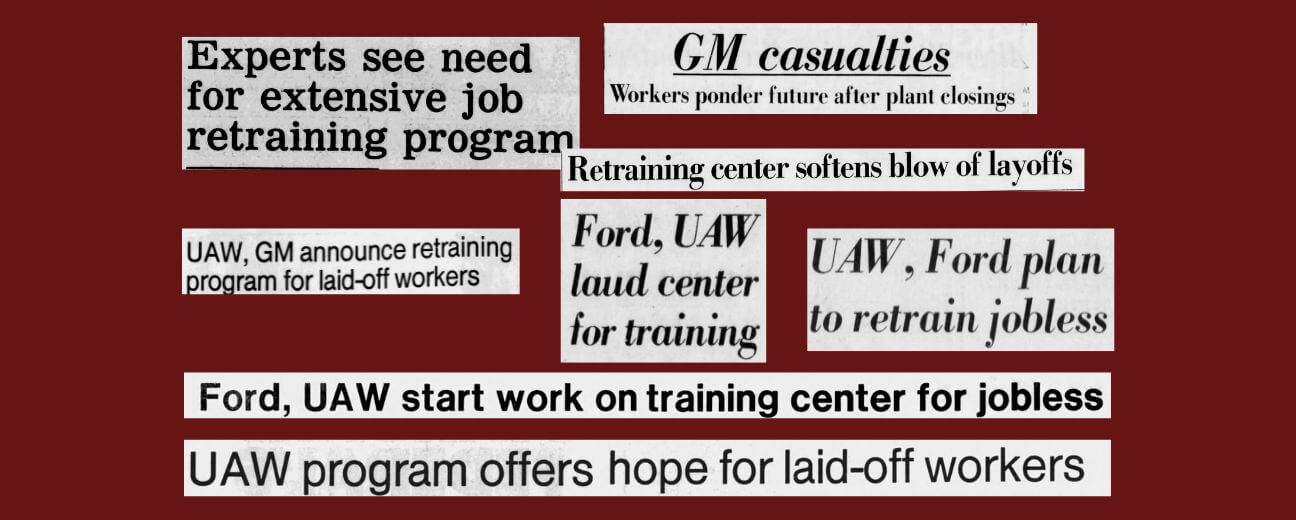
By situating these programs and their animating ideology at the center of the deindustrialization story, I also hope to make the case that the history of job training itself is deserving of more scholarly attention. Among historians, job training has long been viewed as a modest and inconsequential policy apparatus, with a lifespan roughly coterminous with the rise and fall of the War on Poverty. But the idea that unemployed workers need only acquire new skills in order to be reabsorbed into the labor market enchanted policymakers, academics, business executives, labor officials, and educators for much of the twentieth and twenty-first centuries. It conditioned the parameters of public debate, for example, over automation in the 1950s and 1960s, welfare reform in the 1970s, plant closures in the 1980s, and “globalization” in the 1990s and early 2000s.
In its latest instantiation, retraining has been cast by the likes of Google and OpenAI as a life raft for workers navigating the generative AI-induced churn in the labor market. The voices and protagonists may be new, but the message sounds familiar: economic dislocation is inevitable, and the best that workers can do is to upskill in the hopes of keeping up with an ever-changing pattern of labor demand. Breaking the grip that the “job training ideology” (to borrow a phrase from Gordon Lafer’s excellent book on the subject) continues to exert on economic and social policymaking requires, I think, a better understanding of its intellectual foundations as well as its reproduction across time and in different contexts.