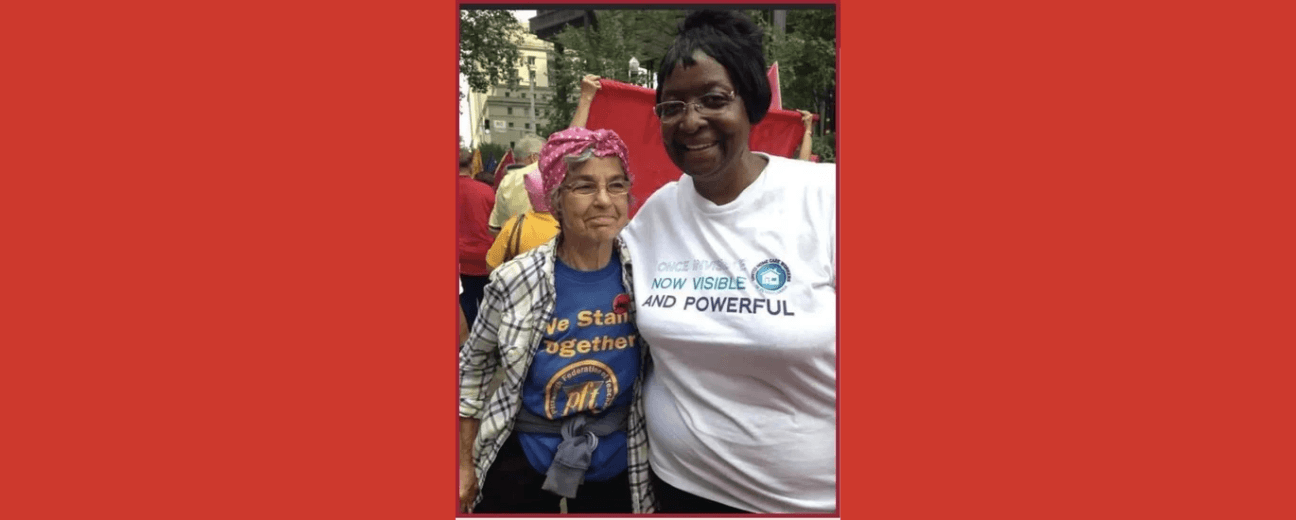
Kathy M. Newman serves as the Arts and Media editor for Labor. She recently interviewed Jessie B. Ramey, her friend and fellow LAWCHA member, about her efforts to chronicle the life and activism of Kipp Dawson. Dawson, now 81, has been at the forefront of multiple social justice movements over the course of her life, from the civil rights movement, to the anti-war movement, to the labor movement, to the gay liberation movement, to the education justice movement—which is where Dawson met both Ramey and Newman. Newman queried Ramey about her current campaign to raise enough money to publish a graphic biography of Dawson’s life.
When did you first meet Kipp Dawson and when did you realize that her story was one that needed to be told?
I met Kipp in 2006 when my oldest child started Kindergarten in the Pittsburgh public school where she was teaching middle school. She was one of the teachers who would work fifteen hour days to attend our monthly Parent/Teacher Organization meetings. I really got to know her a few years later when Pennsylvania’s tea party governor slashed a billion dollars from public schools and teachers and parents started organizing together.
As I heard more of her stories, I started to learn how remarkable her life has been: Kipp spent a month in jail when she was twenty-one for her six arrests during the civil rights sit-ins, mined coal underground for thirteen years, and faced machine-gun toting death squads in El Salvador. She helped to organize the Women’s Strike for Equality in Betty Friedan’s living room and some of the early Pride Day events after Stonewall. But her stories were never about herself.Kipp always talked to me about the other people she was in solidarity with, and especially about the leadership of Black women.
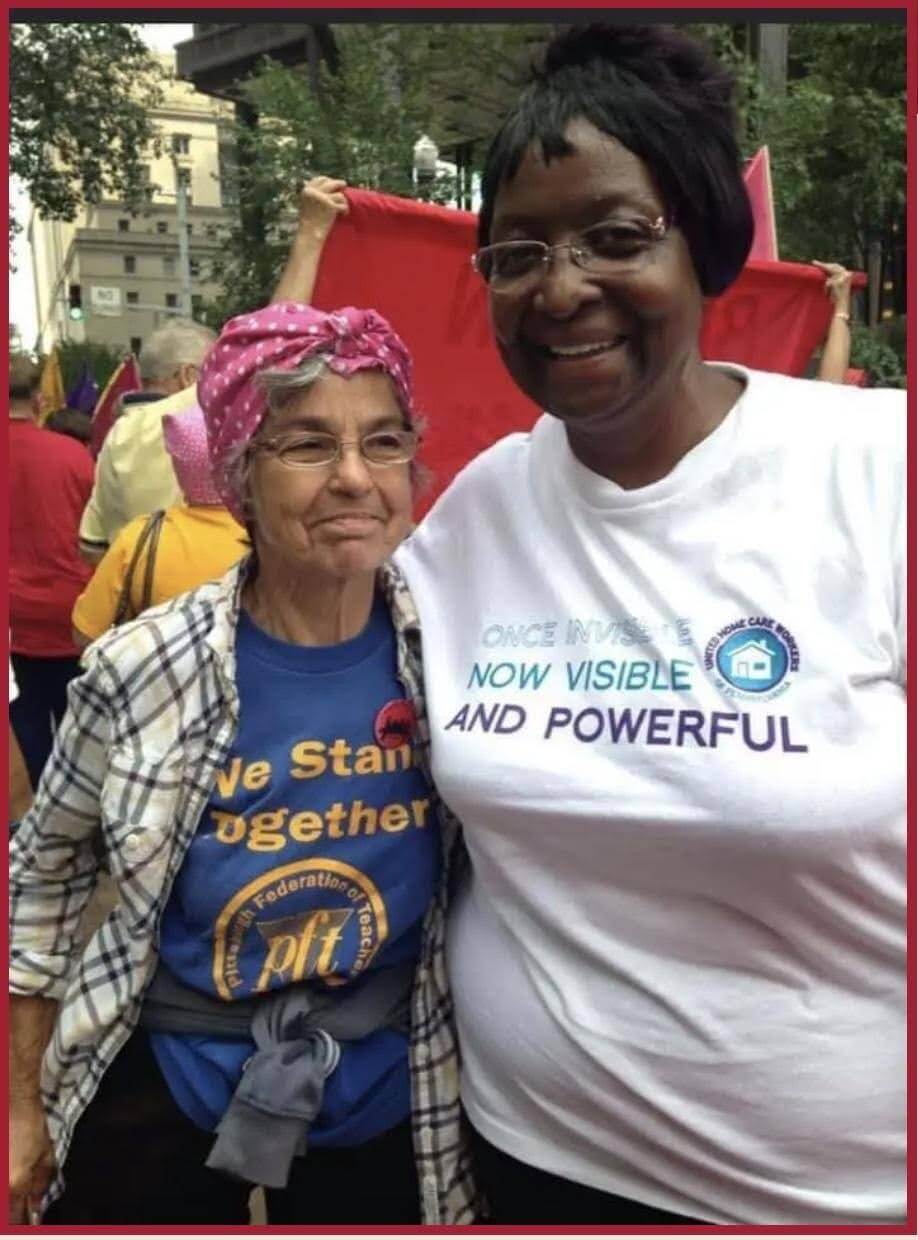
Kipp regularly speaks with my students at Chatham University and they are deeply inspired by her work. Young people are especially curious about Kipp’s particular brand of feminist/socialist/labor organizing. Her stories offer a much needed antidote to their despair. Her stories about her own struggles also serve as a weapon of memory, helping to preserve our collective, inherited legacy of the long freedom movement. Stories like Kipp’s are essential right now, as global authoritarianism tries to erase that shared history of resistance and possibility.
You’ve been working on various aspects of the Kipp Dawson project for many years. When did you first envision a graphic biography of her, and why?
Back in 2019, the Holocaust Center of Pittsburgh asked me to write a short introduction for a volume about women survivors in their graphic novel series, “Chutz-Pow! Superheroes of the Holocaust.” I was so moved by the way that artists and authors were using graphic narrative to tell this history. Of course, historians and comic artists had been using the medium beautifully and effectively for some time to engage with broader audiences. But that project served as my entry point.
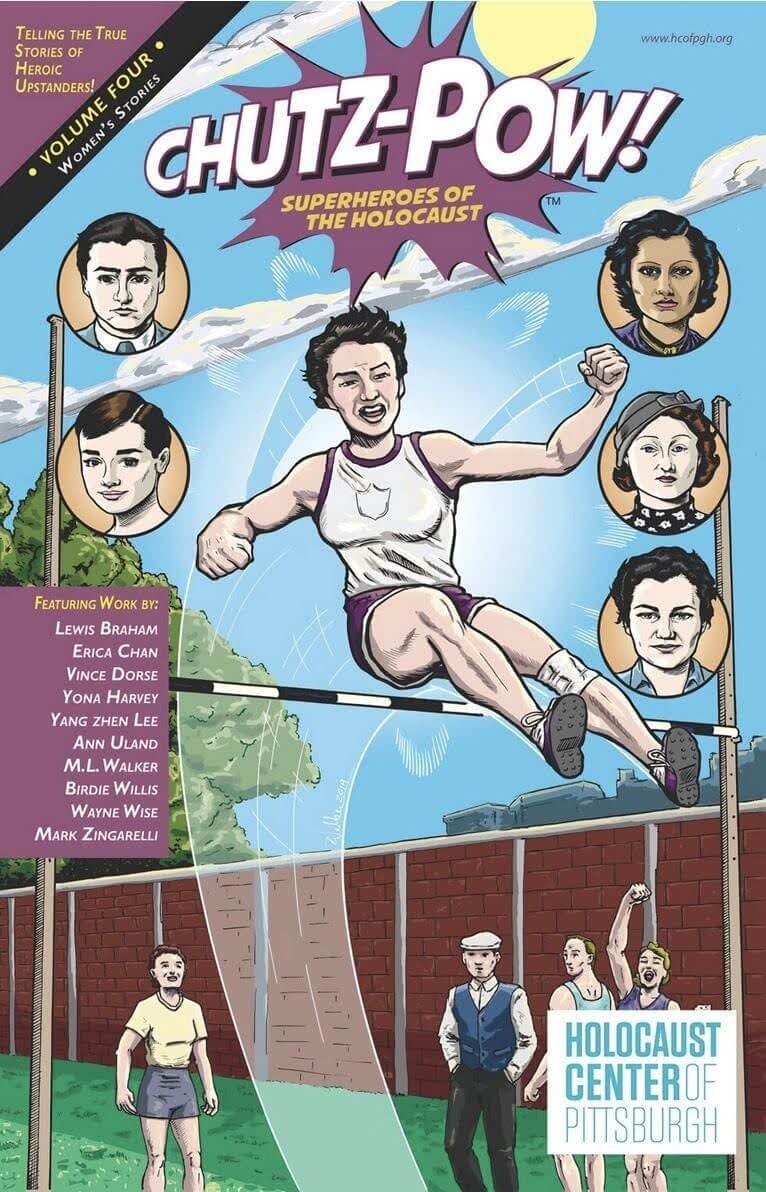
I remember telling Kipp that someone should represent her story as a graphic novel. Her response was basically, “no way.” She did not want to be put in a metaphorical cape or up on a pedestal and treated like a superhero, since she has always seen her movement work as collaborative, community building, and in solidarity with others. Eventually I think I convinced her it could be a great way to share some of the stories from the freedom struggle that she loved to tell her middle school students. It also dawned on me that I would probably have to try to write it.
You’ve written a more traditional biography of Kipp Dawson. Or is it? Tell me about that book and what’s happening with it.
I realized fairly quickly that I wasn’t going to be able to write a graphic version of Kipp’s life until I knew far more about her and all of the movements she worked in. Graphic prose is incredibly concise, almost like poetry. Before I could imagine writing something like that, I had to go much deeper into the stories that Kipp had been telling me during the years we worked together in the education justice movement. I never had the intention of writing a full biography, which was frankly an overwhelming thought, but by then COVID had hit and Kipp and I were talking regularly on zoom. She would hold up to the camera and show me these incredible things she was finding in her house – posters from the Vietnam antiwar movement, letters, photographs – and you know how excited historians get about boxes of old documents!
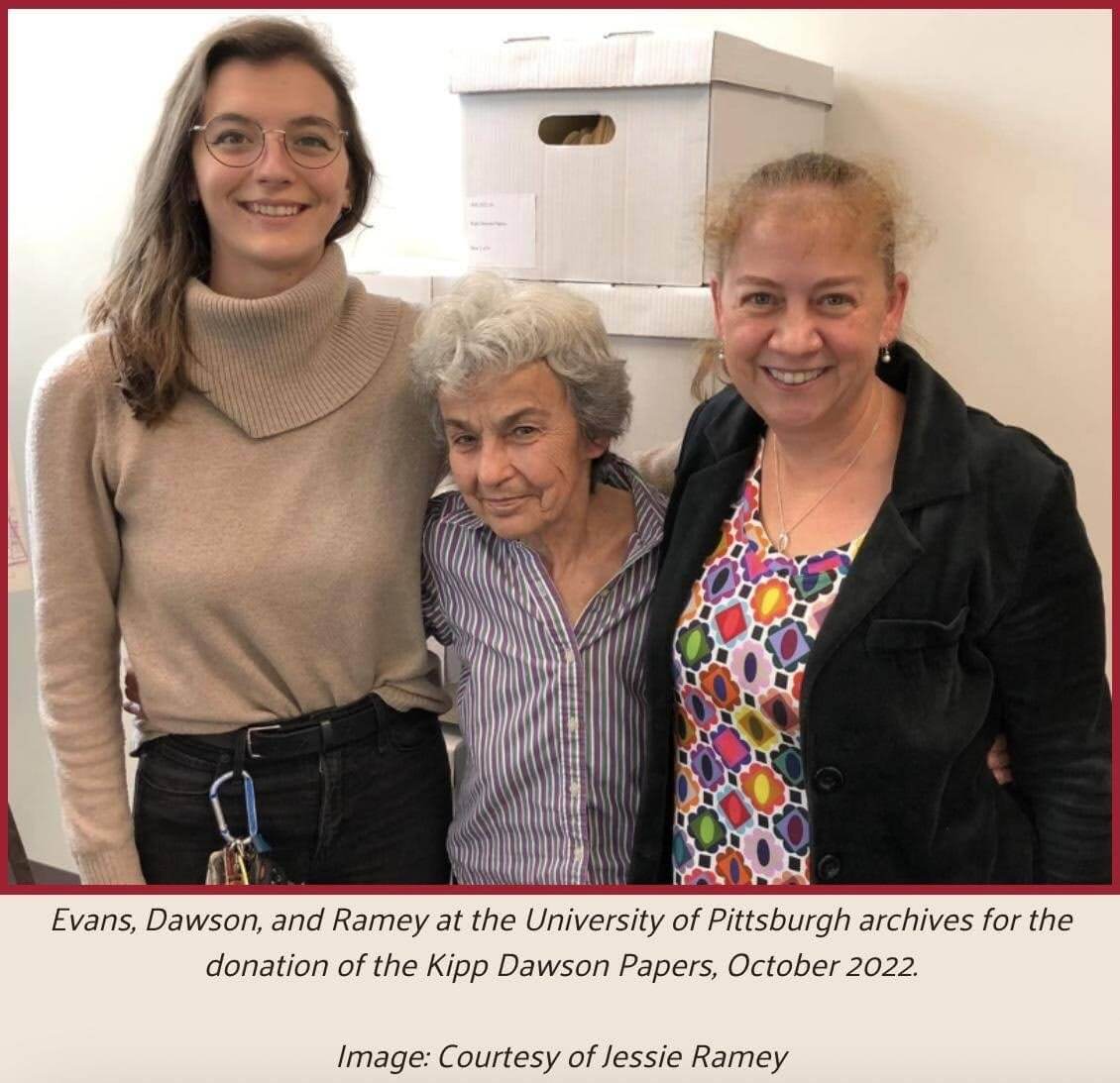
Kipp wanted to transfer her enormous personal collection to an archive, so we recruited Catherine Evans, a PhD student at CMU, who worked tirelessly to organize what is now the Kipp M. Dawson Papers at the University of Pittsburgh. At the same time, Kipp and her coal-mining sisters reached out to Jessie Wilkerson, a Senior Associate Editor of LABOR, who, in conjunction with her students, has been collecting the stories of some of the first women in the mines for the Women Miners Oral History Project at West Virginia University. For that project, I interviewed Kipp every week or so for the better part of two years. The biography, which is under contract with University of Illinois Press, uses the Pitt archive, and the Women Miners Oral History Project, along with other archival material and dozens of additional interviews that I did with Kipp, her family, her friends, and her colleagues.
While it’s a scholarly biography, the book is intended for a cross-over audience, and is really more of an intimate view of the long freedom movement told through Kipp’s engagement with global liberation struggles across seventy years. It also borrows a technique from ethnography and literary journalism, placing quotations from the oral histories in italics and removing some of the typical punctuation marks. This allows me to visually pass the narration back and forth between myself as the historian and the oral history narrators.
Tell me about the title of the project: The Struggle is the Victory. What does it mean?
This is a marvelous quote from Kipp. During one of our interviews we were talking about the many, and sometimes surprising, victories in the long freedom movement, but also the devastating setbacks. Rather than tallying up the wins and losses, Kipp explained that the real victory is in the struggle itself, by working together and helping others to join the struggle. Or as Kipp’s friend and coal mining sister, Libby Lindsay, told me, if you don’t fight, you’ve already lost.
When you decided you wanted to publish a graphic biography, where did you go to learn about the process?
While I have written in many different mediums, this one was completely new to me. I did not grow up with comic books or graphic novels (other than Maus and Sandman, which were required reading in our college circles in the 1980s). So the first thing I did was to read a bunch of graphic non-fiction, especially biographical work inspired by historians. I studied the story-telling techniques, narrative styles, and artwork and tried to figure out what I liked and why. I also found a number of blogs and helpful advice on-line from artists who work and teach in the medium so I could start to learn the vocabulary to describe what I was seeing.
I told myself what we tell our students: that new things are hard at first, but we get better with practice. I gave myself permission to be terrible at the beginning, which was liberating and also pretty scary. Truly, the most useful preparation I had was my theater background. I produced an improv company in the 1990s and those lessons applied directly to the storytelling: show, don’t tell. No talking heads. Start in the middle of the action.
What is the typical life cycle for a work of graphic history/graphic nonfiction? What do authors usually do first? How do authors find a suitable graphic illustrator?
What I learned is that scholars do not typically write their own graphic narratives! A number of people whom I deeply respect advised me against it. We are usually too close to our own work and generally not very good at this kind of storytelling. Historians love to explain everything with lots of sentences and context and nuance.
Most often in graphic history, an artist will adapt a piece of scholarship and do both the writing and the art. Sometimes, an author will write the script based on available historical evidence and then find an artist to collaborate with. And it can take some trial and error to find compatible partners.
How do illustrators make enough money to live? Why don’t publishers pay for the artist’s work?
The short answer is “capitalism.” Artists are still far too often expected to make art because they have a passion for it, and are rarely compensated fairly for their labor. An artist who decides to write and draw a graphic novel might work for years before seeing any financial returns from book sales. In the world of small, independent, and radical presses who are publishing much of the graphic history right now, projects are expected to arrive fully funded and even partially completed! These publishers are operating on narrow margins and rarely pay an advance. Graphic novels can be expensive to produce and offer riskier returns for some publishing houses than traditional books. For authors who are collaborating with an artist on a book, and it is true in our case, they have to pay for the art up front.
What are some of your favorite works of graphic non-fiction, and what makes them special?
I teach Wake: The Hidden History of Women-Led Slave Revolts by historian Rebecca Hall and artist Hugo Martinez. It’s an absolutely stunning piece of history and my students get so much out of it (and it introduces concepts like epistemology and historiography). The March trilogy about John Lewis is also beautifully done by Andrew Aydin and Nate Powell. Marcus Rediker’s tremendous scholarship combined with the powerful art of David Lester is truly exciting and helping to transform the field, including: Prophet Against Slavery: Benjamin Lay, a Graphic Novel; Under the Banner of King Death: Pirates of the Atlantic; Revolution by Fire: New York’s Afro-Irish Uprising of 1741; and The Black Schooner: Rebellion on the Amistad. Of course, the eminent historian of the American Left, Paul Buhle, helped to pioneer graphic non-fiction and has collaborated on over two dozen titles. He brought the artist Summer McClinton and editor Raymond Tyler to our current project. Together they most recently published the terrific Black Coal and Red Bandanas: An Illustrated History of the West Virginia Mine Wars.
I’m curious about the artist. Can you tell me more about her?
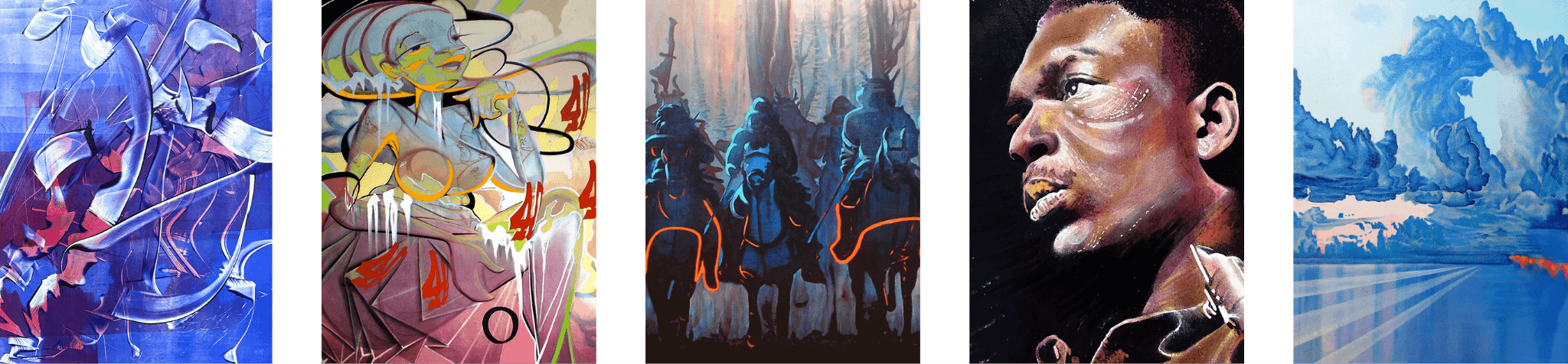
Summer McClinton has illustrated thirteen books including Harvey Pekar’s Huntington, West Virginia “On the Fly,” the Xeric Award-winning Thread, and Michael Demon’s Masks of Anarchy. Most recently she drew Black Coal & Red Bandanas: An Illustrated History of the West Virginia Mine Wars (with author Raymond Tyler) and Partisans: Anti-Fascist Resistance (with Sander Feinberg). Based in the Bronx, her early works were influenced by her participation in the turn of the century NYC graffiti scene. She holds a BFA from the University of Wisconsin-Madison where she also earned a BA in Political Science.
Where can we learn more about the project?
This project is truly a community effort, just like Kipp’s movement work. The struggle is the victory, always, and in this case we’re struggling to raise $27,000 so that we can pay the artist and get this graphic biography into the world! Will you help us?
https://kippdawson.betterworld.org/campaigns/struggle-victory