
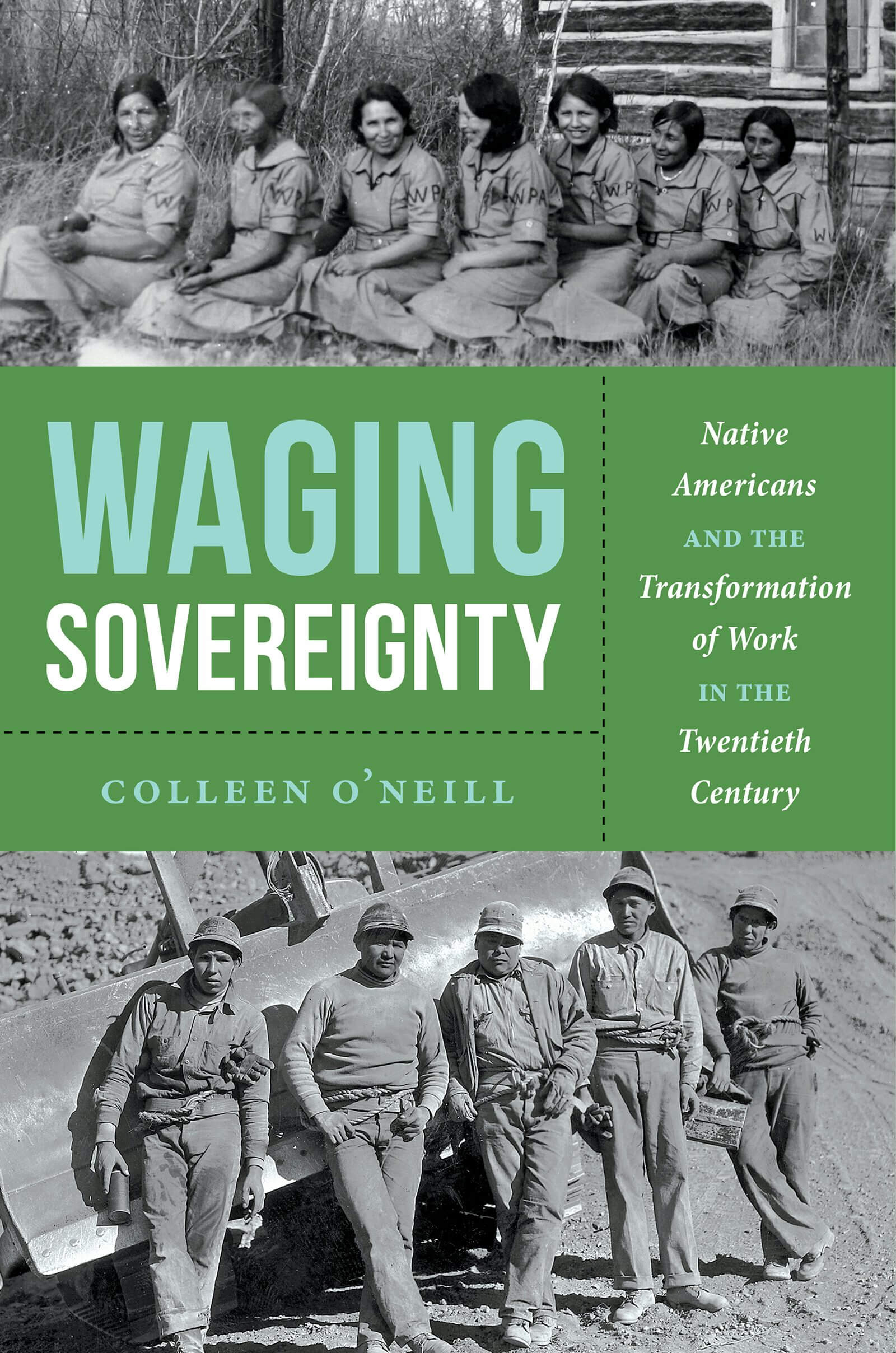
In Waging Sovereignty: Native Americans and the Transformation of Work in the Twentieth Century, historian Colleen O’Neill examines the rise of wage work as a critical arena of conflict over Native American sovereignty and assimilation. Using federal archives as well as Native memoirs and oral histories, O’Neill shows how federal policymakers sought to impose new systems of employment designed to erase traditional seasonal employment and lifestyle patterns, while labor became increasingly central to the anti-colonial struggles of indigenous peoples in the US. Historian Liza Black interviewed O’Neill about her book.
Your book contrasts sovereignty rights with civil rights. How has the settler colonial economy shaped Native relationships with mainstream labor unions, but also with industries like energy, construction, and casino gaming?
Non-Native workers of color have pursued civil rights unionism, seeking to transform unions into broader social movements that demand justice beyond the workplace within U.S. civil society. Native workers too have battled hiring and workplace related discrimination. But Indigenous peoples in the United States have also contended with a legacy of colonial policies, particularly around resource extraction, that have weakened their economies and fundamentally undermined Native land use and collective wealth.
For Native workers, gaining meaningful control over labor conditions has been inseparable from struggles over land and resources. Because extractive industries derive their wealth directly from Indigenous lands, workplace power is closely linked to sovereignty over those lands. As a result, Native workers are often positioned between multiple forces: labor unions protecting the rights of non-Native workers, corporate employers, and federal Indian policy.
These dynamics become even more complex in the context of tribal gaming. Casino industries are owned and operated by tribal nations, which fundamentally alters the relationship between workers and management. Profits from gaming enterprises are often redistributed to support tribal governance, social services, education, and community welfare. This distinguishes them from off-reservation corporations, where profits primarily benefit private owners or shareholders.
Consequently, labor struggles in tribal gaming raise difficult questions about sovereignty, governance, and economic development. Workers may find themselves negotiating not only with employers, but with tribal leadership, complicating traditional models of labor organizing. Unions, whose members draw their rights to organize from federal labor law, have been reluctant to concede that power to tribal governments, over which they enjoy little political authority. As a result, organizing casinos sometimes aggravates racial tensions between Native and non-Native workers, tribal governments and their surrounding communities.
Despite these challenges, some unions have made meaningful progress in addressing Native workers’ concerns. Organizations such as the Carpenters Union, the Laborers’ International Union, the United Mine Workers, and Communication Workers have, at times, demonstrated a willingness to engage with tribal governments and respect the unique political status of Native nations. These efforts suggest that while tensions remain, there is potential for more collaborative and sovereignty-conscious approaches to labor organizing in Indian Country.
Waging Sovereignty also traces the Tribal Employment Rights Ordinance (TERO) movement. How has TERO changed the struggle for sovereignty rights? What tensions has it created between tribal labor sovereignty and the right of non-Native casino workers to organize?
The movement that established the Tribal Employment Rights Ordinance (TERO) transformed prevailing definitions of sovereignty. Rather than limiting sovereignty to Native control over land, governance, culture, and economies, TERO activists asserted sovereignty as the power to control the workplace itself. In doing so, they confronted corporations, federal bureaucracies, and labor unions that had long controlled access to jobs and working conditions on reservation-based projects—especially in the energy industries, where non-Native workers dominated the workforce.
Waging Sovereignty extends this argument to Native American casinos in the late twentieth century. The growth of tribal casinos near major urban areas has, in many cases, strengthened tribal sovereignty by providing tribes with unprecedented sources of capital. As a result, some tribes have diversified their economies, expanded infrastructure, and increased their political influence at both the state and national levels. These developments have improved opportunities for Native workers while strengthening tribal economies more broadly.
At the same time, tensions between Native and non-Native workers have emerged over the source of labor rights and organizing authority. Non-Native workers and their unions generally understand the right to organize as guaranteed under federal labor law. Native casino workers also possess those protections, yet tribal governments have insisted on their sovereign authority to establish and regulate their own labor laws. In this sense, Native and non-Native workers occupy different relationships to the means of production. Native workers—particularly members of tribes that own and operate casinos—may receive benefits unavailable to non-Native workers, including hiring and shift preferences and, in some cases, per capita payments. During contentious union campaigns, these differences can intensify workplace conflict.
Despite these tensions, many Native workers have organized unions on tribal lands. Native activists, including members of the Council for Tribal Employment Rights, forged alliances with unions that supported Native training programs and expanded access to jobs on and off reservation worksites. In the Navajo Nation, for example, workers partnered with the Laborers’ International Union to organize Indian Health Service employees, and more recently, the United Mine Workers successfully secured union recognition for Navajo Nation employees.
Your book addresses the gendered nature of work. How did this gendered division of relief work shape the long-term economic marginalization of Indigenous women? How are Native women today reclaiming control over work and sovereignty?
The gendered division of labor in relief work was part of a broader system of settler colonial exploitation that reshaped Native economies and disrupted matrilineal structures that had historically afforded Native women significant authority. As a result, Native women remain among the most marginalized workers in the United States. Although conditions vary across communities, Native women experience some of the widest pay gaps, along with disproportionately high rates of unemployment, poverty, and violence.
Despite these structural inequalities, Native women have been at the forefront of activism addressing the gendered violence associated with extractive industries. They have played leading roles in movements such as the Tribal Employment Rights Office (TERO) campaigns and sovereignty struggles including Standing Rock, Idle No More, efforts to protect Bears Ears and raising awareness to the problem of Missing and Murdered Indigenous Women.
In these contexts, Native women’s activism operates at the intersection of economic development and environmental protection. They have worked to defend land, wildlife, fisheries, and the water that sustain their communities, while also asserting their place within reservation-based economies, including extractive sectors. Their leadership highlights the deep interconnections among labor, sovereignty, environmental justice, and gender in contemporary Native communities.
What do labor scholars and activists miss when they assume that “more federal protection” is always the answer for Native working people? What might non-Native labor movements learn from the Council for Tribal Employment Right’s model of workplace protection rooted in Indigenous sovereignty?
The reaction of Native labor officials to civil rights attorney Jacqueline Berrien’s well‑intentioned remarks reveals a deeper disconnect: she did not understand these leaders’ perspectives or their historical experiences. Their response reflects a longstanding distrust of federal initiatives that have repeatedly been imposed on Native communities with minimal consultation. In this context, the officials were reacting not simply to her comments, but to her lack of awareness of the colonial legacies that continue to structure the relationship between American Indian nations and the federal government. That moment also vividly illustrated the limits of a civil rights–based solution for addressing Native American concerns.
The strategies developed by the Council for Tribal Employment Rights show that meaningful social change does not flow from the top down. Instead, both the central problems and the most effective solutions emerge from workers’ own historical experiences. For Native labor leaders, organizing around employment rights is inseparable from longer histories of treaty violations, land dispossession, and federal oversight. Any labor activism that ignores this context will fail to resonate in Native communities.
Over the past generation, feminist and intersectional scholarship has emphasized that working‑class activism does not always originate in the formal workplace. Workers’ gendered and cultural relationships to their communities, kin networks, and households shape how they understand themselves, their position in the broader economy, and the kinds of social change they pursue. Historians of Black workers and women workers have shown that, in some cases, turning to the federal government has been a strategic way to circumvent entrenched racial and gender barriers within labor unions. At the same time, feminist labor scholars have demonstrated how working‑class women have effectively organized social justice movements through community‑based networks rather than relying solely on unions or state institutions.
The Council for Tribal Employment Rights demonstrates, however, that unions can still be important partners when they operate within a framework that also centers tribal sovereignty. This model suggests that labor organizing, when grounded in respect for self‑determination, can complement rather than undermine Native political goals.
Taken together, the Berrien example underscores the importance of crafting solutions that account for the interplay of colonial legacies, federal power, and community‑rooted organizing traditions. Only by recognizing these dynamics can we understand how different groups of workers interpret and enact social change.