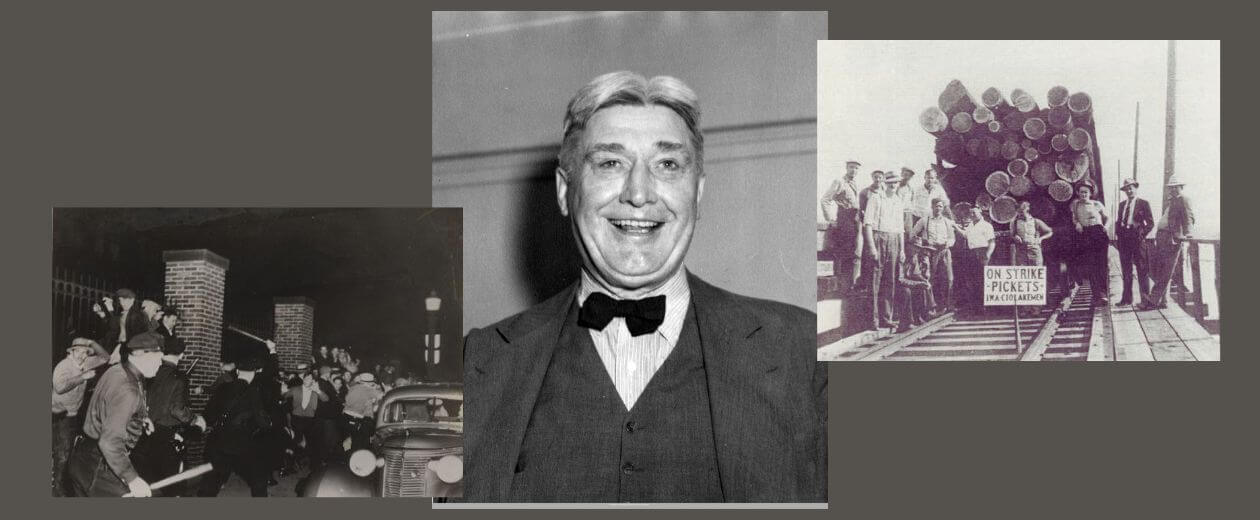
Last summer, Arizona State University professor Benjamin Y. Fong held up Adolph Germer as a model for today’s unions (“The Responsible Socialism of Adolph Germer,” Damage Issue 4: Responsibility). Germer served as the “senior field man” for the Congress of Industrial Organizations (CIO) in some of the key moments of its rise in the 1930s and 40s. For Fong, host of a Jacobin podcast series on the CIO and author of research and commentary on renewing the labor movement through new organizing, Germer was the ultimate responsible organizer—a pragmatist who delivered real wins compared to leftists indulged in “childish,” “disgruntled,” and “irresponsible” behavior.
There’s just one problem: Fong’s own source material, the work of Lorin Lee Cary, tells a different story.
Fong wants today’s unions to wage “strategic disruption” in the spirit of the CIO in order to organize the giants of the 21st-century economy. But Germer—his model mentor—spent his career in the CIO doing the opposite. He didn’t facilitate strategic disruption. He contained it.
Germer’s Way
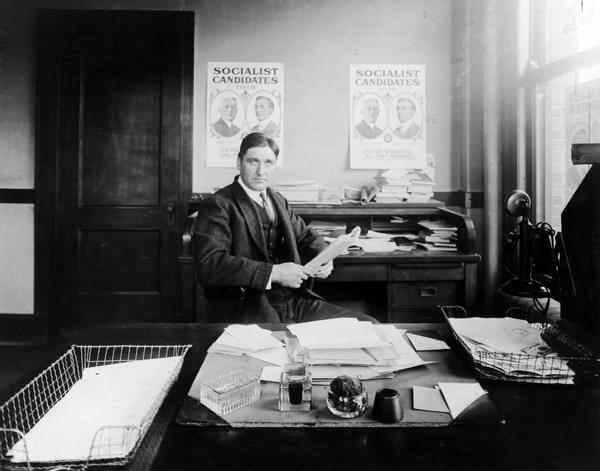
Historian Lorin Lee Cary documented Germer’s actual approach. According to Cary, Germer believed the CIO faced two primary challenges to building “effective trade unionism” — rank and file militancy and ideological factionalism (Cary, iii). Germer’s solution to the first was a preference for appealing to and mastering legal proceduralism. Cary shows this preference for proceduralism was honed during Germer’s days in the United Mine Workers of America (UMWA), where Germer embraced “contract sanctity” and discouraged pit level strikes prohibited by the contract. Germer counseled UMWA members to “wait until their existing contract expired…” as “this was the proper way to handle the problem, for then the whole district could ‘strike, and strike together, against the common enemy’” (Cary, 18). His early militancy and factional battles in the UMWA and Socialist Party gave way to a firm belief Germer developed in the collective bargaining process as an “orderly” means of settling disputes and avoiding strikes.
When the New Deal passed its first labor protections in the National Industrial Recovery Act (NIRA), Germer’s commitment to collective bargaining became married to a faith in state-backed labor rights as a method for securing labor’s goals. After a brief stint for the government investigating unfair labor practices, he declared NIRA section 7a would eliminate “much of the conflict between the man who works and the fellow who works for him” (Cary, 79). This was, at a minimum, wishful thinking given these legal protections were essentially unenforceable. Nonetheless, Germer’s new faith in the rights conferred onto labor by the New Deal dovetailed neatly with what Cary called an “institutional” orientation to union-building and collective bargaining.
The Goodyear Strike: Workers Won Despite Germer, Not Because of Him
Fong credited Germer’s institutional experience and orientation for winning the CIO’s first major strike—the 1936 walkout at the Goodyear Tire & Rubber Company in Akron, Ohio. The story of Germer’s role there is supposed to prove that responsible leadership trumps radical disruption.
Except that’s not what happened.
When Germer arrived in Akron, he advised union leadership to offer Goodyear a weak proposal from a federal mediator. He sought to make the union look reasonable, in order to build public sympathy, and hoped that Goodyear management would reject it, which they did. But he never asked the workers. When this plan was announced, workers rejected it in a mass meeting (Cary, 94). A few weeks later, Goodyear made a counteroffer. Again, Germer advised strikers to accept it. Again, they rejected his advice, chanting at the meeting, “No, no, a thousand times no, I’d rather be dead than a scab” (Cary, 95).
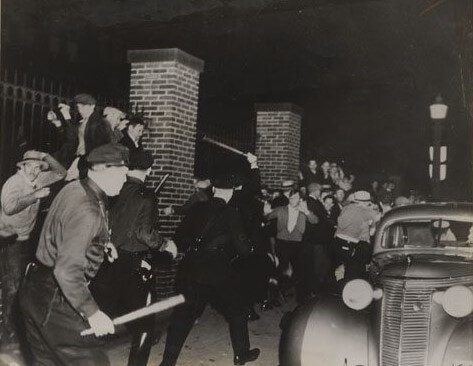
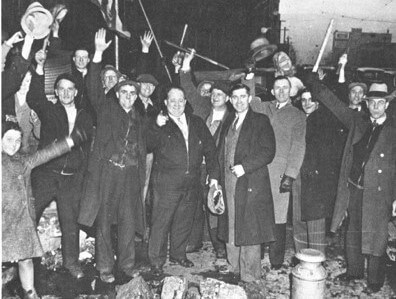
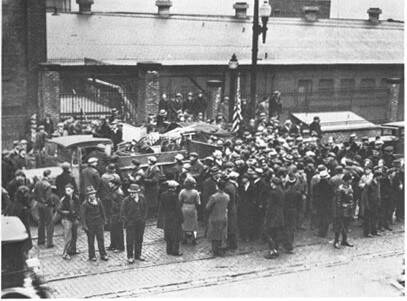
So what finally forced Goodyear to settle on terms the workers saw as a victory? Not Germer’s negotiating skills—those had already failed twice. It was the workers themselves, as Cary shows. For over a month, thousands of strikers shut down Goodyear’s production. They prevented scabs from crossing picket lines. The Akron Central Labor Council prepared for a general strike, and worked to build public support (Cary, 94). That’s what brought Goodyear to the table. Does Fong really believe this pressure from below played less of a role in winning the strike than Germer’s negotiating skills, which had already failed twice before the final settlement was reached?
Fong suggests that leftists who accused Germer of “constraining militancy” in Akron were engaged in “counterfactual fantasizing.” But we might wonder, what if Goodyear had not rejected the federal mediator’s proposal? Germer’s tactic would have signed the union’s name to an offer rejected by their own members. Wouldn’t that have weakened the trust between the fledgling CIO and the very workers it sought to organize? Fong argued that Germer wasn’t wrong to err on the side of caution given Goodyear President Paul Litchfield’s brutal repression of an earlier strike in 1913 and argues, without any supporting evidence, that the “strategic and tactical know-how” of Germer and other CIO leaders secured the eventual winning settlement. But this narrative discounts the pressure applied on the company by the workers and their allies.
And here’s another dimension of the strike that Fong completely ignores: before Germer arrived, the rubber workers invented the sit-down strike—the tactic that turned the CIO into a juggernaut. Instead of just picketing outside, they occupied key departments to stop production from within. This gave the workers a tactical advantage over the company they didn’t hold in previous struggles like the failed 1913 strike Fong cites to affirm Germer’s caution. A year later, auto workers copied this “strategic disruption” playbook in Flint, Michigan and forced General Motors—then the most powerful corporation in the world—to recognize their union. That sparked a national wave of sit-downs that broke open previously anti-union strongholds across multiple industries.
The post-Flint moment was the CIO’s real breakthrough. And Germer didn’t just ignore it—he actively tried to stop it.
Germer Crushed the Tactics That Actually Worked
Take what happened at Consumers Power Corporation of Michigan a short time after Akron, an example Fong ignores but Cary profiled. When the company stopped recognizing the CIO’s Utility Workers Organizing Committee (UWOC) contract, Germer stepped in and filed complaints with the National Labor Relations Board and other government bodies. Germer told workers not to strike while the legal process played out. While he won some favorable decisions, procedural victories without workers’ power to back it meant little and the company didn’t budge. Workers then ignored Germer and initiated sit-down strikes that “tied up major centers…” and “ultimately forced Consumers Power to reinstate the contract as it had existed…and to improve the grievance procedure” (Cary, 119).
It is not surprising that the real sources of the CIO’s “strategic disruption”—rank and file militancy—terrified the strike-averse Germer. What is curious, however, is that Fong has recognized elsewhere the limits of the law and traditional collective bargaining approaches when facing the likes of Amazon, Walmart and FedEx. He has written about finding “chokepoints” in today’s workplaces—weak spots workers can exploit against these giants of our economy. But in his treatment of Germer, Fong seems determined to defend, in Cary’s words, Germer’s “preoccupation with well-regulated procedure” (Cary, 118) and erase the successful examples of “strategic disruption,” like the utility workers who, in defiance of Germer, identified where the company was vulnerable and struck there to win their demands.
The Communist Purge: Ideology Over Organizing
In addition to rank and file militancy, the other challenge Germer believed he faced as a CIO organizer was ideological factionalism. Cary’s work demonstrates that for Germer, this problem often reduced to dealing with Communists in the CIO. Fong celebrates how Germer helped purge the “Moscow-liners” from the CIO who were “out of step with the rank and file.” The problem? Germer’s anti-Communist efforts had little to show for it in terms of concrete results for workers and, in fact, weakened the labor movement as a whole.
Fong’s prime example is Germer’s stewardship of the International Woodworkers of America (IWA). In Fong’s narrative, the IWA was a mess in 1940. Its Communist president, Harold Pritchett, cared more about factional politics and foreign policy debates than building the union. Then Germer swooped in, helped anti-Communist workers take over, single-handedly secured a major first contract, and drastically increased IWA membership.
Once again, Cary’s research tells a different story.
How Germer Wrecked the Woodworkers Union
When Germer arrived at the IWA, he came with rigid principles: his preference for proceduralism, extreme caution about strikes, and hardline anti-Communism. Cary noted that navigating a polarized union might have required flexibility. Germer had none.
Cary credited Germer with making initial progress on improving basic organization in the IWA. He convinced the union’s conservative opposition, principally organized in the Columbia River District, to support raising dues to fund the IWA’s organizing drives (Cary, 134). Winning rank
and file support for increasing dues for new organizing is a test of commitment, then and now. Germer told organizers they couldn’t engage in political organizing on union time—an order clearly directed at the Communist-affiliated organizers (Cary, 135). However, this policy differed little from that of Germer’s contemporary, James Matles, Director of Organization of the supposedly Communist-dominated United Electrical Workers (UE). Matles famously told UE field organizers that if they had enough time on the weekend to sell Communist Party literature, they were not doing enough to build the UE. “Who are you working for and who is paying you?” he demanded (Bonislawski, 247).
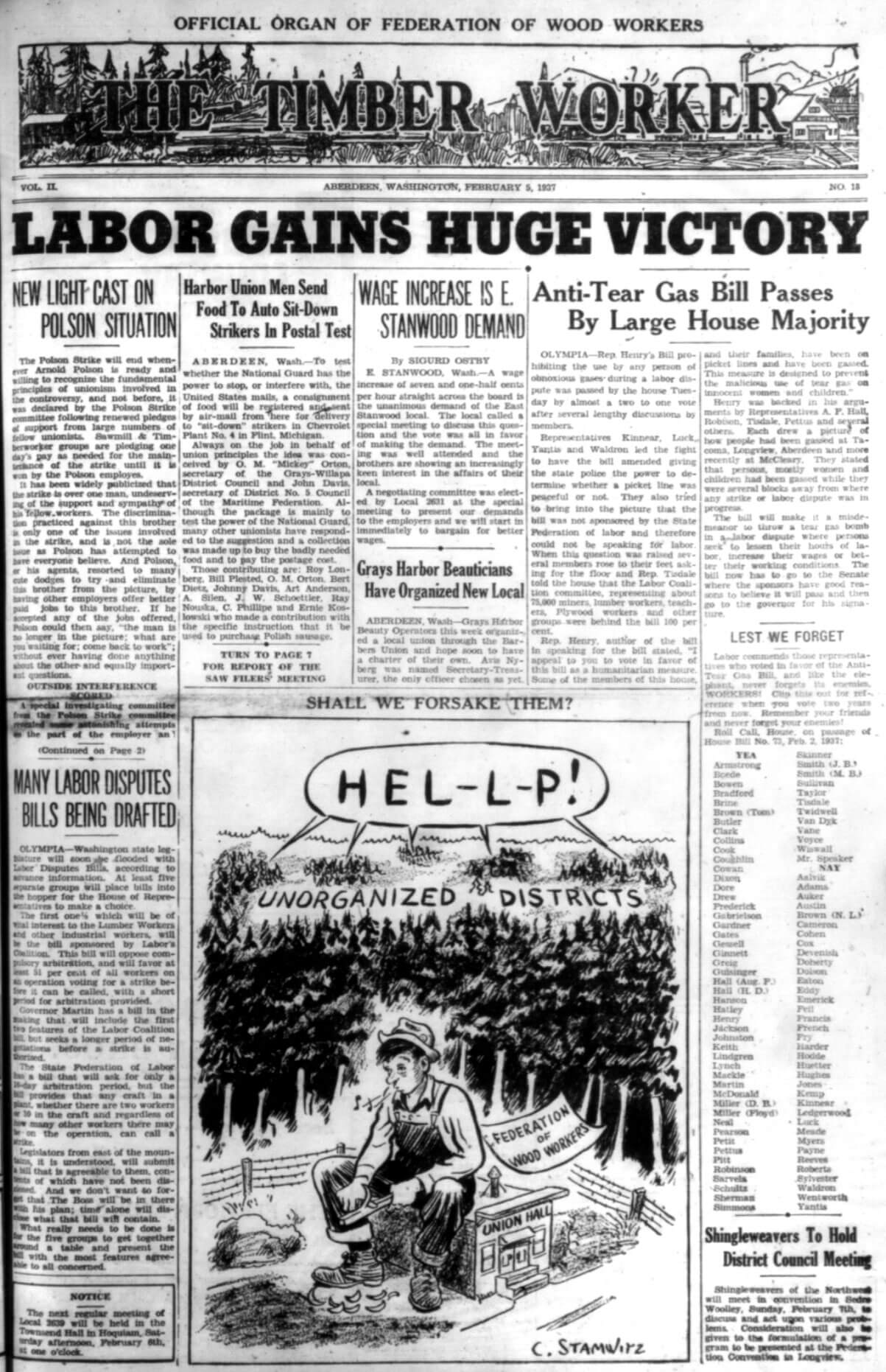
But despite these positive first steps, Germer failed to heal the factional split in the IWA and instead threw salt in its wounds. He began by constantly interfering in union matters beyond his authority over the organizing program. He pressured the IWA to drop strike threats from their bargaining approach. He demanded the Timber Worker, the IWA newspaper, stop covering foreign policy, even though political debate was central to the IWA’s culture (Cary, 133).
And Germer’s hiring practices turned political and rigid. Instead of merely restricting political involvement of his staff after they were hired, he selected organizers based on their politics, stacking his team with anti-Communists from one faction of the union. Cary documented that within months, Germer had effectively taken a side in the same factional battle he was assigned to pacify and the split within the union reached new depths by 1941 (Cary, 135).
The irony? When IWA’s leadership finally changed in 1941—a shift Fong painted as Germer’s victory—it had almost nothing to do with Germer’s efforts. After Hitler invaded the Soviet Union in 1941, Communists in the U.S. took a 180 degree turn to fully support the Roosevelt administration’s war effort. At this time, IWA’s Communist leaders abruptly adopted a unity stance in which they agreed to resolve nearly all outstanding issues on the terms of their conservative opposition (Cary, 143). It was this turn of events, as well as the charismatic Canadian Pritchett losing his visa and being forced to resign the presidency in 1940, that played the biggest role in handing the anti-Communist faction control.
Germer’s “Success” Was Actually A Spectacular Failure
What did Germer achieve with full control of the organizing department, an IWA leadership ideologically aligned with him, and the Communists self-muzzled throughout the World War II years? Some early wins in the West. Then stagnation.
The IWA’s organizing program was especially hampered in the South, which Cary chalked up to the region’s anti-union climate and its employers’ unparalleled willingness to deploy violence against union drives (Cary, 149). However, scholars like Michael Goldfield note that many CIO unions, faced with the same difficult conditions, achieved organizing success in the South, both in the core industries of coal, rubber, steel, as well as lower-margin industries like meatpacking and canneries that shared similar characteristics to woodworking (Goldfield, 208).
In fact, Goldfield charged that the IWA stood out within the CIO for its disregard of the importance of Southern organizing and sheer incompetence when it did attempt to set up organization. The IWA was gifted thousands of woodworker members who were organized “as a side effect” from CIO campaigns in other industries (Goldfield, 237). Germer made little effort to represent these new members effectively even though the Southern lumber industry at the time accounted for nearly half of the total U.S. output (Goldfield, 183).
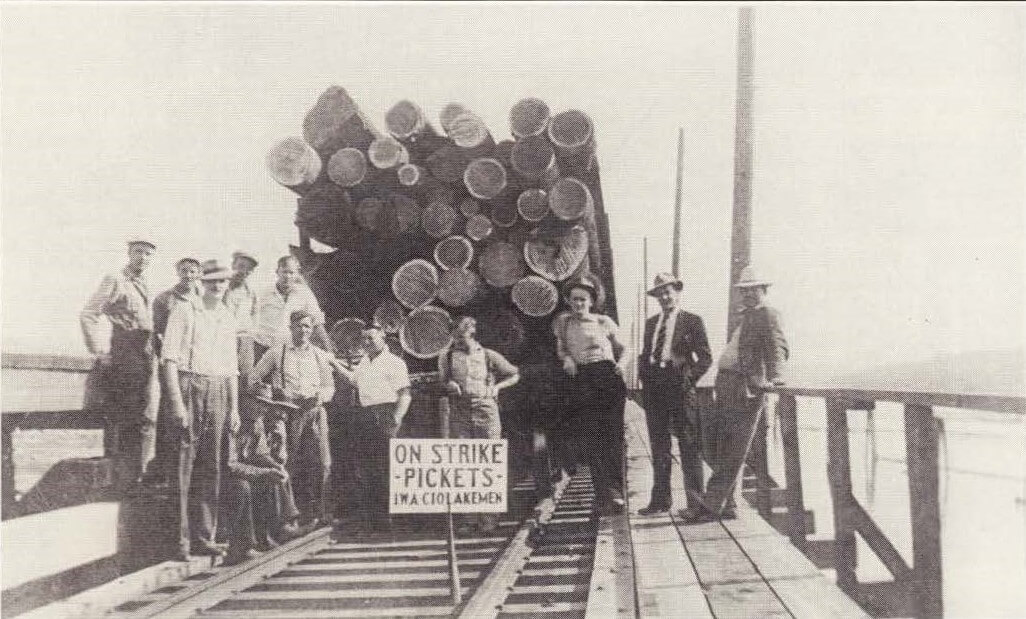
In an ironic twist, Germer, fresh off his triumph to purge Communists from the IWA, couldn’t even spare one representative for the South, and so authorized another Communist-led CIO union, the Cannery Workers (UCAPAWA), to temporarily represent new IWA shops (Goldfield, 237). When the IWA did finally staff its Southern district, Goldfield found they were “incompetent loyalists, with whom Germer was even disgusted” (Goldfield, 238) Germer was reaping the consequences of his earlier political screening that had excluded the IWA’s more capable organizers.
Cary noted that by 1949, “despite the continued expansion in the lumber industry,” IWA membership only fluctuated between 75,000 and 100,000 members (Cary, 179). Goldfield estimated the woodworking workforce at 600,000 strong nationwide (Goldfield, 181). These were unimpressive numbers compared to the rest of the CIO, in which the IWA ranked 12th out of 16 unions in total membership in 1949.
Cary lists several factors that plagued the IWA at the time: an unsteady alcoholic president, a “depleted union treasury,” disorganized staffing assignments, and serious infighting on the executive board. As Cary dryly observed, “it seemed that more than ideological factionalism determined a union’s ability to function effectively” (Cary, 179).
These problems became so pronounced that the IWA once again pleaded for Germer to take back his assignment as their Director of Organization to set things straight. He reluctantly returned, and while he made some basic improvements to their finances and staffing—procedural questions well within his wheelhouse to solve—Cary wrote that his two-year long posting did “not significantly increase IWA membership” (Cary, 180).
Confronted with this mediocre record, it is frankly astonishing that Fong celebrated Germer’s time in the IWA as a testament to building “powerful working-class organizations.”
Germer Helped Create the “Apathy” He Later Condemned
By the 1950s, Cary wrote that Germer himself decried the troubling widespread “apathy” in union members and the increasing “professionalism” among union leaders and staff (Cary, 184). Yet Germer appeared to be blind to his own role in contributing to these trends. His emphasis on what Cary called “procedural purity” may have helped stabilize the basic functioning of newly born CIO unions. But by limiting worker participation, whether through complex contractual grievance procedures or appeals to government regulation, Cary argued Germer constructed unions as institutions separate from its rank and file members (Cary, 98).
In the case of the 1936 Goodyear strike, Germer was incensed by a wave of sitdown strikes rubber workers initiated after the settlement to continue, in the words of James Gray Pope, “worker lawmaking” from the shop-floor. Though the sit-downs were effective at winning concrete concessions from management — concessions that were not achieved through traditional collective bargaining until Goodyear officially recognized the union five years later—Germer could not accept rank and file militancy expressing itself “outside the channels provided by the union” (Cary, 97).
But this conflict between rank and file militancy and building up and maintaining the institution of the union was a false choice. Other CIO unions, primarily those with left-wing leadership like the UE or Farm Equipment Workers (FE), championed tactics that involved deep rank and file participation, like short strikes in response to shop-floor grievances, and used them to force their employers to respect and fear the power of the union’s members to stop production.
However, Germer’s involvement in the successful campaign to purge Communist influence from the CIO, which Fong celebrated, also deprived it of its most dynamic affiliates, like the FE, who continued to foster this spirit of militancy responsible for the kind of “strategic disruption” Fong advocates today.
A “Final Crusade”
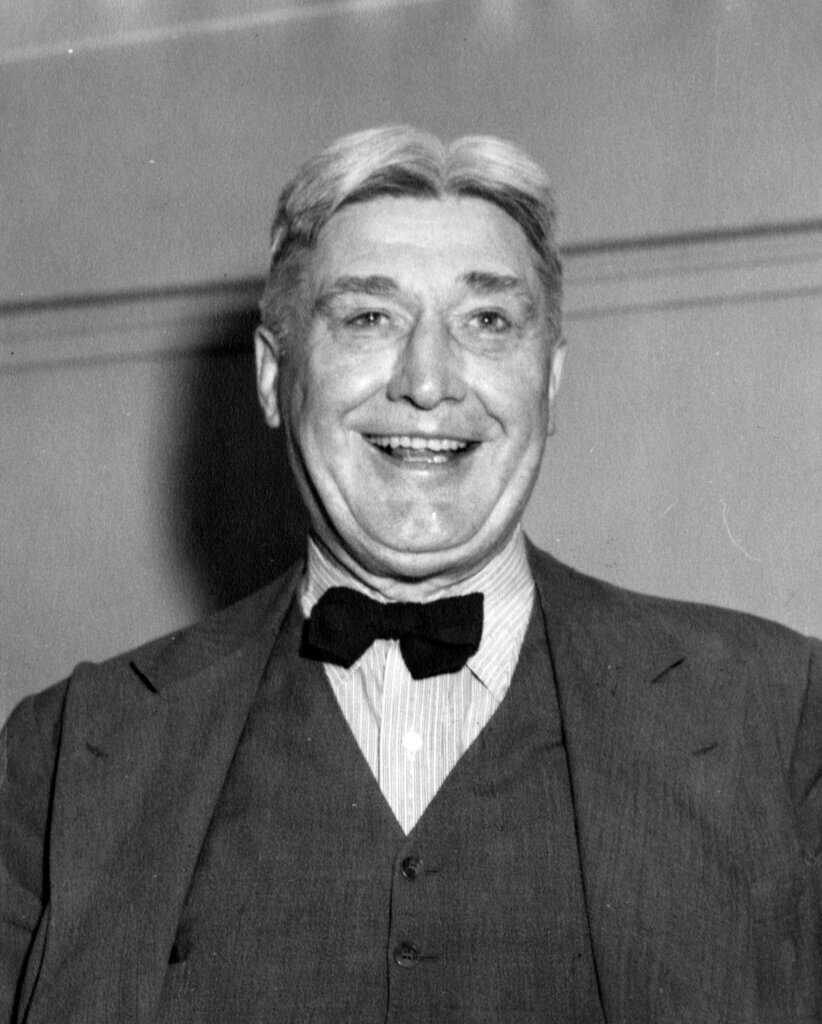
In response to the apathy and professionalism creeping into the labor movement, Cary observed that Germer returned to the strident class struggle rhetoric of his youth as an agitator in Socialist Party of America to “stir up” rank and file members in order to “revive the spirit of the early days of the CIO when everyone wanted to help” (Cary 184).
His call to action in this “final crusade”? Tell workers to vote for Democratic congressional candidates in the 1954 elections (Cary, 185).
No increased participation in their unions. Not workplace organizing. Just vote Democrat.
Cary described this as a “contradictory climax” to Germer’s CIO career. The man who “denied the existence of a class struggle and, as a labor professional, helped to generate the very apathy he was trying so hard to eradicate” couldn’t understand why workers were apathetic (Cary, 185). This isn’t just historical irony. It’s the origin story of labor’s current crisis: dependence on the Democratic Party, over-reliance on compromised labor law, and leadership who often won’t or can’t mobilize passive memberships when proceduralism fails.
The Real Lesson: Practice vs. Institution
Fong grapples with some of these problems in his other writing, yet valorizes a man whose career helped plant the seeds for these very crises labor faces today. At the same time, there is some value to Fong’s critique of historical remembrance on the labor left that can slip into romanticization of the 1930’s and indulge in “what if” fantasies about roads not taken.
Philosopher Alastair MacIntyre made a useful distinction between “practices” and “institutions” that is a helpful guide for navigating this tension. A “practice” is any “coherent and complex form of socially established cooperative human activity,” like playing chess (MacIntyre, 187).
Participants in a practice achieve “internal goods” that can only be realized within the practice
itself; in chess it may be exercising analytic skill, strategic imagination, competitive intensity. If chess is a practice, then a chess club is its corresponding “institution.” Institutions are driven by “external goods…involved in acquiring money” and “they are structured in terms of power and status” (MacIntyre, 194). As such, MacIntyre warned that the internal goods of practices are always vulnerable to corruption by the “acquisitiveness” and “competitiveness” of their institutions. This is not a moral indictment of institutions over practices, but rather a reminder that a balance that must be struck, “for no practices can survive for any length of time unsustained by institutions” (MacIntyre, 194).
Unions are both a practice and an institution. Workers fighting together for better conditions generate internal goods: they exercise cooperative strategy-making, they sharpen persuasion skills, they recognize each other’s leadership, trustworthiness, and courage through the heat of collective struggle. At the same time, unions are also an institution that solidifies the gains made through its practice — in contracts covering wages and benefits which MacIntyre would classify as external goods — but can also suppress participation in the name of organizational stability and preservation of those external goods.
Cary noted that throughout his career, Germer was “overly immersed in perfecting the institutional means of achieving…bread and butter objectives” (Cary, 113). He became blind to trade unionism’s internal goods, its existence as a practice. As such, Germer repeatedly “failed to see that rank and filers were often as interested in how the union was run, as in what and how it produced,” (Cary, 113) and that this interest in self-governance was the catalyst for the “strategic disruption” that led to the most successful worker insurgency in U.S. history.
What We Actually Need
I share Fong’s goal for labor to achieve a similar “strategic disruption” today, but in order to do so we must find a far better equilibrium between “practice” and “institution” than Germer and the CIO did.
We need to learn from the workers who practiced sit-down strikes, not celebrate the bureaucrat who tried to stop them.
We need to study the utility workers who struck at chokepoints of their employer, not Germer’s failed appeals to regulatory agencies.
We need to remember that the CIO’s most dynamic unions—the ones that grounded their tactics and strategy in rank-and-file militancy—were the left-led unions Germer helped purge.
Finally, we need to recognize labor’s renewal will take some combination of the power, resources, and experience of unions as “institutions” and the dynamism, militancy, and creativity of workers organizing as a “practice.” That quest for equilibrium and the challenges and joys that come with it is the real work ahead. In some ways, that quest itself is a practice worth pursuing.
Just don’t look to Adolph Germer as your guide along the way.
Bibliography
Bonislawski, Michael J. “Field Organizers and the United Electrical Workers: A Labor of Love, Struggle, and Commitment 1935-1960.” Ph.D. diss. Boston College, 2002.
Cary, Lorin Lee. “Adolph Germer: From Labor Agitator to Labor Professional.” Ph.D. diss. University of Wisconsin, 1969.
Fong, Benjamin Y. “The Responsible Socialism of Adolph Germer.” Damage, Issue 4: “Responsibility.” June 30, 2025.
Fong, Benjamin Y. “Strategic Disruption.” Damage. November 29, 2023. https://damagemag.com/2023/11/29/strategic-disruption/.
Fong, Benjamin Y. “We Can’t Foreclose Grubbing Analysis.” Damage. February 14, 2024. https://damagemag.com/2024/02/14/we-cant-foreclose-grubbing-analysis/.
Goldfield, Michael. “Paul Bunyan and the Frozen Logger.” In The Southern Key: Class, Race, and Radicalism in the 1930s and 1940. New York, NY: Oxford University Press, 2020.
MacIntyre, Alasdair. “The Nature of the Virtues.” Essay. In After Virtue: A Study in Moral Theory . Notre Dame, IN: University of Notre, 1981.
Molyneux, Cameron and Gregory, James. “CIO unions – Mapping locals and membership 1938-1949.” https://depts.washington.edu/moves/CIO_combined.shtml. University of Washington, Mapping America’s Social Movements Project, 2006.
Pope, James Gray. “Worker Lawmaking, Sit-Down Strikes, and the Shaping of American Industrial Relations, 1935-1958.” Law and History Review 24, no. 1 (2006): 45-113.