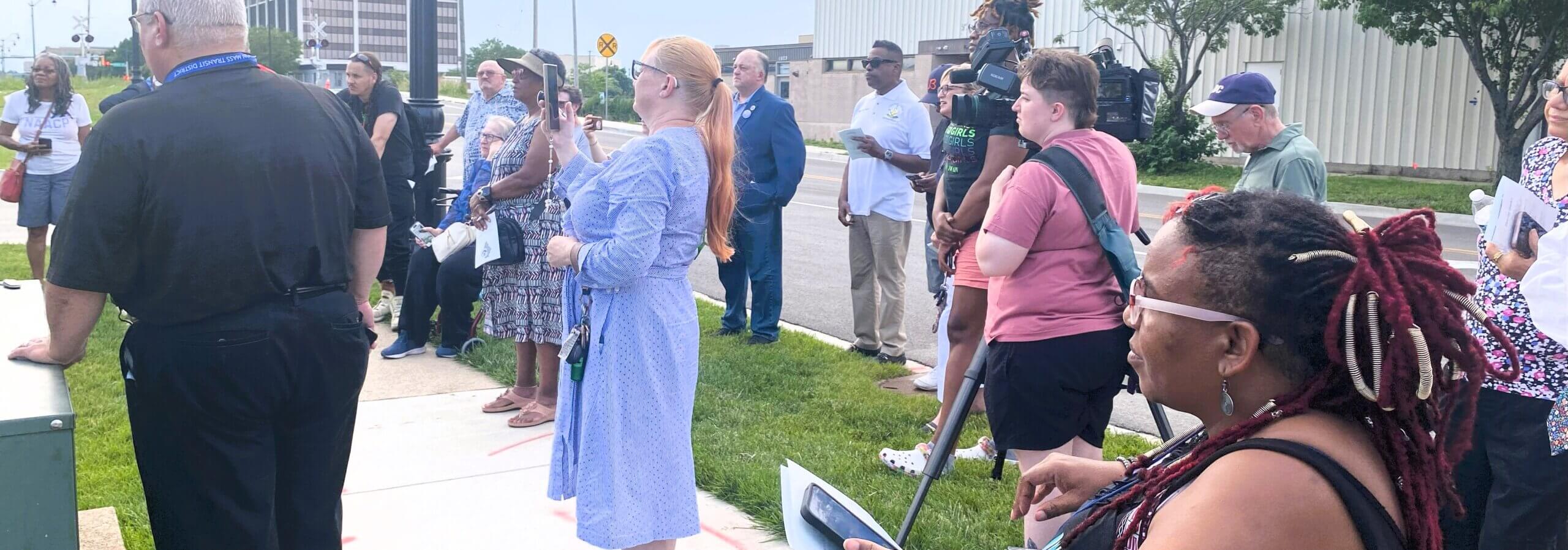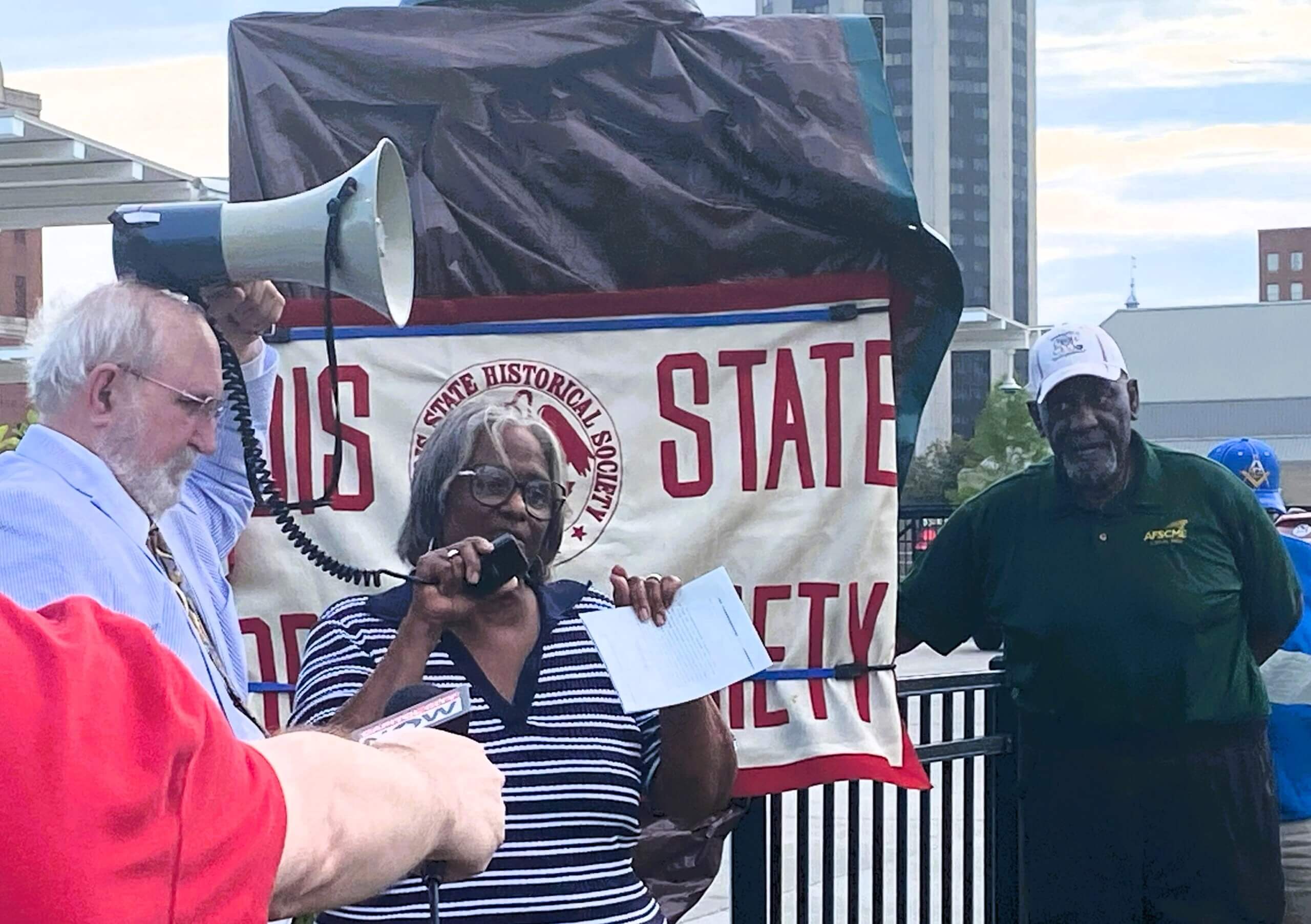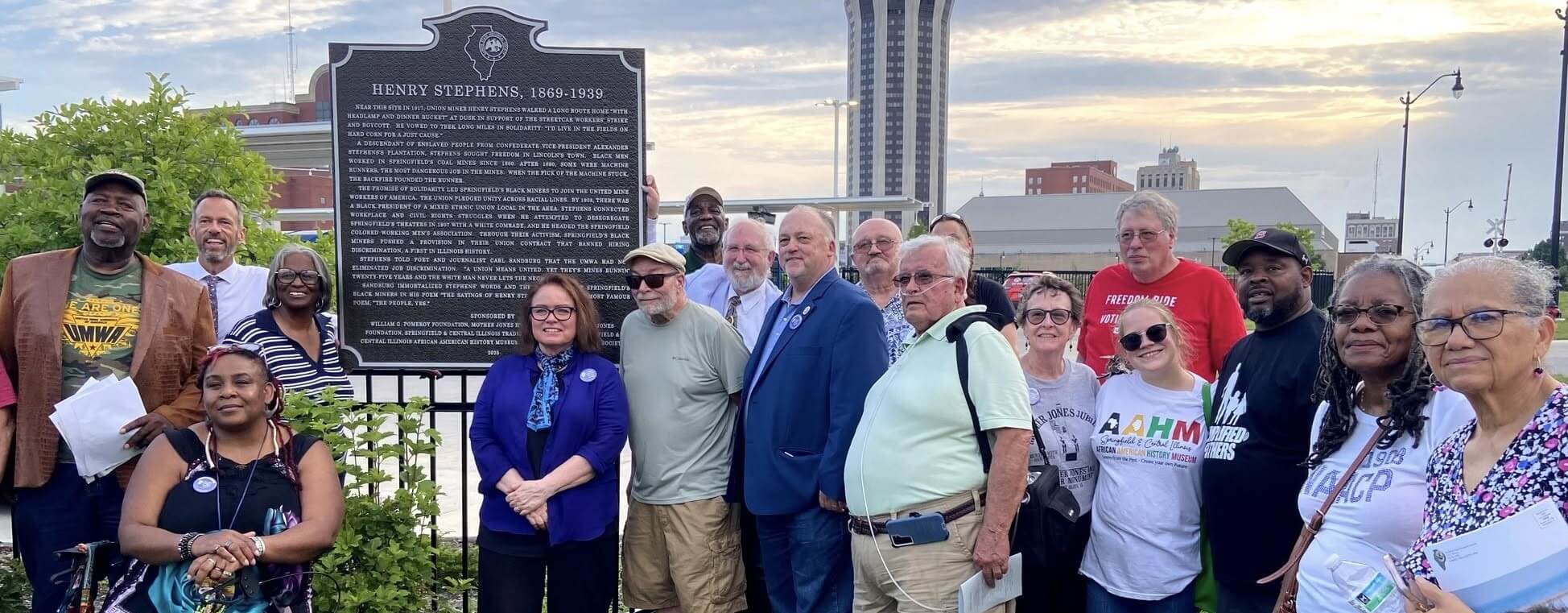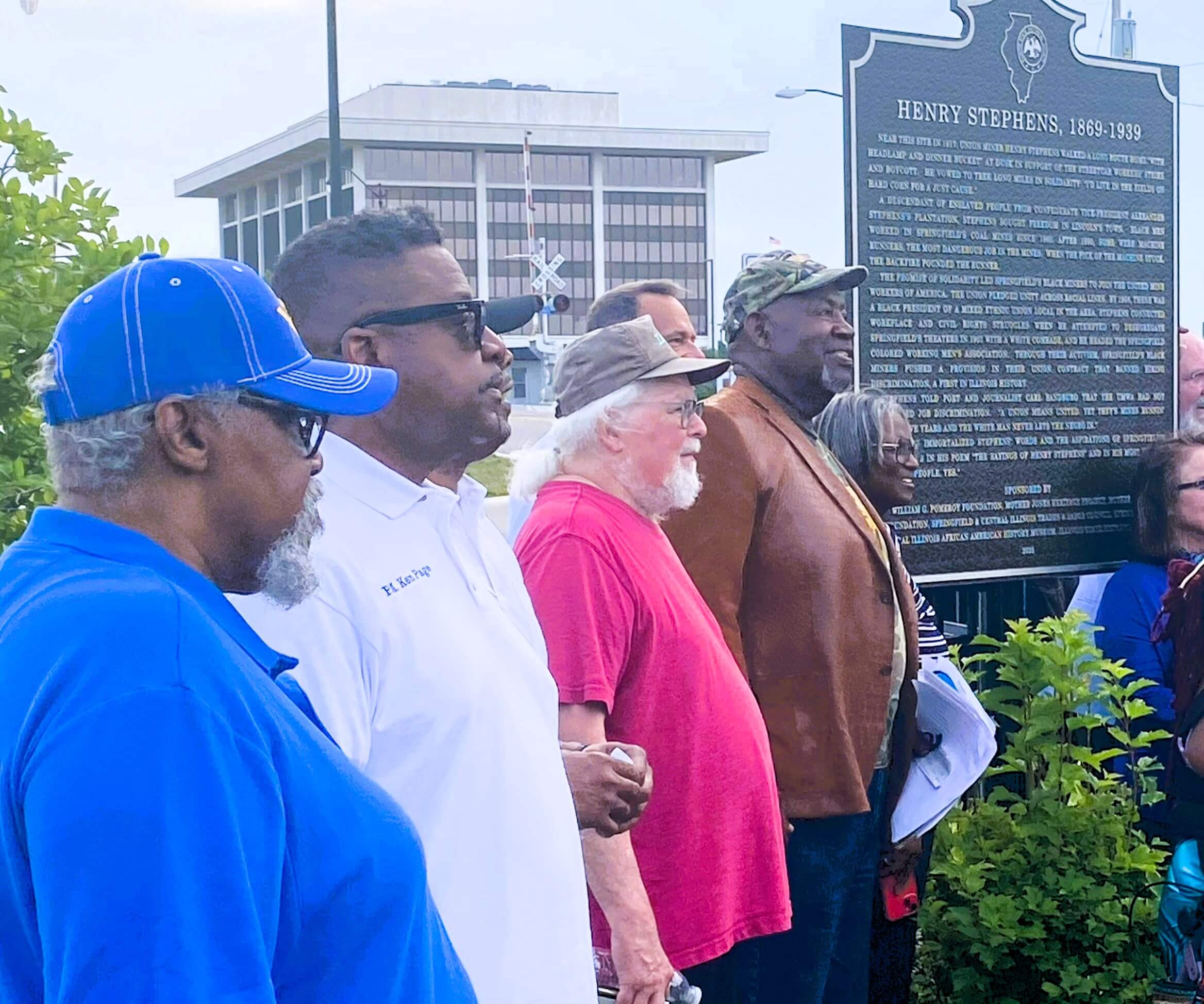
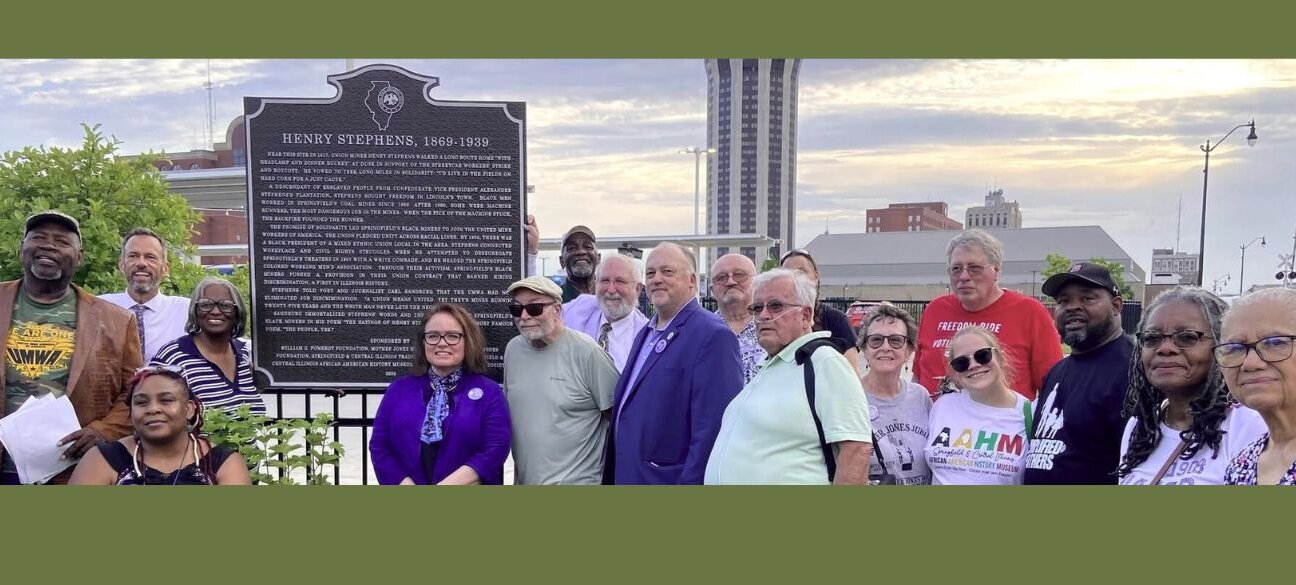
On June 17, 2025, an official Illinois historical marker that highlights the experiences and activism of Black coal miners in Illinois was dedicated at the Springfield Transportation Hub, on the southwest corner of 11th and Washington streets in Springfield, Illinois. This new addition to the state capital’s memorial culture stands near the more well-known 1908 Springfield Race Riot National Monument.
Titled “Henry Stephens, 1869-1939”, the marker recounts the efforts of Stephens and African American miners in Illinois to build equal opportunity in the North in the Jim Crow era. I have been researching Stephens as part of a wider project on a book on the Illinois Mine Wars, 1860-1940, and his story is even more fascinating than what appears on the marker. Erecting the marker was a collective effort, and all involved felt proud to have contributed to memorializing an unsung activist. As people walked by at the dedication, they wanted to know which famous person was getting a historical marker. That shows what we have come to expect of markers, and how much work there is to be done for popular conceptions of history. This is the first historical marker that acknowledges that black miners played a role in Illinois history. It uses the story of Stephens, whose words we know through the poet and journalist Carl Sandburg from his poem “The Sayings of Henry Stephens.” Sandburg always claimed the poem was “a transcript” of Stephens’s words, and asks us to imagine what solidarity could mean.
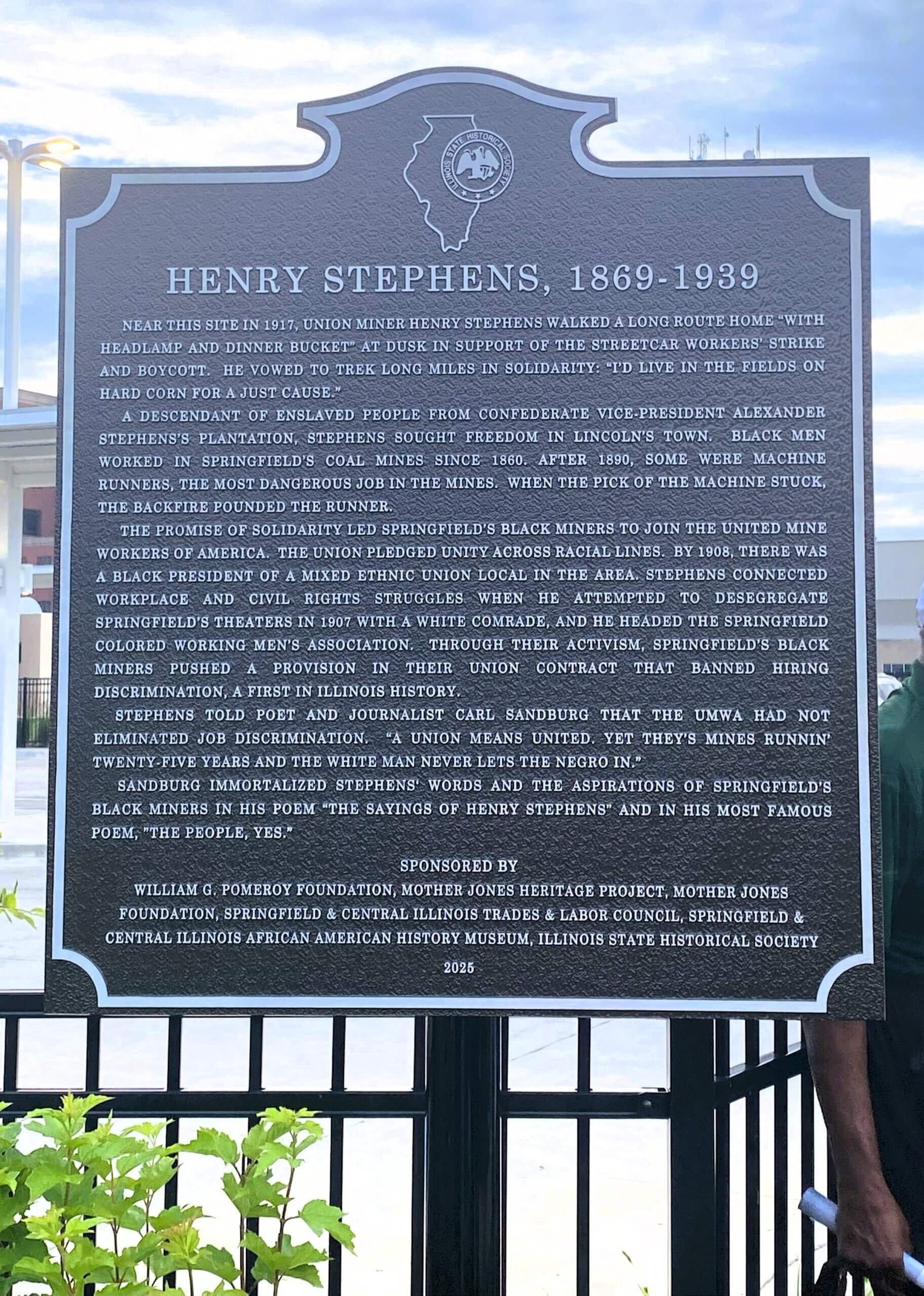
The marker text reads:
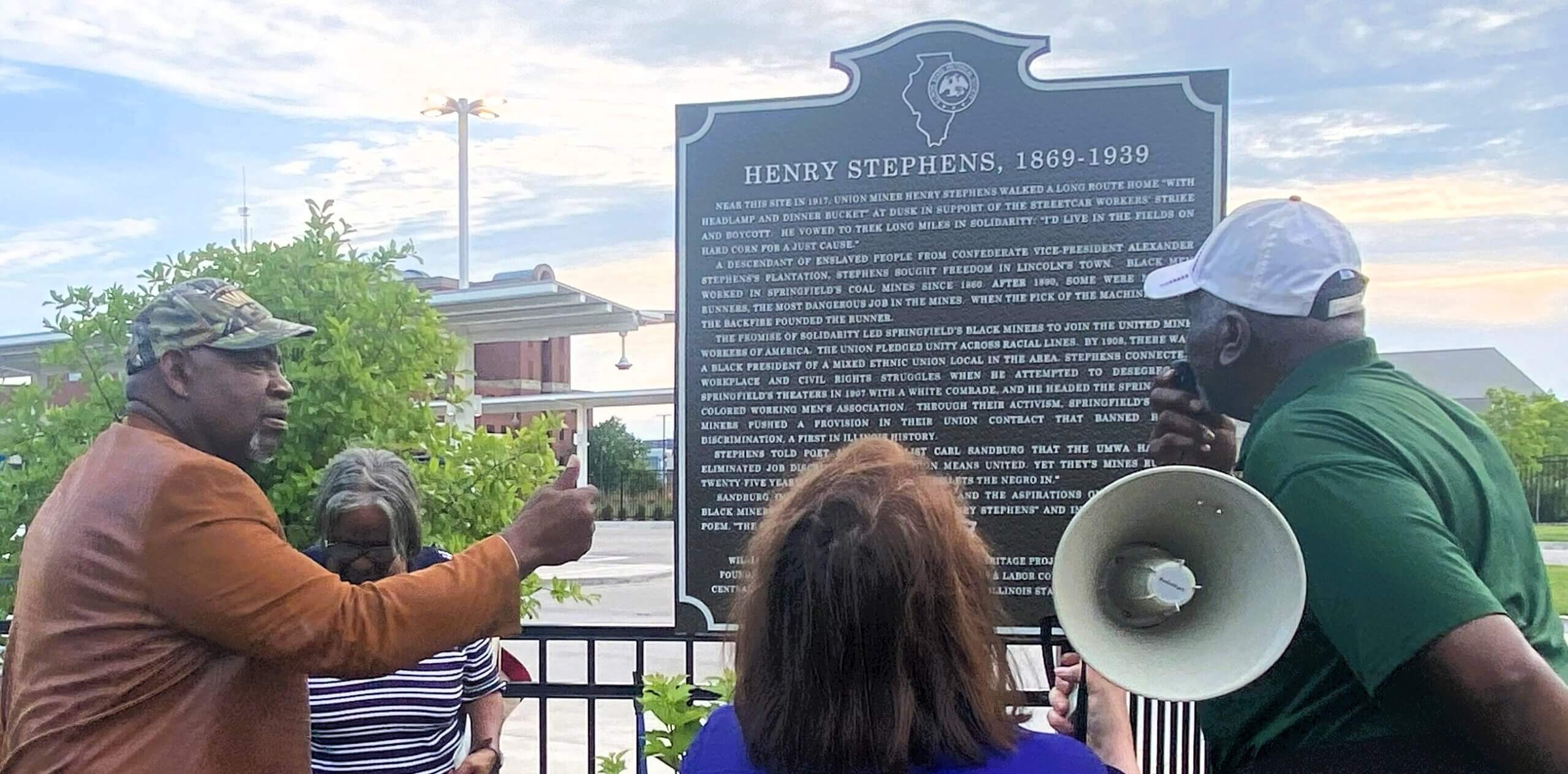
“Near this site in 1917, union miner Henry Stephens walked a long route home ‘with headlamp and dinner bucket’ at dusk in support of the streetcar workers’ strike and boycott. He vowed to trek long miles in solidarity. ‘I’d live in the fields on hard corn for a just cause.’
A descendant of enslaved people from Confederate Vice-President Alexander Stephens’s plantation, Stephens sought freedom in Lincoln’s town. Black men worked in Springfield’s coal mines since the 1860s. In the 1890s, some were machine runners, the most dangerous job in the mines. When the pick of the machine stuck, the backfire pounded the runner.
The promise of solidarity led Springfield’s black miners to join the United Mine Workers of America. The Union pledged unity across the racial lines. By 1908, there was a black president of a mixed ethnic union local in the area.
Stephens connected workplace and civil rights struggles when he attempted to desegregate Springfield’s theaters in 1907 with a white comrade, and he headed the Springfield Colored Working Men’s Association. Through their activism, Springfield’s black miners pushed a provision in their union contract that banned hiring discrimination, a first in Illinois history.
Stephens told poet and journalist Carl Sandburg that the UMWA had not eliminated job discrimination. ‘A Union means united. But they’s mines runnin’ twenty-five years and the white man never lets the negro in.’
Sandburg immortalized Stephens’ words and the aspirations of Springfield’s black miners in his poem ‘The Sayings of Henry Stephens’ and his most famous poem, ‘The People, Yes.’’
Sponsored by the William G. Pomeroy Foundation, the Mother Jones Heritage Project, the Mother Jones Foundation, Springfield and Central Illinois Trades and Labor Council, Springfield and Central Illinois African American Museum, and the Illinois State Historical Society.
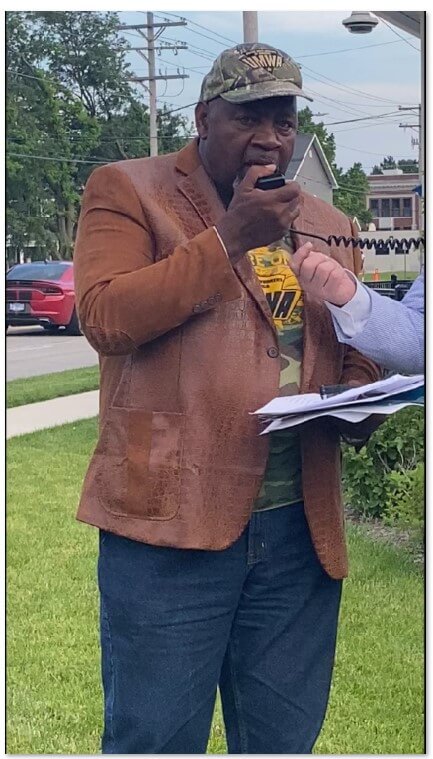
The marker came about after the 2020 George Floyd uprisings, when the Illinois State Historical Society and the Pomeroy Foundation made a call for more historical markers that highlighted diverse stories. These large markers are costly. The Mother Jones Heritage Project, of which I am director, has erected other markers, and has built a robust network. Even before I had drafted the marker text, a coalition came together. The Springfield-based Mother Jones Foundation raised a significant portion of the cost at their annual dinner. Local activist Terry Reed spearheaded a major donation from the Springfield and Central Illinois Trades and Labor Council. Reed connected us to Aaron Guernsey of the Building Trades Council of Springfield, who succeeded in getting the marker placed at the new Springfield Transportation Hub. When completed, the Hub will have significant foot traffic as a major midwestern transit stop. That location is close to where Stephens lived, so we feel positive that it was near this location that Stephens walked in solidarity. We also gained support from the Springfield and Central Illinois African American Museum.
These were my remarks from the dedication:
“We gather here in defiance of small-minded history, in defiance of a history that covers up parts of our past so that it can be useful for a great man theory of history. We need more markers that honor the likes of Henry Stephens.
I have been searching for Henry Stephens for many years. Whenever I do find him, I find a wider window to the past, one that hits back hard just like he does in Carl Sandburg’s poem, that recognizes the hard struggles of all and shows us what the archive can reveal.
Henry Stephens was a descendant of slaves of the vice-president of the Confederacy, Alexander Stephens, who declared — as the states began to secede — that the natural and moral position of Black people was slavery. Alexander Stephens insisted all his slaves take his name, but when Henry Stephens sought freedom in the Land of Lincoln, he made the name his own.
Henry Stephens story calls to mind the dreams and aspirations of those who felt Lincoln’s town should deliver justice, and who fought back when it didn’t. Stephens reminds us that working class African-Americans have also played a role in challenging institutions, the city, the state and the nation to live up to its ideals.
His story most especially reminds us of the great struggles waged in unions and by unions and between unionists. It was a struggle to define solidarity in reality, not just in platitudes or constitutions. Stephens was telling Carl Sandburg that without justice for everybody, solidarity loses its power. He calls on us to remember that today.
We can listen to these words because on that day in 1917, Sandburg recognized Stephens as someone who had something powerful to say, and wrote a transcript (he insisted on calling the poem a transcript, to indicate that he had simply written down and arranged Stephens’s words)
Sandburg met him while covering the strike and boycott by streetcar workers against horrible conditions:16 hour days, low pay, subject to 24-hour days at times. We should note that Stephens was expressing solidarity with white workers, as access to these jobs was barred to African-Americans. It is powerful to just ponder that for a moment.
Stephens and his comrades had gained much through the United Mine Workers of America, which was the most egalitarian institution in the US in the 1890s. While Stephens points out the limits of that solidarity, I want to mention why he might still have been proud to identify with the UMWA. During the 1908 Race Riot, Black miners were carrying guns as they went to the mines, for protection. White miners told their union they wouldn’t go down in the mines with the Black miners because of fear. The union leadership replied, those are your union brothers, you won’t have a job in the mines if you don’t go down. They went down, and the fear subsided.
In late 1917, Stephens hoped to expand the concept of solidarity. The unity between the streetcar strikers and the miners promised to transform the local labor movement, and perhaps wind its way up through the ranks of labor. When Mother Jones came to Springfield she urged the men and unwaged women to shut everything down, Stephens was almost surely among the miners who came to hear her, because the reporters said that all miners were there, black and white, cheering her on.
This strike was lost, a bitter defeat, but the descendants of that local are here today, and represented by AFSCME. There were many dreams deferred, but we are all part of a long struggle. As Mother Jones always said, “Struggle and lose, struggle and win, but you must struggle.” Without the Henry Stephens’s of the world, both then and now, we would not have justice, rights, or a democracy. Stephens reminds us of the hard work of solidarity and its unfulfilled promise.
As with all markers, many sign-offs were needed, including from the Transit Authority. We waited to dedicate the marker in anticipation of completion of the Hub, but that still faces continued Congressional haggling and the Trump rollbacks. Finally, we decided to dedicate the marker before the hub was completed.
For the marker text, I am grateful for feedback from Terry Reed, Joseph Rathke, Dave Rathke, Kamau Kemayo, Bill Furry, and members of the Illinois State Historical Society Markers Committee and the Mother Jones Foundation. Terry Reed was also important in originally alerting me to the poem, many years ago and in helping with some of the initial research.