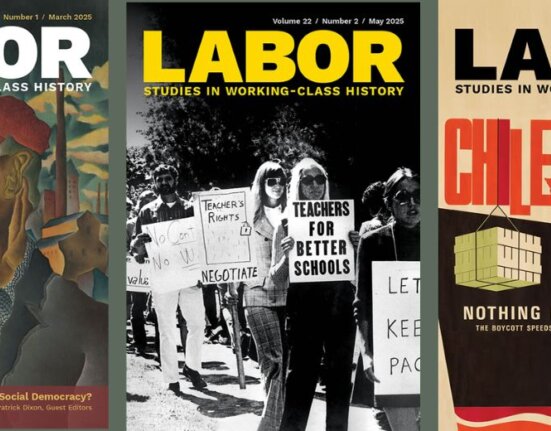
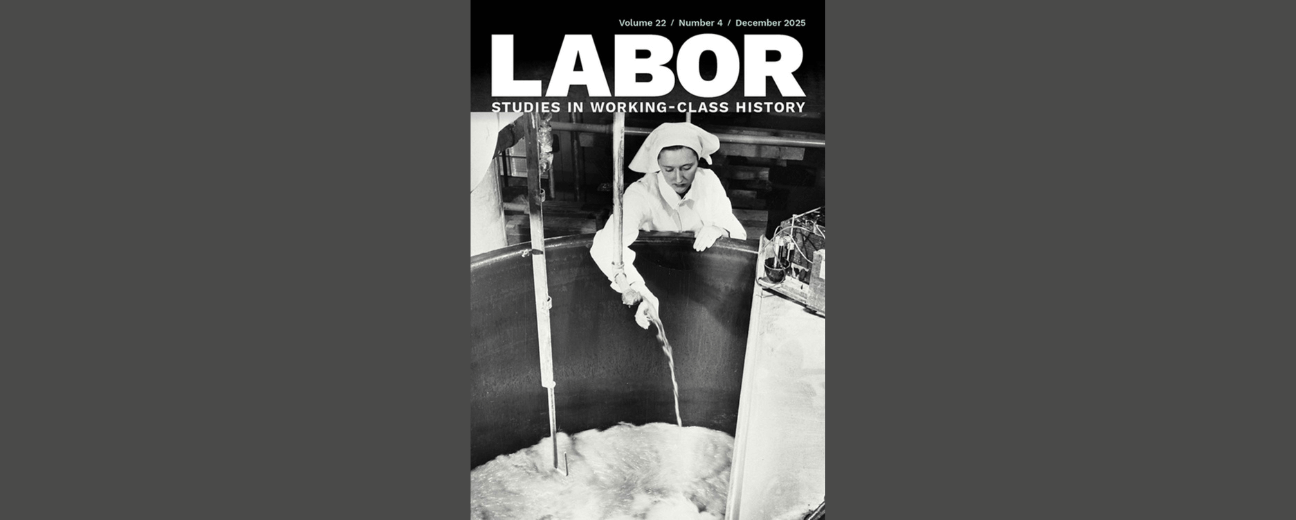
Sarah Milov’s essay,“Damned Women: Fetal Protection as Employer Offensive at American Cyanamid,” in the December 2025 issue of Labor: Studies in Working Class History, has been released from behind the paywall and will remain available until April 23, 2026. Milov’s article is about the “fetus protection policy” at American Cyanamid’s Willow Island plant in West Virginia, where women were forced to be sterilized. We asked Sarah to discuss how she came to the topic, and this introduction below tells us about the article and the larger projects Milov is pursuing.
On a hot July afternoon in 2023, I sat in Steve Wodka’s kitchen, looking out of a picture window onto Little Silver Creek in northeast New Jersey. Wodka is a retired lawyer who had a long career representing workers sickened by workplace chemical exposures. But from 1969 until 1981, he was a deputy to Anthony Mazzocchi, the Citizenship-Legislative Director of the Oil, Chemical, and Atomic Workers Union – perhaps the leading advocate for the passage of the Occupational Health and Safety Act.
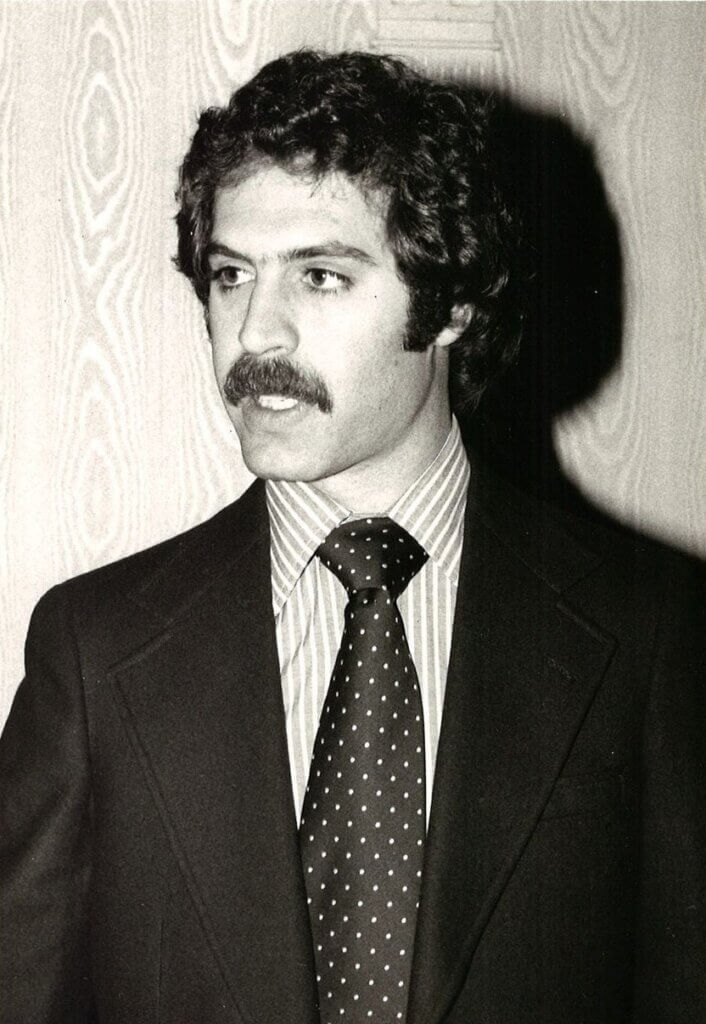
I was there to interview Wodka for a yet-undefined project—a book? a podcast?—about nuclear whistleblower Karen Silkwood, a plutonium laboratory technician at a Kerr-McGee nuclear fuels facility who died in a car accident en route to deliver documents to a New York Times reporter. Her spectacular death came less than a week after suffering a series of plutonium contaminations. Together with that reporter, a 25-year-old Steve Wodka had waited at an Oklahoma City Holiday Inn for the knock that never came. Wodka and Mazzocchi had encouraged Silkwood’s undercover sleuthing, believing that by publicizing her information on Kerr-McGee’s falsification of quality control documents the union might gain an advantage during contract negotiations. Silkwood’s too-short life culminated in a series of disturbing events seemingly tailor-made for Hollywood. I’ve you’ve seen Silkwood, the 1983 Mike Nichols biopic, Steve Wodka is the character portrayed by actor Ron Silver. Silkwood is, of course, portrayed by Meryl Streep.
When I asked Wodka how the Silkwood case had shaped his subsequent career, I thought he might say something about his decision to go to law school. Instead, he mentioned American Cyanamid, a fertilizer, chemical and pharmaceutical behemoth infamous for leaving a trail of environmental destruction in its wake.
“We’re talking about women moving into the workplace. So there was American Cyanamid, it had this pigment plant in Willow…Willow something, West Virginia. Do you know about this?” I did, I said. I recently relistened to a recording of our conversation, and I sounded more confident than I recall feeling. I only vaguely remembered a reference to some kind of lurid sex discrimination suit in Susan Faludi’s 1991 Backlash, a shimmering indictment of Reagan-Era antifeminism. As I explore in my article “Damned Women: Fetal Protection as Employer Offensive at American Cyanamid,” in 1978, several female employees at an American Cyanamid plant in Willow Island, WV, underwent sterilizations in order to keep to keep their jobs, under the pretext of a “fetal protection policy” that applied only to women.
The workers at Willow Island were represented by OCAW and Wodka had gotten wind of the affair. “It was our position that if there was lead exposure in the plant it should be brought down to a level of safe for everyone within the childbearing age, as well as men,” he told me. Then Wodka slipped into passive voice. “That thing blew up…that was blown all over. I went on Phil Donohue. It was on the front page of the Washington Post, all kinds of stuff.” The women of Cyanamid, I later learned, were also on the show, sitting grim-faced as Wodka debated Cyanamid’s corporate medical director about the policy.
I did not realize it at the time, but that interview with Wodka yielded two research projects. One is now a manuscript, Karen Silkwood: A Life and Afterlives, co-authored with Katherine Turk (UNC) and under contract with OneSignal. The other, in its early stages, is a history of the meaning and legacy of the “occupational sterilizations” at Willow Island. My article in Labor comes from this research. Using depositions generated by the women’s sex discrimination suit against American Cyanamid, it sheds light on how employers weaponized OSHA’s lead standard in order to weaken the union and punish the plant’s few female production workers.
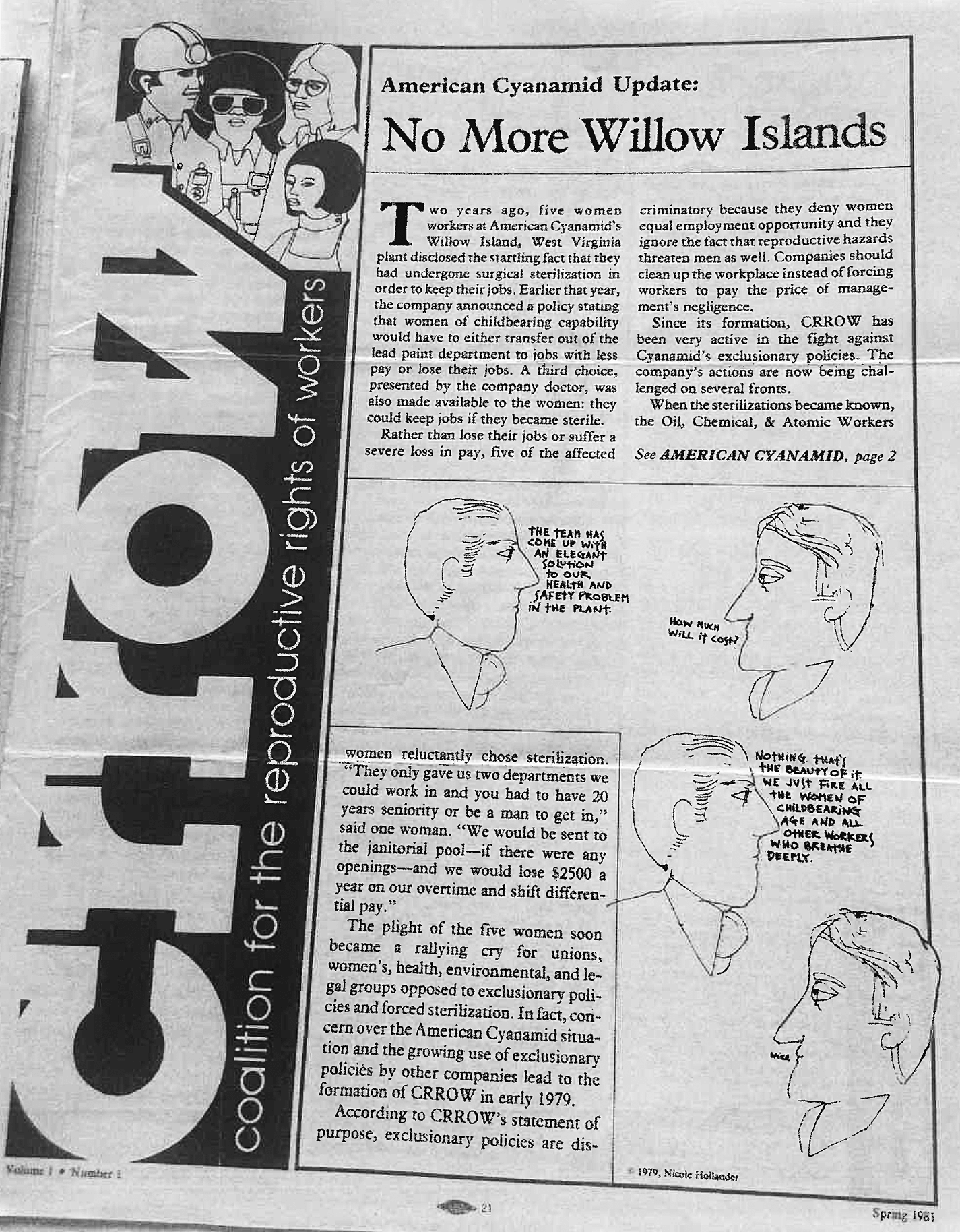
In the wake of the Willow Island publicity, Wodka helped to found the Coalition for the Reproductive Rights of Workers (CRROW) – a group dedicated to eliminating discriminatory employment practices at chemical workplaces and raising awareness of the genetic and somatic effects of chemical exposures. “No More Willow Islands!” the organization proclaimed, turning the gothic spectacle of mutilation into a rallying cry for worker health. Wodka saved many documents from his time with the union and generously allowed me to photograph his CRROW materials. These offer a fascinating window into the vibrant world of labor-led health organizing that also involved broader progressive and feminist groups: the ACLU, Planned Parenthood, the National Lawyers Guild, the Center for Constitutional Rights, the Consumer Coalition for Health, and more. But as I snapped pictures of fundraising appeals and memos on non-profit letter head, I fixated on the women.
By virtue of their presumed capacity to bear children, the bodies of women production workers could be exceptionally helpful instruments in the fight for stronger workplace health regulation. Or, from the perspective of employers, these bodies could be an exceptional liability, one that companies like Cyanamid took no small degree of pleasure in eliminating.