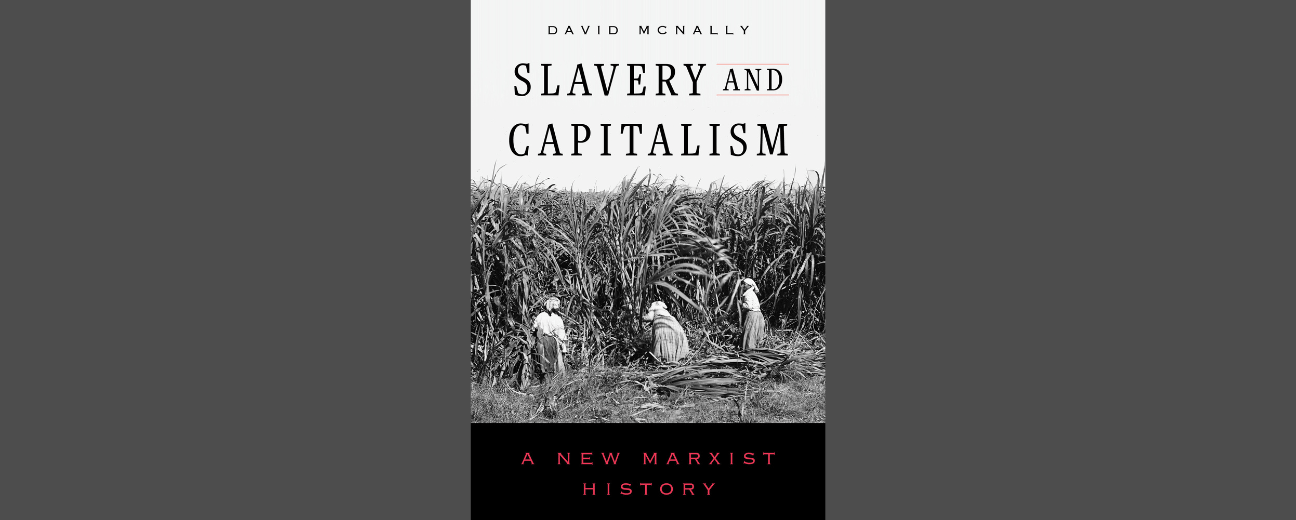
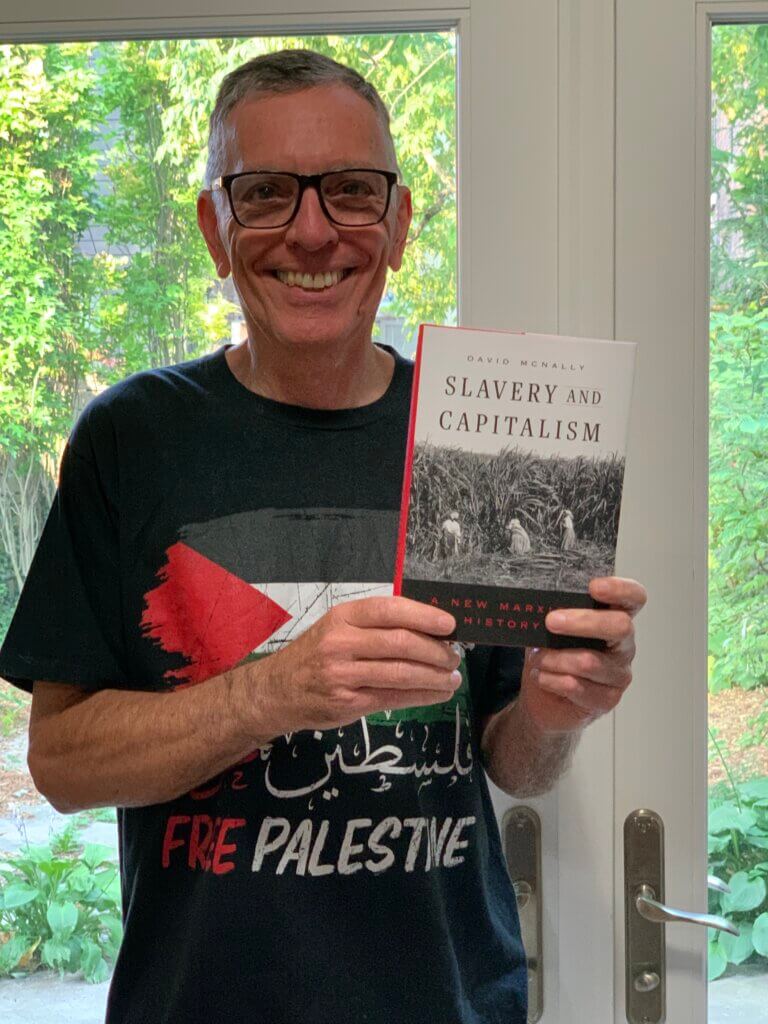
In his new book, Slavery and Capitalism: A New Marxist History, David McNally intervenes in ongoing debates over the relation between slavery and capital to offer a systematic Marxist analysis. Drawing on the scholarship of thinkers such as C.L.R. James and W.E.B. DuBois, McNally argues that the modern plantation system constituted a system of capitalist commodity production, and that the enslaved people who worked these plantations constituted a modern working class. Historian Matthew Stanley spoke with McNally about his book.
I feel compelled to preface our discussion by saying that Slavery and Capitalism was a tremendous pleasure to read and chew over. I think many of us who teach the history of slavery from a more materialist perspective have been waiting for a book just like this, and I want to thank you for writing it.
Thanks for the kind words. An author never really understands the moment in which they are writing until after their book has entered the world. I am deeply gratified that you and others are connecting with the arguments I have made.
With that, can you begin by telling us a bit about your background as a scholar-activist, and what about your experiences informed or inspired this book?
I am a product of the freedom struggles of the late 1960s and 1970s. I joined the movement against the Vietnam War as a teenager in Toronto. Soon, I was drawn into support for the Black Power movement and became a socialist. As a first-year undergraduate in Washington state in the early ‘70s, I co-founded a campus chapter of the Committee to Free Angela Davis and other Political Prisoners. So anti-racism and anti-capitalism were formative for me. As a graduate student back in Toronto, I immersed myself in the debates over the origins of capitalism. It has always seemed to me that, if we imagine the possibility of a society beyond capitalism, then understanding past historical transitions between forms of society is indispensable. However, despite my involvement in anti-racist struggles, my early work on the rise of capitalism did not centrally address the question of New World slavery. I focused on the debates over “primitive accumulation” in England and the emergence of new systems of labor and exploitation. My strong inclination at the time was to see the modern plantation system as part of the capitalist mode of production, but I did not do the archival work to offer a compelling case. A shift in that direction came with my book, Blood and Money (2020). As I was working on that book, I also took a position teaching in Houston. For the first time, I found myself living in a city of the US South where the intertwining of race and class is especially conspicuous. Slavery and Capitalism took shape in this context. It is my full-fledged effort to address a question that is rooted in my history as a scholar and an activist.
The book’s subtitle is “A New Marxist History.” What does it mean to write history through a Marxist lens?
For me, the only Marxist approach worth its salt is grounded in the methods of history from below. As a student I had the opportunity to study with one of the practitioners of that tradition, the late George Rudé, author of The Crowd in the French Revolution among other landmark works. At its core, history from below means to me the following. First, always attending to the social relations of wealth production and human reproduction. Who is doing the labor and under what circumstances of domination and exploitation? Connected to this, what patterns of resistance develop within these relations? How do laboring people push back against their oppression? What cultures of solidarity and what freedom dreams do they nurture? If we begin with these questions then we cannot simply write history from above—in terms of the dominant institutions, cultures, and modes of thought. And we certainly cannot understand New World slavery primarily by focusing on the slaveholders. Of course, I spent a lot of time studying planter records—account books, diaries, correspondence, and the like. But while I was tracking the capitalist “rationality” of the plantation, I was also searching for clues to the resistance of the oppressed—absenteeism, disputes with overseers, demands for better food, clothing, and housing, for control over childbirth, and for more time to work their gardens and provision grounds. All of this requires tracking the actual forms of agency exercised by enslaved people. Many historians in the US and beyond have seen certain capitalist features within Atlantic slavery, but too often they have depicted enslaved people as commodities, as forms of capital. Against this, I argue that bondpeople were in fact living labor. This is why, however brutal their domination, they never stopped carving out spaces and times where freedom dreams and practices of resistance could be nourished.
C. L. R. James imagined the Caribbean plantation as “at the advanced front of modern capitalism.” How does your book, and particularly the notion of enslaved workers as a “chattel proletariat,” expand that thesis?
To begin with, Slavery and Capitalism centers the plantation complex as a site of global commodity production. Bonded labor was not used primarily for domestic purposes. Overwhelmingly it was devoted to producing commodities—sugar, cotton, rice, tobacco, and so on—for world markets. More than this, these goods were produced through tightly disciplined modes of gang labor, with different groups (or “gangs”) of enslaved workers assigned to distinct parts of the labor process. Plantations were thus animated by large-scale commodity production; they were “factories in the field.” They were organized according to detailed division of labors, regimented supervision of work (backed by the whip), strict use of clock time, and the most modern accounting practices of the era. Most of this held true, as I show, for so-called “task work” systems as well. Then, from the late eighteenth-century onward, as the world market system became ever more integrated, technological change—from the generation of new seed strains to mechanical inventions like the cotton gin and the widespread integration of steam-power in both sugar and cotton—became ever more systematic.
This takes us to my concept of “the chattel proletariat.” As producers of commodities for world markets, enslaved people were also producers of surplus value. Surplus product was not simply appropriated from them directly (as use values)—as was the dominant pattern in feudal society, for instance. Instead, surplus products entered global circuits of exchange for money. Surplus labor was thus monetized, converted into units of abstract labor. And this money was overwhelmingly reinvested in expanding the scale of commodity production. By every serious definition, then, these workers were proletarians—modern laborers producing for capital. More than this, they resisted like proletarians. They slowed down, they skipped work, they organized against brutal overseers, they engaged in strikes—and sometimes even mass strikes—and they fought to reduce the labor time they devoted to capital so that they might have more time and life energies for recreation, worship, independent production, nurturing kin, i.e. for social reproduction and life-making. Marx says that the struggle to reduce the working day constitutes “the political economy of the working class.” And enslaved people engaged continuously in just such struggles, generating what I call a “labor ethic,” premised on the right of workers to the full value of what they produce. In short, this chattel proletariat generated a demonstratively working-class consciousness alongside classically working-class repertoires of resistance.
In addition to James, Slavery and Capitalism draws inspiration from a handful of other great texts of the Black Radical Tradition, including W. E. B. Du Bois’s Black Reconstruction in America. As someone who teaches slavery and emancipation through the prism of the “Black worker,” the “general strike,” etc., why do you think so many scholars who profess such admiration for Du Bois also tend to misread him?
In an era in which there has been a general retreat of intellectuals from notions of class and class struggle, Du Bois has often been reduced to a cultural critic of race and white supremacy. Of course, he was that. His analysis of the “double consciousness” of Black people in America is brilliant. But there is so much more to Du Bois’s legacy. In particular, his monumental work Black Reconstruction in America advances Marxist themes—as well as Marxist innovations—that don’t fit the temper of our times, especially in the academy. We live in an era in which mass strikes seem almost fantastic, perhaps unimaginable in North America. But, of course, Du Bois was writing his great work in the 1930s, when mass strikes were erupting across the US and would soon bring industrial unionism with them. He could readily conceive the centrality of “the mass strike of the slaves” to the defeat of the Confederacy. In so doing, he put the collective self-activity of Black workers at the very heart of his analysis. Sadly, this is something that too many in the neoliberal academy just cannot see today. Mass, collective self-activity has become unimaginable for them in the present. And so they cannot see it in the past either.
Slavery and Capitalism also speaks to—and sometimes takes aim at—the New History of Capitalism. Generally speaking, what has that scholarship gotten wrong and why?
First, let me acknowledge what the New History of Capitalism (NHC) has achieved. Most significantly, it has put the question of capitalism itself back into serious historical study. It is fascinating the degree to which capitalism as a distinct system of social production and mode of life had almost vanished from historical scholarship prior to the global economic crisis of 2008-09. When that crisis struck, a minority of historians realized that a lack of attention to political economy had left them ill-prepared in the face of an immense historical event. This is why a number of scholars returned to the question of capitalism as an historical system. And they should be commended for that—and for the many valuable studies that have been produced as a result.
But, perhaps because the 2008-09 crisis was concentrated in the financial sector, NHC writings have tended to focus overwhelmingly on finance and credit markets. The latter are clearly of great importance. But if we effectively detach finance from the domains of production and distribution of commodities, we end up with an impoverished conception of capitalism, one that treats enslaved people fundamentally as “assets” to be used as collateral for loans. But financial assets lack agency. It is only by restoring the role of bonded people as producers of wealth—and in this case of commodities and surplus value—that we can foreground their agency, their subjectivities, their repertoires of resistance, their social-cultural lives, and their freedom dreams.
Relatedly, part of your critique involves society’s long political retreat from the freedom struggles of the 1960s and 70s. What is the relationship between the neoliberal turn in national politics and what you term “depletion of the radical imagination” among scholars? How have liberal assumptions—from identifying capitalism with markets to presenting race and racialization as removed from their basis of capitalist discipline—become almost naturalized within broad sections of the academy?
A number of recent studies argue strenuously that enslaved people struggled only for survival, not for freedom. Whatever the other merits of these works, they epitomize the “depletion of the radical imagination” during the neoliberal era. They do so by projecting present circumstances onto the past. One can easily see, after all, that many working class people today are dedicated to survival and dubious about grand projects of human emancipation. What else would we expect after decades of defeats for labor and social movements? But we should never eternalize such episodes. To read them back onto bondpeople in the system of Atlantic slavery is utterly ahistorical. And it diminishes our historical sense of the possible. How do we say that the hundreds of thousands of enslaved people who brought down slavery in Saint-Domingue (later Haiti) over the course of a thirteen year war against three empires had no interest in freedom? How can we claim that the 30,000 bond people who waged a mass strike to topple slavery in Jamaica at Christmas 1831 were thinking only of survival, not of liberty? And how do we explain the mass exodus from slavery of half a million people in the US South during the Civil War—what Du Bois rightly calls a “general strike of the slaves”—in terms of a pragmatism focused only on day-to-day survival? It should be obvious that the “survivalist” position does not fit the historical evidence. And in Slavery and Capitalism I try to show as well that freedom dreams were nurtured in the course of much more modest everyday practices of resistance.